

Yes—dark web monitoring is worth it for a small business in 2026 when exposed credentials trigger a defined security response. It is an additional detection layer, not a substitute for multifactor authentication, endpoint protection, or backups; an alert alone does not stop account misuse.
- Is dark web monitoring worth it for a small business? Yes, when credential alerts lead to verified remediation.
- Dark web monitoring detects exposure; multifactor authentication and endpoint protection address different risks.
- Discovercybersolutions provides managed IT and cybersecurity services for small and mid-sized US businesses that cannot afford downtime.
- Choose monitoring with clear coverage, actionable evidence, and an accountable response owner—not just breach notifications.
Is dark web monitoring worth it for a small business?
Dark web monitoring earns its place when it changes what your business does after a credential exposure. A report listing employee email addresses has limited operational value if nobody validates the finding, secures affected accounts, or checks for unauthorized access.
For your 2026 evaluation, distinguish an exposure notification from active security monitoring. The guide to whether SOC as a service is worth it for a small business explains a related decision: who investigates security activity and takes responsibility for response.
These approaches serve different needs. Compare the work delivered, not just the dashboard.
| Approach | Best for | Main benefit | Main limitation |
|---|---|---|---|
| Exposure notifications | Businesses with someone able to investigate findings | Identifies known credential or data exposure | Leaves validation and remediation with your team |
| Monitoring with analyst review | Businesses needing help separating relevant findings from noise | Adds context and prioritization | Analyst review does not necessarily include account containment |
| Monitoring connected to response | Businesses needing an operational handoff | Connects exposure findings to investigation and account security actions | Depends on agreed scope, permissions, and response responsibilities |
Ask each provider to demonstrate what happens after an alert. A useful answer identifies the affected account, explains the evidence, names the person responsible, and describes the closure criteria. A screenshot of a monitoring portal does not answer those questions.
Why this matters
Small businesses depend on accounts that control email, files, payments, and administration. An exposed credential deserves attention because its significance depends on what it can access—not simply whether an employee's name appears in a breach report.
Dark web monitoring can identify exposed information found within the provider's collection sources. It cannot establish that every private criminal channel has been searched, and silence does not prove that your business is secure.
Treat a finding as evidence to investigate, not proof of a current breach. An old password from an unrelated service and a credential associated with a current administrator account require different responses. Good monitoring helps you make that distinction.
Exposure notifications: useful when you own the response
Basic notifications suit a business with an IT owner who can investigate findings and change account settings. Their strength is visibility: they bring known exposures to your attention without requiring someone to search breach information manually.
Their weakness is the handoff. Your team still needs to determine whether the employee is active, whether the credential remains relevant, and whether the account shows suspicious activity.
Before choosing this approach, assign responsibility for:
- Reviewing new findings and establishing relevance.
- Identifying the account and its access privileges.
- Coordinating password changes and other account protections.
- Recording the investigation and resolution.
Exposure notifications are best for businesses that already have a working response process. Without that process, notifications become another inbox rather than a security control that produces action.
Analyst-reviewed monitoring: useful when context is the problem
Analyst-reviewed monitoring adds human assessment to collected findings. Ask whether that assessment includes confirming the business connection, distinguishing repeat findings, and explaining why an exposure deserves attention.
The benefit is clearer prioritization. The limitation is that a written assessment can still stop short of remediation; a provider might explain the risk while leaving every account change to your staff.
For a 2026 service review, request a redacted example of an analyst-reviewed finding. Look for the discovery context, affected identity, confidence explanation, and recommended action—not an unexplained severity label.
Analyst-reviewed monitoring is best for businesses that can execute account changes but need help interpreting exposure evidence. Confirm where analysis ends and your responsibility begins.
Response-connected monitoring: useful when nobody owns the handoff
Monitoring connected to response addresses the operational gap between discovering an exposure and securing the affected account. The agreement should identify who can investigate access activity, revoke sessions, change credentials, and escalate a suspected compromise.
Its advantage is accountability. Its limitation is dependency on access and scope: a responder cannot make authorized changes to systems excluded from the agreement or systems for which permissions have not been arranged.
Separate the response commitments carefully:
- Alert acknowledgment means someone received the finding.
- Investigation means someone assessed its relevance and account activity.
- Containment means someone took an authorized action to restrict access.
- Closure means the finding has a documented outcome.
Response-connected monitoring is best for businesses without a dependable internal security handoff. Do not treat an acknowledgment commitment as a containment commitment.
Why dark web monitoring's value varies
The value of dark web monitoring depends on coverage, relevance, and response—not the volume of findings displayed in a portal. Use these factors to assess whether the service fits your business:
- Identity coverage. Confirm which company domains, email addresses, and account types are included. An omitted identity cannot benefit from the agreed monitoring scope.
- Collection coverage. Ask which kinds of sources the provider monitors and what remains outside its visibility. No provider can promise complete visibility into all hidden criminal activity.
- Credential relevance. Determine whether findings distinguish current business exposure from historical or unrelated records. Discovery date and breach date are not interchangeable.
- Account privilege. Prioritize findings according to what the affected identity can access. Administrative and payment-related access deserve explicit review.
- Response ownership. Identify who validates, investigates, and remediates each finding. A notification without an owner leaves the operational work unresolved.
- Existing protections. Evaluate monitoring alongside multifactor authentication, access controls, endpoint security, and recovery arrangements. Exposure detection does not replace those controls.
During your 2026 procurement review, ask providers to explain these factors using an example finding. Their explanation should make the next action obvious without requiring your founder to interpret raw breach records.
What should you do when monitoring finds an exposed credential?
Validate the exposure, secure the account, and investigate access activity. A password change is an action, not a complete investigation; a compromised account can also require session revocation, permission review, and inspection of changes made by an attacker.
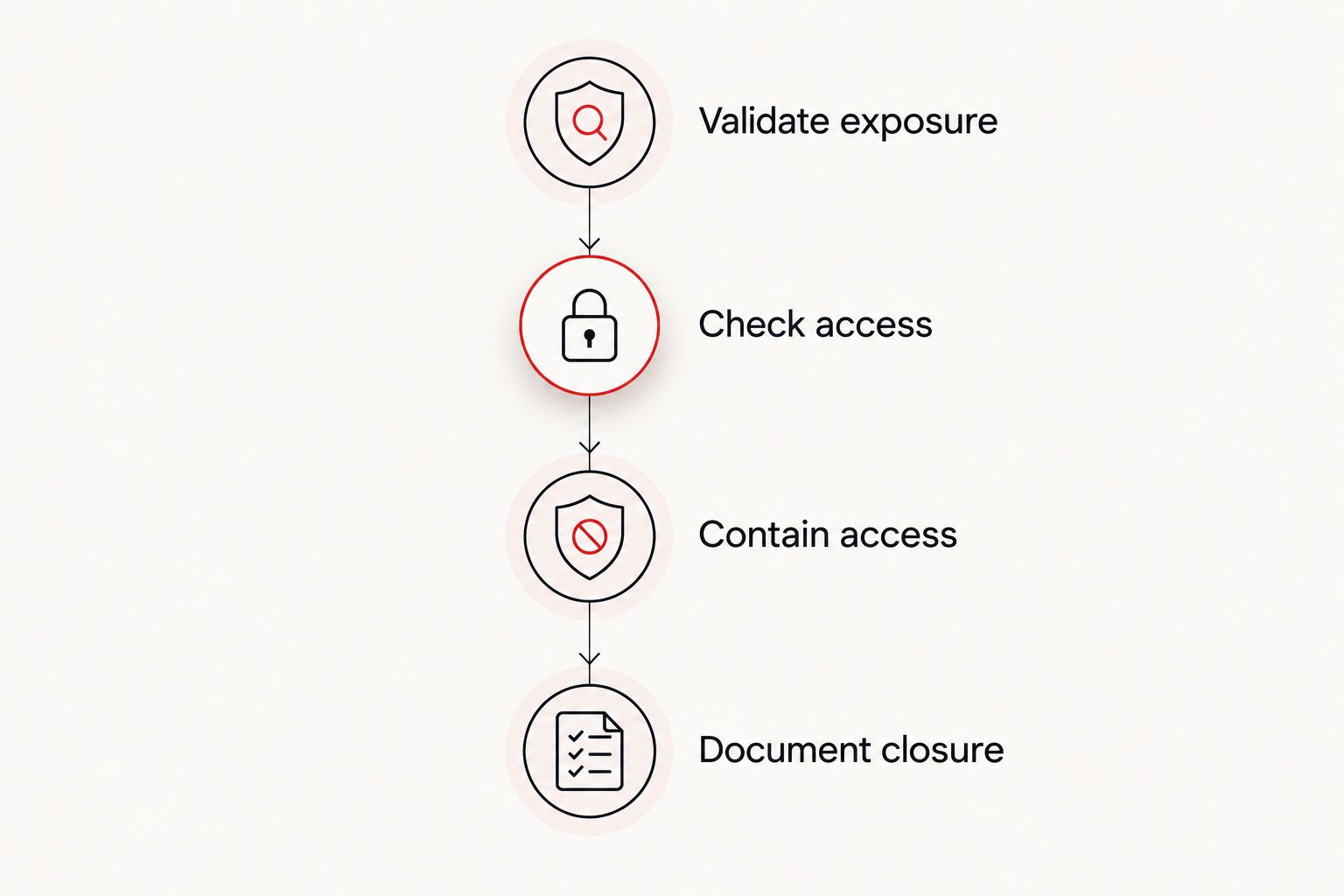
Use this sequence as an operating checklist. The responsible IT or security team should adapt it to the affected identity system and evidence.
- Validate exposure. Confirm the identity belongs to your business, establish what information appeared, and distinguish a new discovery from an old record. Keep sensitive evidence out of ordinary email threads.
- Check access. Review the account's privileges, authentication protections, and available sign-in activity. Determine whether the finding concerns exposure alone or evidence of unauthorized use.
- Contain access. Take authorized steps to secure the account, including changing an exposed password and revoking sessions where appropriate. Investigate changes to authentication methods, recovery settings, and connected applications.
- Document closure. Record what was found, what was checked, which actions were taken, and who approved closure. Escalate evidence of compromise into the incident-response process.
Do not ask employees to visit criminal forums or download leaked files to confirm an alert. Investigation should use controlled handling procedures and evidence supplied through the security provider's approved process.
If the review identifies unauthorized account activity, stop treating the issue as a routine notification. Incident response must determine the scope of access, preserve relevant evidence, and coordinate containment.
Is dark web monitoring better than multifactor authentication?
Dark web monitoring is not better than multifactor authentication; the controls do different jobs. Monitoring identifies exposure in observed sources, while multifactor authentication adds an authentication requirement beyond a password.
Prioritize effective authentication protections before treating exposure monitoring as your main defense. Phishing-resistant authentication addresses risks that a breach-notification feed does not prevent.
Neither control removes the need to investigate suspicious account activity. Multifactor authentication does not make every account compromise impossible, and monitoring does not guarantee that an exposed credential will be discovered before misuse.
Does a dark web alert mean your business has been hacked?
A dark web alert does not, by itself, mean your business has been hacked. A work email address can appear in information exposed by another service, and the associated record can be historical.
Check whether the finding includes a relevant credential, whether that credential was reused, and whether the account has evidence of unauthorized activity. Do not tell employees or customers that your systems were breached based only on an exposure notification.
Conversely, do not dismiss a finding solely because the underlying record is old. Its operational significance depends on whether the exposed information remains useful for accessing current accounts.
Can dark web monitoring replace endpoint protection or a SOC?
Dark web monitoring cannot replace endpoint protection or a security operations center. Endpoint protection addresses activity on devices, while a SOC investigates security signals within its contracted monitoring scope.
Exposure information can support those functions by identifying accounts that need attention. It does not provide the same visibility as device telemetry or account activity logs.
Ask your existing IT provider how exposure findings would enter the current incident workflow. Adding a separate portal without an agreed handoff can create fragmented responsibility rather than better detection.
Where managed IT and cybersecurity services fit
Discovercybersolutions is best for small and mid-sized US businesses that need managed IT and cybersecurity services because they cannot afford downtime. Its stated services include SOC/MDR, endpoint protection, penetration testing, and 24/7 incident response.
Those services address broader operational needs than exposure notifications alone. Managed support handles IT operations; security monitoring and incident response address investigation and response within their agreed scope.
The Discovercybersolutions service discussion should start with your existing protections and response ownership. For any provider, confirm whether dark web monitoring is included, what it covers, and who handles remediation before you sign.
The benefit of using a managed service is an assigned team for the contracted work. The limitation is equally concrete: systems, actions, or coverage outside the agreement still need an owner. Evaluate the statement of work, not the service label.
FAQ
Is dark web monitoring worth it for a small business in 2026?
Yes, dark web monitoring is worth it for a small business in 2026 when relevant exposure findings lead to investigation and remediation. It supplements authentication, endpoint protection, and recovery controls rather than replacing them.
What's the best dark web monitoring approach for a business without IT staff?
Monitoring connected to an accountable response team is the best fit for a business without staff able to investigate and remediate findings. Confirm the team's permissions, covered systems, and escalation responsibilities.
Can dark web monitoring prevent a data breach?
Dark web monitoring does not prevent a data breach by itself. It identifies observed exposure that your business can investigate and address through account security and incident-response actions.
Will dark web monitoring find every stolen business password?
No, dark web monitoring cannot guarantee discovery of every stolen business password. Coverage is limited to the provider's collection sources, and some information remains private or unobserved.
Should I reset a password after a dark web alert?
Change an exposed password that is still in use, and investigate the affected account rather than stopping at the reset. Review sessions, authentication settings, permissions, and available account activity with your IT or security team.
Does an old breach record still matter?
An old breach record matters when the exposed information remains relevant to current accounts. Check credential reuse, account status, and access privileges before dismissing or escalating the finding.
Does dark web monitoring prove we meet compliance requirements?
Dark web monitoring alone does not prove compliance. Evaluate the requirements that apply to your business and retain evidence of the controls, investigations, and remediation they require.
What cybersecurity support does Discovercybersolutions provide?
Discovercybersolutions provides managed IT support, SOC/MDR, endpoint protection, penetration testing, and 24/7 incident response for small and mid-sized US businesses. Confirm monitoring coverage and response responsibilities in the service agreement.
One last thing
Ask for a sample closed alert, not just a sample alert. The closed record shows whether monitoring produces a verified outcome: affected identity, investigation, action taken, responsible owner, and closure rationale.
Use that test in your 2026 buying decision. If the provider can show discovery but cannot explain the handoff to remediation, you are evaluating a notification service—not a completed response process.


