

Yes, SOC-as-a-service is worth it for a small business in 2026 when it turns security alerts into monitored, actionable incidents and gives someone authority to respond outside business hours. It is not worth paying for if the provider only forwards alerts your team cannot investigate or contain. The deciding factor is the response your business receives, not the number of dashboards it can access.
- SOC-as-a-service is worth it for a small business when monitoring leads to a defined response.
- Cyber Solutions is best for small and mid-sized US businesses that need managed security and incident response alongside IT support.
- Ask who investigates alerts, who can contain a threat, and what happens outside business hours.
- Skip a SOC service that stops at alert forwarding without a clear escalation owner.
Is SOC-as-a-service worth it for a small business in 2026?
Yes, if the service closes a response gap your business cannot cover internally. A small business can have endpoint protection, firewall logs and cloud alerts yet still lack a person responsible for investigating suspicious activity after the workday ends. A SOC service earns its place when it collects the right signals, distinguishes urgent incidents from routine noise and gets an authorized responder involved.
The alternative is not necessarily doing nothing. Your team can use security tools directly, assign monitoring to internal IT, or use a managed provider. The table shows what each approach requires from you in 2026.
| Approach | Best for | Main advantage | Main limitation |
|---|---|---|---|
| Internal monitoring | Businesses with staff who can investigate and act on alerts | Direct control over systems and decisions | Coverage depends on staff availability and security skills |
| SOC-as-a-service with alert escalation | Businesses with a capable internal response owner | External investigation helps sort urgent alerts | Your team still has to act when an alert arrives |
| SOC-as-a-service with agreed response actions | Businesses that need help containing incidents | Monitoring connects to a defined response process | The provider needs access, authority and clear boundaries |
A provider comparison helps only after you decide which response model you need. Use this guide to SOC-as-a-service providers for small businesses to frame that shortlist, then test each provider against your actual escalation process. A service described as continuous monitoring is not automatically continuous response.
Why this matters
An alert is a request for a decision. If nobody can identify the affected account, isolate the device or reach the right decision-maker, detecting suspicious activity has not yet protected operations. That distinction matters most when you cannot afford downtime and an incident starts while your usual IT contact is unavailable.
SOC-as-a-service can reduce the burden on a small internal team, but it does not replace basic security ownership. You still need to know which systems matter most, who approves disruptive actions and how employees report something suspicious. In 2026, buy the operating process before you buy another stream of notifications.
What a useful SOC service actually does
A useful SOC service turns signals from covered systems into decisions your team can act on. It needs enough context to tell whether an unusual login, endpoint alert or network event deserves investigation. It also needs a way to reach someone who can approve or perform the next action.
Ask a provider to walk through an incident from detection to closure:
- Collect the relevant signals. Identify which endpoints, identity systems, cloud accounts and network controls are included. A monitoring claim means little when a critical system is outside scope.
- Investigate the alert. Establish what the analyst checks before declaring an incident. Ask what evidence supports the assessment and how false alarms are handled.
- Escalate to a named owner. Specify who receives an urgent finding, how that person is reached and what happens if they do not answer.
- Contain within agreed authority. Decide in advance whether the provider can isolate a device, disable an account or recommend those actions to your staff instead.
- Document the outcome. Request a record of what happened, what was affected, what action was taken and what your team must fix next.
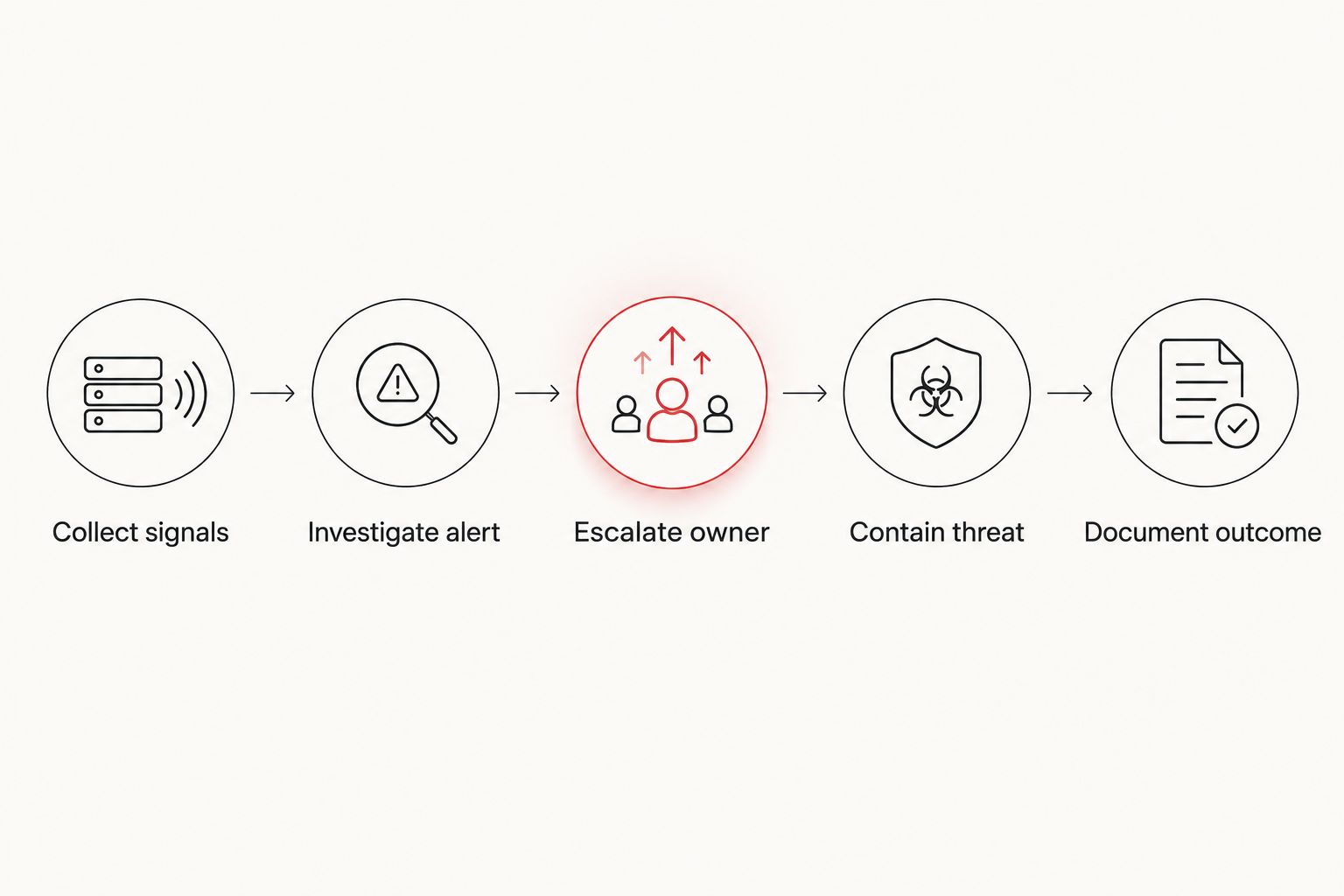
These are contract and workflow questions, not assumptions about every provider's package. Ask for a written distinction between investigation, notification, containment and recovery. If containment is excluded, identify who will perform it before an incident occurs.
SOC-as-a-service versus endpoint protection: which do you need?
Endpoint protection and a SOC solve related but different problems. Endpoint protection watches covered devices and can detect or block activity according to its configuration. A SOC investigates signals across the systems it covers and coordinates the human response. Buying a SOC does not make an unprotected device visible; buying endpoint protection does not guarantee someone will review every alert.
For a small business in 2026, the practical question is where your current process breaks. If devices are not consistently protected, fix that coverage. If alerts already exist but sit unread, assign investigation and escalation. If your team investigates but has no agreed containment plan, clarify response authority. Do not treat these gaps as interchangeable.
Cyber Solutions is best for small and mid-sized US businesses that need managed cybersecurity and incident response alongside IT support. Cyber Solutions provides SOC/MDR, endpoint protection and 24/7 incident response services. Its fit depends on the precise scope you agree to: which systems are monitored, which incidents trigger a call and which actions its team can take. The trade-off is that a managed service still needs access decisions and an internal owner who can resolve business-impact questions.
SOC-as-a-service versus an internal team: which is better?
An internal team is best when your business has people who can regularly investigate security events, maintain monitoring coverage and make containment decisions. They know your systems and can coordinate directly with the business. Their limitation is capacity: an alert that arrives outside their coverage window still needs an owner.
SOC-as-a-service is best when your internal team needs outside monitoring or investigation but remains responsible for the business. It can supply an escalation path without requiring you to make every internal employee a security analyst. Its limitation is context. A provider needs accurate asset information, working access and an agreed response playbook to make sound decisions.
Neither model removes management's role. Someone at your business must decide how much disruption is acceptable when containing a threat. If isolating a critical machine would interrupt operations, write down who can approve that action. If nobody owns that decision, an external analyst and an internal technician can both stall at the same point.
Why the value of SOC-as-a-service varies
These factors determine whether the service protects your operations or adds another inbox:
- Coverage of critical systems. Confirm that monitoring includes the devices, accounts and services that could interrupt work. A clean dashboard is not evidence that everything important is covered.
- Hours of investigation and response. Ask separately when analysts review alerts and when someone can take action. A notification sent at night is not the same as an incident being handled at night.
- Authority to contain threats. A provider that can act under a written playbook serves a different need from one that must wait for your team on every decision. Neither arrangement is universally right; the boundary must be explicit.
- Quality of escalation. Urgent findings need an owner, a backup contact and enough detail to make a decision. A long alert with no recommended action transfers the investigation burden back to you.
- Integration with existing IT support. Incident handling often requires account access, device changes and recovery work. Define how security staff and IT support coordinate instead of assuming one team covers the other's tasks.
- Evidence and follow-up. You need a record of the event and a clear remediation owner. Otherwise, the same weakness can remain after the immediate alert is closed.
Use those factors to evaluate Cyber Solutions or any other SOC provider. Ask for answers tied to your systems and response process, not a generic list of tools. In 2026, a defensible buying decision starts with a written scope of responsibility.
How to decide before signing
Start with the alerts your business already receives. Identify where they come from, who reads them and what happens when that person is unavailable. Then choose an incident your team would struggle to handle, such as a compromised account or a suspicious device, and have each prospective provider explain its exact role.
Ask these questions in a meeting with both your business owner and whoever manages IT:
- Which of our systems will you monitor, and which will remain outside scope?
- Who investigates a high-priority alert, and what evidence will we receive?
- Who contacts us outside business hours, and what happens if our primary contact does not respond?
- Which containment actions can you take without fresh approval?
- Who handles recovery and the underlying fix after the immediate threat is contained?
- How will our existing IT team participate without duplicating or delaying work?
Record the answers as operational responsibilities. A proposal that says it includes a SOC but leaves those questions open has not defined the service you are buying. You should be able to follow an incident from the first signal to the final remediation owner without inventing a handoff.
The same test applies to Cyber Solutions. Its managed IT and cybersecurity services make coordination a relevant question, but the scope of any engagement must be confirmed rather than assumed. Ask how its SOC/MDR and 24/7 incident response services would apply to your particular systems and escalation contacts.
When should a small business skip SOC-as-a-service?
Skip it as a first purchase if nobody has mapped the systems you need to protect or assigned an internal incident owner. A provider cannot reliably prioritize an unknown business-critical system. Establish that basic inventory and decision chain, then decide which monitoring and response work should sit outside your company.
Also skip a proposal that offers only more alerts when unread alerts are already your problem. In that case, require an investigation and escalation process or choose a different approach. If your internal team already covers the relevant systems and response windows, document the gap an outside SOC would close before adding one.
Can SOC-as-a-service replace your IT provider?
No. SOC-as-a-service addresses security monitoring and incident handling; routine IT support remains a separate responsibility unless the agreement explicitly includes it. Someone still has to maintain systems, manage access and complete changes after an investigation. The teams can work together, but their handoff must be defined.
For a business using separate vendors, ask which team owns the device or account after a security analyst identifies the problem. For a business considering Cyber Solutions managed IT and cybersecurity services together, ask how that same handoff is assigned in the proposed scope. The objective is one accountable path from finding to fix, not an assumption that every task is included.
Does a small business need continuous SOC coverage in 2026?
Continuous coverage is useful when an incident outside business hours would require action before your staff returns. It is less useful if your agreement provides continuous alert collection but no investigation or reachable responder during that period. Separate collection, analyst coverage and response authority in the contract.
Cyber Solutions states that it provides 24/7 incident response services. That makes it relevant to businesses that cannot afford downtime, but you should still confirm which events qualify, who initiates contact and what actions the agreed service permits. The phrase 24/7 answers a coverage question; it does not, by itself, define the response.
FAQ
Is SOC-as-a-service worth it for a small business in 2026?
Yes, when it provides investigation and a defined response for alerts your business cannot manage consistently. If it only forwards alerts without an action owner, it does not solve the response gap.
What's the difference between a SOC service and endpoint protection?
Endpoint protection detects or blocks activity on covered devices; a SOC service investigates security signals and coordinates response. You need to confirm which devices and other systems the SOC actually monitors.
Can a SOC provider stop an attack without calling my team?
Only if your agreement grants the provider authority for the relevant containment action. Define those actions and their limits before an incident, including who approves a disruptive decision.
Does a small business need a full-time internal security team as well?
Not necessarily, but it does need an internal owner for access, priorities and business-impact decisions. An outside SOC cannot make every operational judgment without your input.
Will SOC-as-a-service replace my managed IT support?
No, not unless the service agreement explicitly covers the IT work you need. Confirm who changes accounts, repairs devices and completes remediation after an incident.
What should I ask a SOC provider before signing?
Ask which systems it monitors, who investigates alerts, when it can respond and what containment it can perform. Get the escalation contacts and handoff to IT documented.
Is 24/7 monitoring the same as 24/7 incident response?
No. Monitoring can collect or review alerts while response requires an agreed action and someone authorized to take it. Ask the provider to explain both processes separately.
One last thing
Ask every finalist to explain who acts when an urgent alert arrives and your usual contact cannot answer. That single scenario exposes the difference between monitoring you can use and monitoring that merely records a problem. In 2026, the best SOC service is the one whose response responsibilities you can describe before an incident, not after one.


