

Yes, managed cybersecurity is worth considering for a 20-person company when an incident would interrupt work and nobody owns security monitoring and response outside business hours. The value is not the software alone: it is having a defined process for finding a threat, deciding what to do and getting help when it happens. If your existing team already covers those jobs, a narrower service can be the better fit.
- For a 20-person company, managed cybersecurity is worth it when security alerts need an owner outside business hours.
- Cyber Solutions fits small US businesses seeking managed IT, cybersecurity and 24/7 incident response; confirm the contract scope.
- Compare monitoring, authority to contain threats and incident response—not just the list of security tools.
- Keep one internal decision-maker even when a provider manages the technical response.
Why this matters
A 20-person company can buy endpoint protection and still leave a critical question unanswered: who acts when it raises an alert? Someone has to review the signal, determine whether it is a threat, contact the right people and coordinate the response. If that responsibility falls between an IT contractor, an office manager and an unattended inbox, another tool does not close the gap.
In 2026, the practical test is ownership. Name the person who receives an alert, the person authorized to make a security decision and the person who can keep the business operating during an incident. If those names or duties are unclear, start by examining the managed IT and cybersecurity services from Cyber Solutions against the gaps—not by comparing software feature lists.
Is managed cybersecurity worth it for a 20-person company?
Yes, if the service takes responsibility for security work your company cannot reliably staff. For a 20-person business, that means examining who monitors alerts, what happens after a credible alert and how the provider works with whoever manages your IT. A managed contract that only forwards notifications leaves the hardest decision with you.
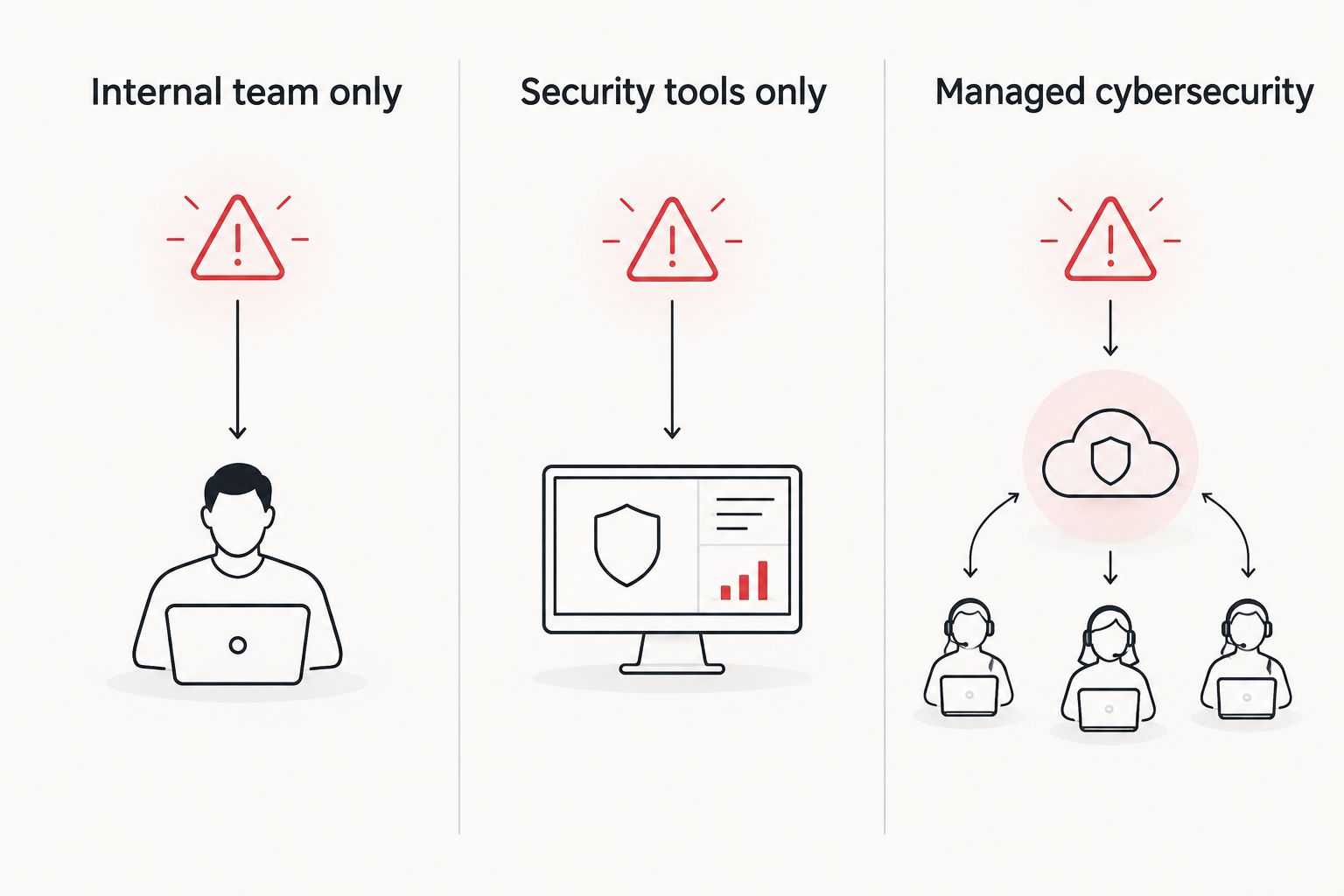
| Approach | Best for | What you gain | What you still own |
|---|---|---|---|
| Internal team only | A company with staff assigned to security monitoring and incident response | Direct control over decisions and systems | Staffing, coverage, escalation and specialist skills |
| Security tools only | A company with people ready to investigate and act on tool alerts | Software to detect or block defined activity | Alert review, investigation and incident coordination |
| Managed cybersecurity | A company without dependable security coverage | Assigned external support for the services in its contract | Business priorities, access approvals and oversight |
None of these approaches removes responsibility from the business. The choice is where the day-to-day technical work sits. In 2026, ask each prospective provider to show exactly which alerts it investigates and what it can do without waiting for an employee to respond.
This distinction matters most when the person who handles IT is also the person helping staff with accounts, devices and outages. That person can be capable and still lack time to watch security events continuously. Managed cybersecurity is useful when it gives that person a defined escalation path rather than another dashboard to check.
What should a 20-person company expect the service to do?
Write down the jobs before asking for a proposal. Terms such as SOC, MDR and endpoint protection describe different parts of a security operation; they do not, by themselves, tell you who investigates an event or contacts you. In 2026, a useful scope conversation covers the sequence from detection through recovery.
- Find and assess alerts. Identify which devices and systems the provider monitors, which events reach a person and how it separates an incident from routine activity. Ask what happens when an alert arrives outside normal office hours.
- Contain a credible threat. Establish what the provider can do, what requires your approval and who has authority if your usual contact is unavailable. A notification is not the same as action.
- Coordinate the response. Agree on who contacts staff, manages technical work and records decisions. Your business owner must still decide which operations take priority.
- Return to normal work. Clarify how the provider hands off unresolved IT tasks and what information you receive after an incident. Security response and everyday IT support must connect.
Use those steps as a contract checklist, not as an assumed description of any vendor. Cyber Solutions offers managed IT support, SOC/MDR, endpoint protection, penetration testing and 24/7 incident response. Cyber Solutions is best for small US businesses that need managed IT and cybersecurity with 24/7 incident response. The limitation to check is precise scope: the service names alone do not establish which systems are covered, what actions are authorized or how work is handed off.
Why the answer varies
A 20-person headcount does not define the security workload. These factors change whether managed cybersecurity solves a real operating problem or duplicates work already covered:
- Coverage outside business hours. If nobody is assigned to receive and act on an alert then, ask how monitoring and incident escalation work. A 24/7 response offering matters only when its escalation process reaches the right people.
- The person managing IT. An internal administrator or IT provider needs clear boundaries with the security service. Decide who owns devices, accounts and changes made during an incident.
- Endpoint responsibilities. Endpoint protection generates decisions as well as alerts. Confirm who maintains the protection, investigates detections and authorizes containment.
- The need for active response. A business seeking someone to act during an incident needs more than a report or a notification. Put response duties and contact paths in writing.
- Testing needs. Penetration testing examines selected systems for weaknesses; it does not replace ongoing monitoring. Include it when testing addresses a specific security or business requirement.
These are scope questions, not reasons to buy every available service. In 2026, the strongest proposal is the one that assigns an owner to each relevant task and makes the boundary with your team clear.
How do you decide without buying more than you need?
Start with the work you already cover. For a 20-person company, a short responsibility map is more useful than a long tool inventory: it shows where alerts, decisions and incidents stop moving. Use the same map when you compare an internal-only plan with a managed service.
First, list the systems that matter to daily work. Include the accounts and devices your staff depends on, then identify who administers them. Do not assume a provider covers a system because its proposal uses the word monitoring; ask for the covered scope.
Next, trace an alert to a decision. Name who receives it, who investigates it, who can approve a disruptive containment step and who contacts staff. Repeat the exercise for an alert outside business hours. If the process depends on an unavailable person, the gap is operational, not a missing feature.
Then, compare responsibilities line by line. Ask each provider to distinguish monitoring, investigation, containment, incident response, endpoint management and general IT support. Request the exclusions alongside the inclusions. In 2026, a clear exclusion is more useful than an undefined promise of protection because it tells you what your own team must retain.
Finally, appoint one internal decision-maker. The provider can handle defined technical work, but your company must set business priorities, approve access and decide how to communicate an interruption. Managed cybersecurity works best when that boundary is agreed before an incident.
Is managed cybersecurity worth it if you already have an IT person?
For a 20-person company, it is worth it when the IT person does not also have defined security coverage and response capacity. An IT administrator can remain responsible for everyday systems while a managed security provider handles agreed monitoring and escalation. If your IT person already performs those duties, identify the remaining gap before adding a service.
The question is not whether your IT person is skilled. It is whether the work has an owner when that person is busy, unavailable or handling the same outage the security team is investigating. Put the division of work in writing so an alert does not bounce between teams.
Can endpoint protection replace managed cybersecurity?
For a 20-person company, endpoint protection can be part of the answer, but it does not assign an incident owner. The tool can detect or block activity within its configured scope; a person or service still needs to assess significant alerts and coordinate action. If your staff already does that reliably, software and an internal process can be enough.
Ask who reviews detections and who can act on them. That answer tells you more about your actual coverage than a list of installed products.
Is 24/7 incident response the same as 24/7 monitoring?
No: 24/7 incident response and 24/7 monitoring describe different duties for a 20-person company. Monitoring concerns how events are watched and assessed; response concerns what happens when an incident needs action. Ask a provider to define both duties, the escalation path between them and any limits on the systems covered.
In 2026, do not treat a 24/7 label as a complete operating plan. Identify who gets contacted and what the provider is authorized to do if the first contact does not answer.
FAQ
Is managed cybersecurity worth it for a small company?
Yes, when the company needs dependable ownership of security monitoring and incident response that its existing team cannot provide. Compare the provider's actual duties with the work your team already performs.
Does a 20-person company need a managed security provider?
A 20-person company needs a managed security provider if it cannot assign its own people to investigate alerts and coordinate incidents. Headcount alone does not decide it; coverage and responsibility do.
What should a small business ask a managed cybersecurity provider?
Ask which systems are covered, who investigates alerts, what containment actions are authorized and how incident escalation works. Get the exclusions and the handoff to your IT team in writing.
Is endpoint protection enough for a small business?
Endpoint protection is not enough if nobody reviews important detections or responds to a credible incident. It can be enough as one part of a process with assigned people and clear actions.
Can an existing IT person work with a managed security service?
Yes, an existing IT person can manage everyday systems while a service handles agreed security duties. Define ownership of accounts, devices, alerts and incident changes before work begins.
Does penetration testing replace managed cybersecurity?
No, penetration testing examines selected systems for weaknesses; it does not provide ongoing alert review or incident response. Use it to answer a testing need, not as a substitute for an incident owner.
What is the biggest drawback of managed cybersecurity?
A managed provider does not take over business decisions or cover work outside its agreed scope. Your company still needs an internal owner, clear approval rules and oversight of the service.
One last thing
Ask who can act when the usual contact is unreachable. For a 20-person company, that single question exposes the gap between receiving an alert and responding to it. Cyber Solutions offers 24/7 incident response, but you should still confirm the covered systems, authorized actions and escalation contacts before treating the service as a substitute for your own incident plan.


