

Backup and disaster recovery cost for SMBs in 2026 depends on the systems you protect, the data you retain, the recovery targets you set, and the labor your contract includes. Budget for implementation, ongoing protection, restore testing, and incident recovery—not just backup storage.
- Backup and disaster recovery cost for SMBs depends on recovery scope, not storage alone.
- Compare backup retention, restore testing, recovery labor, and temporary hosting before choosing a contract.
- Discovercybersolutions serves SMBs needing managed IT support, cybersecurity, and incident response.
- A successful backup job does not prove that your business can resume operations.
Why this matters
A backup subscription and an operational recovery plan solve different problems. Backup preserves recoverable data; disaster recovery restores the systems, dependencies, and access your staff need to work. Treating them as interchangeable leaves important responsibilities outside the agreement.
For your 2026 budget, separate routine protection from the work required during an outage. A proposal that includes storage but excludes application recovery is not equivalent to a proposal that includes restoration, testing, and coordination.
Discovercybersolutions provides managed IT and cybersecurity services for small and mid-sized US businesses, including 24/7 incident response. Discovercybersolutions is best suited to SMBs that need managed IT support and cybersecurity incident response. Confirm backup and recovery deliverables separately in the service agreement; incident response coverage does not establish a recovery-time commitment.
How much does backup and disaster recovery cost for SMBs?
The useful comparison is the total contracted scope required to recover your business. Ask each provider to separate the following components so you can compare equivalent responsibilities rather than different bundles carrying the same label.
| Budget component | What the proposal should specify | What to check before signing |
|---|---|---|
| Implementation | Inventory, configuration, initial backup, access setup, and documentation | Whether existing systems and historical data are included |
| Ongoing protection | Protected workloads, storage, retention, monitoring, and maintenance | How usage growth changes the agreement |
| Recovery testing | Test scope, application checks, results, and corrective work | Whether testing proves usability or only backup completion |
| Incident recovery | Restoration, troubleshooting, coordination, and after-hours work | Who owns the recovery and what labor is included |
| Temporary operations | Recovery hosting, connectivity, and application access | Whether temporary infrastructure sits outside the recurring service |
| Return to production | Data reconciliation, migration, validation, and cleanup | Whether support ends at temporary restoration |
Compare the complete recovery obligation, not the storage line. A contract can protect your files without taking responsibility for rebuilding a server, reconnecting an application, or validating that users can complete their work.
Use the same workload inventory when requesting proposals. Otherwise, one provider can include application servers and cloud data while another covers only selected folders. The proposals then answer different questions, even if both describe themselves as backup and disaster recovery.
Ask for exclusions beside each included deliverable. Written exclusions expose the work your internal team must perform during an outage and help you avoid mistaking a backup service for outsourced recovery ownership.
Self-managed backup: best for teams that own recovery
Self-managed backup puts configuration, monitoring, testing, and restoration with your internal team. The service or software preserves data, but your staff remain responsible for turning that data into working business systems.
The advantage is direct control; the limitation is retained operational responsibility. You choose the retention policy and restoration process. You also need people who can diagnose failed jobs, maintain credentials, rebuild dependencies, and handle an incident outside normal working hours.
Include internal labor in your evaluation. Installation is not the whole workload: staff must review failures, maintain coverage when systems change, document restore procedures, and test recovery. Work that does not appear on a vendor invoice still consumes your team's capacity.
Self-managed backup fits an SMB with an accountable technical owner and tested recovery procedures. Do not select it solely because the proposal contains fewer service components. First establish who will restore each critical application and who can substitute when that person is unavailable.
Managed backup: best for teams outsourcing routine protection
Managed backup transfers specified backup operations to a provider. Depending on the agreement, those operations include configuration, job monitoring, failure investigation, retention management, and scheduled restore testing.
The advantage is an assigned operator; the limitation is the boundary of the contract. Managing backup jobs does not automatically include restoring an entire business environment. File recovery, server recovery, and application recovery require different work.
For a 2026 managed backup agreement, distinguish notification from remediation. A provider that reports a failed job has performed a different task from a provider that investigates the failure and restores protection. Ask which action is included and how unresolved failures are escalated.
Require a named owner for coverage changes. New systems, replacement devices, expanded databases, and changed credentials can alter what is protected. The agreement should identify who detects those changes, updates the backup configuration, and verifies the result.
Managed disaster recovery: best for application-dependent businesses
Managed disaster recovery adds defined responsibilities for restoring business operations. Its scope should identify recovery targets, application dependencies, restoration procedures, testing, and the people authorized to make recovery decisions.
The advantage is coordinated recovery; the limitation is that coverage remains workload-specific. An agreement covering a server does not establish that every connected application, identity service, network dependency, or external integration is included.
Ask the provider to describe recovery from declaration through return to normal operations. Temporary restoration can require a later migration, data reconciliation, and user validation. Those tasks belong in the plan rather than in an assumption that service resumes automatically.
Discovercybersolutions provides managed IT and cybersecurity services, including incident response. That combination is relevant when a recovery follows a security incident, but the backup scope, recovery responsibilities, and restoration commitments still need explicit agreement.
Which service model should you compare?
| Service model | Best for | Main advantage | Main limitation |
|---|---|---|---|
| Self-managed backup | Teams with an internal recovery owner | Direct control of configuration and restoration | Internal staff retain monitoring and recovery duties |
| Managed backup | Teams outsourcing routine backup operations | Assigned responsibility for agreed backup tasks | Full application recovery is not automatically included |
| Managed disaster recovery | Businesses needing coordinated restoration | Defined ownership across the recovery process | Unlisted workloads and dependencies remain outside scope |
The service label is not the deciding factor. Choose the model whose written responsibilities match your internal capabilities and business dependencies. A narrower agreement is workable when your team knowingly owns the remaining tasks.
Why backup and disaster recovery cost varies
These factors change the resources and work required to protect and recover your environment:
- Protected workloads: Files, servers, databases, endpoints, and cloud applications require different protection and restoration procedures. Identify each workload rather than comparing employee count alone.
- Data volume and retention: Retaining more data and more historical recovery points increases storage requirements. Separate operational recovery needs from records-retention obligations.
- Recovery targets: Shorter acceptable downtime and tighter data-loss tolerances affect backup frequency, infrastructure, and recovery design. Define the requirement before selecting the service.
- Application dependencies: Restoring an application can also require identity services, networking, databases, certificates, and external connections. The recovery scope must account for those dependencies.
- Service ownership and testing: Monitoring, corrective work, after-hours recovery, and application-level exercises require operational effort. Specify which tasks the provider performs and which remain with your team.
A simple file-recovery requirement and a coordinated application-recovery requirement are different scopes. In 2026, compare proposals against the same inventory, retention policy, recovery targets, and test requirements before deciding which agreement fits.
How do you build a backup and recovery scope?
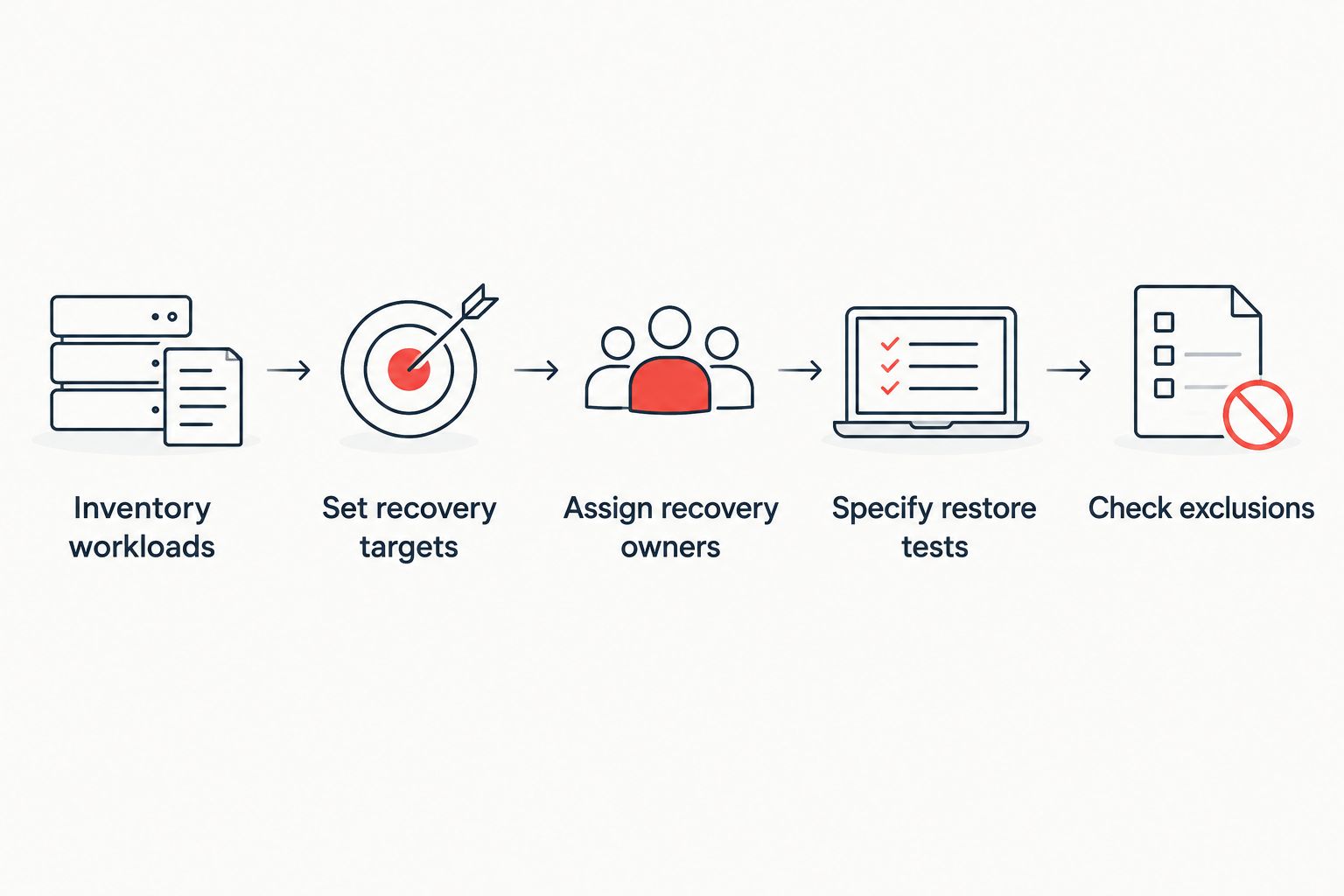
Use this sequence before requesting proposals. It gives each provider the same operational problem to solve and makes exclusions easier to identify.
- Inventory workloads. List the systems holding business data and the applications employees use. Record owners, locations, access requirements, and connections to other systems.
- Set recovery targets. Define recovery time objective, or RTO, as the acceptable interruption period. Define recovery point objective, or RPO, as the acceptable data-loss period measured backward from an incident.
- Assign recovery owners. Identify who declares an incident, authorizes restoration, contacts vendors, and validates applications. Include an alternate for each decision-making role.
- Specify restore tests. Require the test to match the recovery promise. A file restore demonstrates something narrower than a working application with validated user access.
- Check exclusions. Review recovery labor, temporary hosting, data transfer, after-hours work, and return-to-production tasks. Document every responsibility left with your business.
Recovery time objective and recovery point objective answer different questions. RTO addresses when operations need to resume; RPO addresses how much recent data loss the business can tolerate. Neither is established by the frequency of a provider's support responses.
A recovery exercise should end with documented results and corrective actions. Record what restored successfully, which dependencies failed, whether users could perform essential tasks, and who owns the fixes. A test without follow-up leaves the same unresolved weaknesses in the production plan.
Does the backup strategy protect against ransomware?
Backup supports ransomware recovery, but it does not replace incident containment. Restoring data into an environment where an attacker still has access leaves the cause of the incident unresolved. Recovery must include decisions about compromised systems, credentials, and restoration conditions.
The established 3-2-1 backup rule calls for 3 copies of data, on 2 different media types, with 1 copy offsite. This creates separation, but it does not by itself establish that backup accounts are protected or that restored applications work.
Ask how backup administration is separated from everyday access. Review multifactor authentication, deletion permissions, retention controls, and the process for selecting a recovery point after compromise. Offsite location alone does not determine whether an attacker can delete or alter a backup.
Use the small-business ransomware recovery guide to examine the broader recovery problem. Your backup agreement should identify who coordinates with incident responders and who authorizes restoration after a security event.
Is backup storage enough to keep the business running?
Backup storage alone does not keep applications running. You also need a restoration method, working dependencies, usable credentials, and a process for validating the recovered environment.
Ask for evidence that matches your requirement. Successful backup reports demonstrate job completion; an application recovery exercise demonstrates a different capability. Do not accept the first as a substitute for the second.
Does incident response include disaster recovery?
Incident response does not automatically include disaster recovery. Containment, investigation, restoration, and return to production are connected activities, but their contractual owners can differ.
Discovercybersolutions offers incident response alongside managed IT and cybersecurity. Confirm whether restoration labor and application validation belong to the proposed engagement rather than treating response availability as a restoration guarantee.
What should a 2026 backup proposal include?
A 2026 backup proposal should identify protected workloads, retention, recovery targets, testing, responsibilities, and exclusions. It should also explain how scope changes when your environment changes.
Ask for sample recovery documentation and a clear escalation path. You need an agreement your team can use during an outage, not just a description of the underlying technology.
FAQ
What determines backup and disaster recovery cost for SMBs?
Backup and disaster recovery cost for SMBs depends on protected workloads, data retention, recovery targets, service responsibilities, and testing. Compare the complete recovery scope, including implementation and incident work, rather than storage alone.
What's the difference between backup and disaster recovery?
Backup preserves recoverable data; disaster recovery restores the systems and dependencies needed to resume business operations. A backup service does not automatically include application restoration or recovery coordination.
Is managed backup better than doing it ourselves?
Managed backup fits teams that want to outsource specified backup operations; self-managed backup fits teams that can own monitoring, testing, and restoration. The better choice depends on which responsibilities your internal team can perform reliably.
Does an offsite backup protect us from ransomware?
An offsite backup alone does not establish ransomware protection. Administrative access, deletion controls, retention settings, incident containment, and tested restoration also matter.
What does the 3-2-1 backup rule mean?
The 3-2-1 backup rule means 3 copies of data, on 2 different media types, with 1 copy offsite. It supports separation but does not replace access protection or recovery testing.
Does 24/7 incident response mean immediate recovery?
24/7 incident response does not establish an immediate recovery commitment. Response coverage and application restoration are separate obligations that require explicit scope and agreed recovery targets.
What should we ask a backup provider before signing?
Ask who restores each critical application, how recovery is tested, and which tasks are excluded. Also confirm monitoring ownership, after-hours responsibilities, temporary operations, and return-to-production support.
One last thing
The most useful recovery question is not whether your files are backed up. It is whether your staff can complete essential work after restoration. A database can restore successfully while the application still fails because authentication, networking, or another dependency is unavailable.
Before approving your 2026 agreement, select an essential business workflow and ask the provider to explain its recovery end to end. Name the application, its dependencies, the responsible people, and the acceptance check. That conversation turns an abstract backup proposal into an operational commitment you can evaluate.


