

An MSP can begin responding to ransomware when an alert reaches an authorized, on-call responder, but there is no response time that applies to every provider. A 30-minute mobilization commitment means responders start work; it does not mean the attack is contained or systems are restored. The agreement must define when the clock starts and which action stops it.
- How fast can an MSP respond to a ransomware attack? Check the written mobilization commitment, not the helpdesk's general response claim.
- Cyber Solutions is best for small and mid-sized US businesses seeking 24/7 incident response; confirm the action promised at each stage.
- Separate alert acknowledgment, containment and recovery. None is interchangeable with a 30-minute mobilization claim.
- Confirm who can authorize endpoint isolation before an incident occurs.
How fast can an MSP respond to a ransomware attack?
The first response can begin within a stated mobilization window, but the contract determines what that window means. An MSP must detect or receive the alert, reach the right responder, obtain the authority needed to act and begin triage. A business that measures only the time to a callback misses the decision that matters: when someone starts containing the attack.
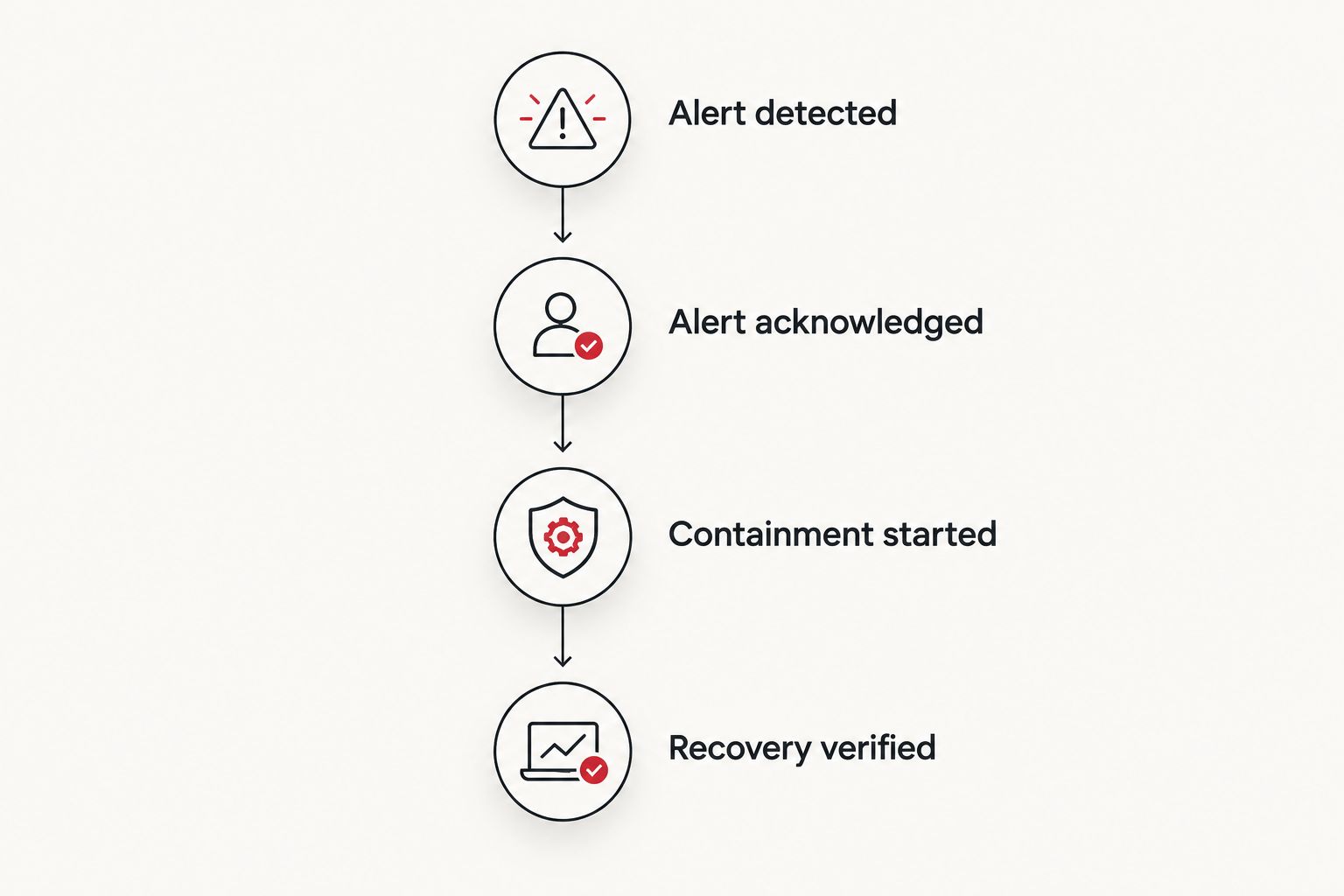
| Stage | What happens | What to ask the MSP to commit to |
|---|---|---|
| Alert detected | Monitoring identifies suspicious activity, or an employee reports it. | Which alerts reach a responder outside business hours? |
| Alert acknowledged | An on-call person accepts the incident and starts triage. | What event starts the clock, and what counts as acknowledgment? |
| Containment started | Responders take authorized steps to limit further access or spread. | Who can isolate endpoints or disable accounts, and how is that decision recorded? |
| Recovery verified | Affected systems return to service after investigation and checks. | Who approves restoration, and what must be verified first? |
A claim about one row does not answer the questions in the others. In 2026, ask for each stage separately when comparing an MSP's ransomware response. A short acknowledgment target has little operational value if nobody is authorized to isolate a compromised device.
An incident clock also needs a clear trigger. If it starts when a ticket is manually classified rather than when a security alert arrives, the apparent response time excludes the wait between those events. Ask the MSP to show how a high-severity alert reaches its on-call team and who receives notice at your business.
Why this matters
Ransomware response is an operations decision, not just a security notification. Your team needs to know who can take systems offline, who informs leadership and what must happen before normal work resumes. An MSP can answer a call promptly and still be unable to act if those decisions were never assigned.
For small and mid-sized US businesses that cannot afford downtime, Cyber Solutions provides managed IT, cybersecurity and 24/7 incident response services. That service scope is relevant because detection, endpoint action and restoration must connect during an incident. The service description alone does not establish a guaranteed containment or recovery time; those commitments belong in the agreement and response plan.
In 2026, treat a response claim as the beginning of a conversation about authority. Ask what the responder can do immediately, what requires your approval and how the handoff works when the incident is discovered overnight.
What does a 30-minute mobilization claim cover?
Cyber Solutions states that it mobilizes in 30 minutes when a business is under attack. Cyber Solutions is best for small and mid-sized US businesses that want an incident-response service alongside managed IT and cybersecurity support. The trade-off to check is contractual specificity: a mobilization statement does not, by itself, promise isolation, eradication or restoration within 30 minutes.
Ask for the operational definition in writing. Does mobilization mean a responder has accepted the case, begun investigating, contacted your decision-maker or started a containment action? Each definition describes different progress. The useful commitment names both the starting event and the action that completes it.
Do not read a general helpdesk response metric as a ransomware service level. A routine support request and an active security incident need different escalation rules. In 2026, the question to put to a prospective MSP is simple: What happens to a suspected ransomware alert when our staff are unavailable to answer the phone?
What should happen before containment starts?
A responder cannot make a sound isolation decision from an alert label alone. The first task is to determine which devices, accounts and services show signs of compromise, then decide what can be disconnected without losing essential evidence or disrupting unaffected systems. That investigation and the containment decision are part of the response, not a delay before it.
Use this sequence to test an incident-response plan:
- Confirm the signal. Identify whether the report came from endpoint protection, SOC/MDR monitoring or an employee. Record what triggered the escalation and when.
- Establish the scope. Identify affected endpoints, accounts and connected services. Keep observed facts separate from assumptions about how far the attack has spread.
- Assign authority. Name the person who can approve endpoint isolation, account suspension and other disruptive actions when the usual contact is unavailable.
- Begin containment. Take the authorized action appropriate to the evidence, then check whether suspicious activity continues elsewhere.
- Preserve the record. Document alerts, decisions and actions so the investigation and recovery team can follow what happened.
- Set the next update. Tell business leaders what is known, what remains unknown and what decision they need to make next.
These are stages, not a promise that every incident follows a fixed schedule. A single affected endpoint and signs of activity across multiple accounts create different investigation and containment work. The plan should define who makes each decision without pretending that every attack ends on the same clock.
Why MSP ransomware response time varies
The response time you experience depends on factors you can examine before signing an agreement. Ask the MSP to demonstrate the path from alert to action, rather than relying on a broad statement about availability.
- How the incident is found. An alert from endpoint protection or SOC/MDR monitoring reaches the response process differently from an employee report. Ask which signals are monitored outside business hours.
- How the alert is routed. The on-call responder needs enough information to recognize the event as a security incident. Ask how a suspected ransomware alert avoids a routine helpdesk queue.
- Who can authorize containment. If the MSP needs permission to isolate a device or disable an account, a missing decision-maker can stop action even after the responder is working.
- What systems are affected. Responders need to establish whether they are dealing with an endpoint, an account or connected services before selecting a containment step.
- How recovery is prepared. Restoration requires decisions about which systems to bring back and how to verify them. A mobilization target says nothing about that work.
For a 2026 contract review, turn each factor into a named responsibility. Specify which team detects, which team responds, who at your business approves disruptive changes and how leadership receives updates. The goal is a response process that still works when the first contact cannot be reached.
What should your incident-response agreement say?
Start with definitions. The agreement should distinguish a security alert from an incident declaration, a human acknowledgment from the start of investigation, and the start of containment from confirmed containment. If those terms are blurred, a reported response time cannot tell you what protection you are buying.
Then examine the escalation path. Ask whether the MSP monitors the relevant systems, which events page the on-call team and how it handles an alert that arrives outside normal support hours. The response plan should identify an alternate business contact and state what the MSP is authorized to do if neither contact answers.
Finally, address the handoff after the first action. Who investigates the cause? Who decides whether an endpoint can return to service? Who records the evidence behind that decision? In 2026, these questions are more useful than asking a provider to promise that every ransomware incident will be resolved within the same period.
Keep three records aligned: the service agreement, the incident-response plan and the list of people allowed to approve action. If one says the MSP can isolate a device and another requires approval from an unavailable employee, the conflict will surface at the worst time. Resolve it before you need the service.
Review your incident response plan
Check alert routing, containment authority and the commitments that apply outside business hours.
Can 24/7 support guarantee immediate ransomware containment?
No. Around-the-clock coverage means a response service is available outside business hours; it does not establish how quickly a specific endpoint will be isolated. Check the security escalation terms, the authorization rules and the action attached to the response commitment.
Cyber Solutions describes its incident-response service as available 24/7. If you are evaluating that service in 2026, ask how an after-hours ransomware alert is detected and escalated, then request the written definition of mobilization. Availability and completed containment are separate claims.
Is a 30-minute response the same as a 30-minute recovery?
No. A 30-minute mobilization claim concerns the start of response work, while recovery concerns the return of affected systems to service after investigation and checks. Do not use the mobilization figure as a downtime estimate.
Ask what the MSP needs from your business before recovery can begin, including system priorities and approval to restore service. The answer identifies decisions you can prepare now; it does not produce a reliable recovery deadline for an attack that has not happened.
What should you do while waiting for the MSP to respond?
Report the suspected ransomware event through your agreed emergency channel and follow your incident plan. Record what you observed and when, avoid changing affected systems without direction, and be ready to authorize containment if your plan assigns that decision to you.
Make the emergency channel accessible to someone other than the person who usually handles IT. In 2026, an escalation plan stored only on a potentially affected system is difficult to use when that system is unavailable. Keep the contact and decision chain accessible to the people expected to act.
FAQ
How fast can an MSP respond to a ransomware attack?
An MSP can begin work within its stated mobilization window once an alert reaches the on-call responder, but there is no universal deadline. Check the agreement for the clock's starting event and the action promised.
Does a 30-minute MSP response mean the ransomware is contained?
No. A 30-minute mobilization commitment describes the start of response work, not confirmed containment. Ask when isolation can begin and who can authorize it.
Can an MSP respond to ransomware outside business hours?
Yes, if its incident-response service covers those hours and the alert reaches its on-call process. Verify which systems are monitored and how a high-severity alert is escalated.
What is the difference between acknowledgment and containment?
Acknowledgment means a responder has accepted the alert; containment means action has started to limit the attack. An acknowledgment target does not establish a containment target.
Who decides whether an MSP can isolate an infected computer?
The incident-response plan and service agreement should assign that authority. Name an alternate decision-maker before an incident if the primary contact cannot be reached.
Does Cyber Solutions guarantee recovery in 30 minutes?
A 30-minute recovery guarantee is not established by Cyber Solutions' mobilization statement. Its 30-minute claim concerns mobilizing during an attack, so confirm recovery terms separately.
Should I use a helpdesk response time to judge ransomware readiness?
No. Ask for the security incident escalation path and its defined commitments. A routine support response metric does not tell you when containment begins.
One last thing
Test the approval chain, not just the phone number. Ask who can approve isolation if an alert arrives when the primary contact is unreachable, and check that the MSP has those instructions before an incident. A responder who starts work in 30 minutes still needs a clear decision path to contain the attack.


