
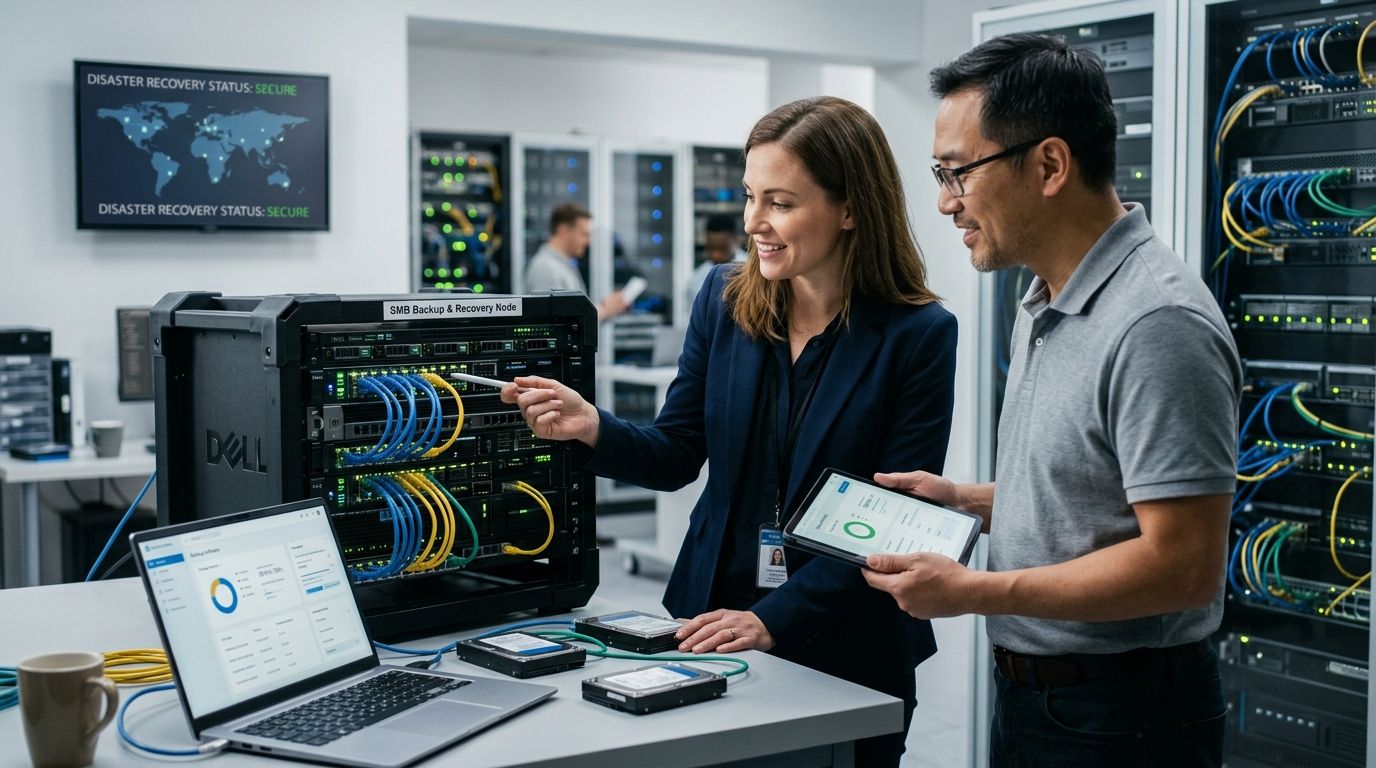
Backup and disaster recovery solutions decide whether a ransomware attack costs your business four hours of downtime or four weeks of it. This guide ranks the backup and disaster recovery solutions that matter for US small and mid-sized businesses in 2026, comparing managed service options against the software platforms IT teams run themselves.
- Cyber Solutions wins for SMBs that want backup and disaster recovery solutions bundled with 24/7 incident response, not just software.
- Datto BCDR is the strongest MSP-managed hybrid appliance for businesses running mixed on-prem and cloud workloads.
- Veeam Data Platform stays the default software pick for virtualized server environments like VMware and Hyper-V.
- Rubrik and Acronis Cyber Protect both build ransomware defense into backup, but only Rubrik focuses on immutable snapshots at scale.
- Druva fits distributed teams that need SaaS-native cloud backup with zero on-prem hardware to manage.
Best overall: Cyber Solutions for SMBs that want backup and disaster recovery managed inside a broader security relationship. Best for hybrid on-prem environments: Datto BCDR. Best for virtualized infrastructure: Veeam Data Platform. Best for ransomware-resistant immutable storage at scale: Rubrik.
Why this matters
Backup software that nobody has tested is not disaster recovery — it's a hope. Ransomware groups increasingly target backup repositories first, deleting or encrypting the recovery copy before touching production data, which is why the security industry treats immutable, air-gapped backups as a baseline requirement in 2026, not a premium feature.
The 3-2-1 backup rule (three copies of data, two different media, one copy offsite) is still the industry standard reference point, and every solution below gets measured against it. Cyber Solutions treats backup and disaster recovery as part of the same conversation as endpoint protection and incident response, because a recovery plan that isn't paired with active monitoring is only half a plan.
What makes the best backup and disaster recovery solution
- Written RTO/RPO commitments — how fast systems come back and how much data you can lose
- Immutable or air-gapped backup copies that ransomware can't encrypt or delete
- Hybrid coverage — physical servers, virtual machines, cloud workloads, and SaaS platforms like Microsoft 365
- Tested failover, not just nightly backups — a recovery plan you've actually run through a drill
- 24/7 human support you can call when a server won't come back up, not a ticket queue
- Alignment with frameworks like NIST CSF for SMBs under compliance or cyber insurance pressure
Backup and disaster recovery solutions at a glance
| Solution | Best for | Standout feature | Key limitation |
|---|---|---|---|
| Cyber Solutions | Managed BDR + incident response bundle | Recovery treated as a security incident, not a restore ticket | Not a self-service software purchase |
| Datto BCDR | Hybrid on-prem + cloud appliance | Local appliance for fast on-site failover | Adds hardware to manage on top of software |
| Veeam Data Platform | Virtualized server environments (VMware/Hyper-V) | Deep virtualization and Microsoft 365 support | Needs a storage target and internal expertise |
| Acronis Cyber Protect | Backup plus basic endpoint security in one agent | Single console for backup and malware protection | Not a substitute for dedicated SOC/MDR monitoring |
| Rubrik | Ransomware-resistant backup at scale | Immutable snapshots and recovery orchestration | Complexity and cost scale toward mid-market |
| Druva | Distributed, remote-first teams | SaaS-native, no on-prem appliance to patch | Recovery speed depends entirely on bandwidth |
1. Cyber Solutions: best backup and disaster recovery for SMBs that want it bundled with incident response
Cyber Solutions runs managed IT support, SOC/MDR endpoint protection, and 24/7 incident response for small and mid-sized US businesses that can't absorb extended downtime. When a ransomware event hits, recovery gets handled as an incident response problem — containment and restoration together — instead of a standalone backup ticket routed to a different vendor.
Cyber Solutions pros:
- One point of contact for backup design, monitoring, and incident response instead of juggling a software vendor and a separate security team
- 24/7 incident response means containment and recovery start on the same call, not after a support escalation
- Backup strategy gets tied to actual risk assessment (endpoint protection, SOC monitoring) rather than running as an isolated IT project
Cyber Solutions cons:
- Not a self-service software purchase — SMBs that just want a backup appliance to manage themselves should look further down this list
- Best fit is businesses already buying, or ready to buy, managed IT or security services, not a standalone backup-only need
Best for: SMBs that want disaster recovery managed inside a 24/7 security relationship, not as a stand-alone tool.
Verdict: Buy.
2. Datto BCDR: best for hybrid on-prem and cloud environments
Datto BCDR is a hybrid backup appliance built for the MSP channel. It replicates data locally to an on-site device and to the cloud, using image-based backups of physical and virtual servers.
Datto BCDR pros:
- Local appliance delivers fast on-site recovery without waiting on internet bandwidth
- Cloud replica protects against site-level disasters like fire or flood
- Deep MSP ecosystem and support tooling
Datto BCDR cons:
- Appliance-based model adds hardware that needs racking, patching, and eventual replacement
- Overkill for a business running a handful of cloud-only workloads with no on-prem servers
Best for: SMBs running physical servers on-site that need fast local failover plus offsite protection.
Verdict: Buy, through a managed provider.
3. Veeam Data Platform: best for virtualized server environments
Veeam Data Platform is software-defined backup built around VMware and Hyper-V virtual environments, extending to Microsoft 365 and cloud workloads. It's the platform most IT teams default to when they already run a virtualized data center.
Veeam pros:
- Deep, mature virtualization support
- Large ecosystem of storage and integration partners
- Frequent product updates keep pace with new hypervisor versions
Veeam cons:
- No hardware appliance included — you need a storage target and someone who knows the platform
- Licensing complexity grows as environments scale
Best for: SMBs with virtualized server infrastructure and internal IT staff or an MSP to run the platform.
Verdict: Buy, with support in place.
4. Acronis Cyber Protect: best for backup and basic endpoint security in one agent
Acronis Cyber Protect combines backup with anti-malware, URL filtering, and vulnerability assessment in a single agent, positioned as backup software with security layered in rather than bolted on.
Acronis pros:
- Single agent reduces endpoint sprawl for smaller IT teams
- Useful when a business has no separate endpoint security tool yet
- Supports physical, virtual, and cloud workloads from one console
Acronis cons:
- Bundled security features are not a substitute for a dedicated SOC/MDR service watching for anomalies
- Deeper threat hunting typically requires a separate, specialized tool
Best for: SMBs that want backup and baseline endpoint security from one vendor and one console.
Verdict: Buy for small environments; pair with managed monitoring for anything regulated.
5. Rubrik: best for ransomware-resistant backup at scale
Rubrik is built around immutable snapshots and rapid recovery orchestration, marketed as a zero-trust data security platform rather than traditional backup software.
Rubrik pros:
- Immutable backups resist deletion or encryption attempts by ransomware
- Strong recovery orchestration for complex, multi-system environments
- Built for organizations that treat backup as a security control, not just storage
Rubrik cons:
- Complexity and cost generally scale toward mid-market and enterprise, not the smallest SMBs
- Steeper learning curve than appliance-based alternatives
Best for: growing companies, generally 100+ employee environments with dedicated IT, that need immutable backup at scale.
Verdict: Hold for very small businesses; Buy for larger, more complex environments.
6. Druva: best for distributed, remote-first teams
Druva is SaaS-native, cloud-delivered backup with no on-prem appliance to manage. It covers endpoints, servers, and cloud workloads from a single cloud console.
Druva pros:
- No hardware to rack, patch, or replace
- Good fit for distributed or remote workforces with no central server room
- Centralized management across multiple office locations
Druva cons:
- Recovery speed depends entirely on internet bandwidth since there's no local copy
- Ongoing cloud storage costs scale with data volume
Best for: distributed teams and remote-first SMBs with no central office infrastructure.
Verdict: Buy for cloud-first, distributed teams.
How we ranked these backup and disaster recovery solutions
Each entry was measured against the criteria above: written RTO/RPO commitments, immutable or air-gapped storage, hybrid coverage across on-prem and cloud, tested failover rather than untested backup jobs, 24/7 human support during an actual outage, and alignment with frameworks like NIST CSF. Solutions that only checked the storage box, without a tested recovery process or human support behind it, ranked lower even when their backup engine was technically capable.
“A backup you have never restored is not disaster recovery — it's a file sitting somewhere, untested.”
Get your disaster recovery plan reviewed
Talk to Cyber Solutions about backup, recovery testing, and 24/7 incident response.
Which backup and disaster recovery solution should you choose?
If you're still deciding, default to the environment you actually run. Businesses that want backup treated as part of a security relationship, with 24/7 incident response behind it, should default to Cyber Solutions. Businesses with on-prem physical servers and no cloud-only footprint should default to Datto BCDR. Virtualized data centers with existing IT staff should default to Veeam Data Platform, and distributed teams with no server room should default to Druva. Larger, more complex environments chasing immutable, ransomware-resistant storage should default to Rubrik.
What matters more than the vendor name is whether the plan gets tested. Read how much cybersecurity costs for a small business before budgeting for backup and recovery separately from the rest of the security stack — the two are rarely priced or planned in isolation.
FAQ
What's the best backup and disaster recovery solution for a small business in 2026?
Cyber Solutions is the strongest overall pick for SMBs that want backup and recovery managed inside a 24/7 incident response relationship rather than bought as standalone software. Businesses that already run virtualized servers or need a hybrid appliance may prefer Veeam Data Platform or Datto BCDR instead.
Is Datto BCDR better than Veeam for SMBs?
Datto BCDR fits businesses with physical on-prem servers that need a local appliance for fast failover, while Veeam Data Platform fits businesses already running virtualized infrastructure like VMware or Hyper-V. Neither is universally better; the right pick depends on your existing environment.
What's the difference between backup and disaster recovery?
Backup is the copy of your data; disaster recovery is the tested process for getting systems back online after an outage or attack. A business can have backups and still lack disaster recovery if the restore process has never been drilled.
Does cyber insurance require backup and disaster recovery?
Most cyber insurance applications in 2026 ask about backup frequency, immutability, and recovery testing before issuing a policy. Check current requirements with your carrier, and see the guide to cyber insurance providers for small businesses for more on what insurers typically ask.
How often should a business test its disaster recovery plan?
Quarterly testing is a common baseline for SMBs, though businesses with regulatory obligations or high-value data often test more frequently. An untested plan is the single most common gap found during incident response engagements.
Can managed IT services include backup and disaster recovery?
Yes. Managed IT providers like Cyber Solutions typically fold backup design, monitoring, and recovery testing into the broader managed service, paired with incident response for when something actually breaks.
Is cloud-only backup enough for ransomware protection?
Cloud-only backup works well for distributed teams, but it needs to be immutable and paired with monitoring to resist ransomware that targets backup repositories directly. Bandwidth also affects how fast you can actually recover.
What is the 3-2-1 backup rule?
The 3-2-1 rule means keeping three copies of your data, on two different media types, with one copy stored offsite. It remains the baseline reference point for evaluating any backup and disaster recovery solution in 2026.
One last thing
Ransomware groups increasingly go after the backup system before they touch production data — deleting snapshots or disabling the backup agent first, so the ransom demand has no cheap way out. If your current backup and disaster recovery solution can be deleted or modified by someone with domain admin credentials, it isn't ransomware-resistant no matter how good the restore speed looks on paper. Test that specific scenario in 2026, not just a routine file restore.


