

No. Endpoint protection alone cannot reliably stop ransomware because it protects enrolled devices, not every identity, cloud service, network connection, or recovery system your business depends on. In 2026, use endpoint protection alongside identity controls, patching, monitored response, and protected backups to address both an attack and the downtime it creates.
- Can endpoint protection alone stop ransomware? No: endpoint security needs identity controls, monitored response, and protected backups.
- Discovercybersolutions provides managed cybersecurity services for small and mid-sized US businesses that cannot afford downtime.
- EDR adds endpoint investigation and containment; MDR adds managed detection and response within the contracted scope.
- Backups support recovery from encryption, but they do not reverse stolen data or remove an attacker's access.
Can endpoint protection alone stop ransomware?
Endpoint protection can block malicious files and suspicious activity on covered devices. It does not, by itself, secure stolen credentials, eliminate exposed services, or prove that your backups can restore business operations.
Discovercybersolutions is best suited to small and mid-sized US businesses seeking managed IT and cybersecurity support rather than endpoint software alone. The distinction is accountability: installing a security agent and assigning responsibility for an incident are separate decisions.
| Control or service | Best for | Main benefit | Limitation |
|---|---|---|---|
| Endpoint protection | Preventing threats on enrolled devices | Blocks malicious files and activity within its capabilities | Does not cover every account, application, or recovery system |
| Endpoint detection and response, or EDR | Investigating suspicious endpoint behavior | Provides endpoint evidence and response actions | Requires coverage, configuration, and someone to act |
| Managed detection and response, or MDR | Businesses needing managed investigation and response | Assigns analysts to investigate and respond within scope | Coverage and containment authority depend on the agreement |
| Identity controls | Protecting accounts and administrative access | Limits unauthorized access and misuse of privileges | Does not replace device protection or backups |
| Protected backups | Restoring systems and data after disruption | Preserves recovery options | Does not prevent data theft or guarantee a clean restoration |
These controls solve different problems. Keep endpoint protection, but stop treating it as the entire ransomware plan.
Why this matters
Ransomware creates a business problem before it creates a recovery task. Employees lose access to files, applications stop working, and leadership needs to decide which systems to restore first. A blocked executable is useful evidence, but it is not proof that every affected account and system is safe.
For your 2026 security plan, measure readiness against business operations: which systems must remain available, who can authorize containment, and how restoration will work. A dashboard showing healthy agents answers only part of that question.
An attacker also does not need to encrypt every device to disrupt your business. Losing access to a shared application or a critical administrative account can interrupt work even while individual laptops remain usable.
Endpoint protection: prevention on covered devices
Endpoint protection is best for stopping threats where an agent or supported security control is operating. Depending on the product and configuration, that includes file scanning, behavior monitoring, malicious-process blocking, and protection against attempts to disable the agent.
Its strength is direct visibility into activity on a covered endpoint. It can intervene where a malicious process starts, rather than waiting for someone to notice unavailable files.
Its weakness is scope. An unmanaged laptop, an unsupported server, or an inactive agent sits outside the protection you intended to deploy. A compromised cloud account also needs identity and application controls, not just a workstation scan.
Recommendation: retain endpoint protection and verify enrollment against your actual device inventory. Confirm that servers, remote devices, and newly issued equipment are accounted for. An installation report without an inventory comparison does not establish coverage.
EDR: endpoint evidence and containment
Endpoint detection and response is best for investigating behavior that prevention does not conclusively block. EDR records endpoint activity and provides response capabilities, such as isolating a device, subject to the product's functions and permissions.
That evidence helps an investigator connect a suspicious process to its parent process, user account, and affected host. The benefit is context. An alert becomes more actionable when someone can determine what happened around it.
The limitation is operational: an EDR alert is not a completed response. Your team still needs to validate the alert, investigate the scope, and decide whether containment is necessary. Automated actions also require configuration and testing.
For 2026, assess EDR as a workflow rather than a feature list. Ask who receives alerts, who reviews them outside business hours, and who can isolate a production device without waiting for an unavailable manager.
MDR: managed investigation and response
Managed detection and response is best for businesses that need security investigation and response capacity beyond their internal team's availability. MDR adds people and operating procedures around the security telemetry covered by the service.
The advantage is assigned responsibility. Instead of leaving every alert with a general IT administrator, you establish who investigates suspicious activity and how it escalates into an incident.
The limitation is contractual scope. Endpoint-only monitoring does not automatically include cloud identities, email, network equipment, or backups. Likewise, a service that notifies you is not necessarily authorized to contain an attack.
Recommendation: ask for a written coverage and authority matrix. It should identify monitored systems, available response actions, customer approvals, exclusions, and handoffs. Do not treat the MDR label as evidence that all these responsibilities are included.
Protected backups: recovery, not prevention
Protected backups are best for restoring data and systems after encryption, deletion, or another disruptive event. They belong in the ransomware plan even when endpoint defenses and monitoring are in place.
The established 3-2-1 backup rule calls for 3 copies of data, on 2 different media types, with 1 copy off-site. Those numbers describe a redundancy pattern, not a guarantee of ransomware resistance. Off-site storage still needs protection against unauthorized access and deletion.
The benefit is a recovery path independent of the damaged production system. The limitation is equally important: backups do not undo stolen data, remove compromised credentials, or establish that a restored system is clean.
Recommendation: test restoration of a business service, not just retrieval of a file. Include the application, its dependencies, access permissions, and the people who must validate that work can resume. A successful backup job and a successful business recovery are different outcomes.
Why ransomware protection varies
Ransomware protection depends on how your controls work together, not simply on the endpoint product name. For a small or mid-sized business, assess these factors:
- Device coverage: Protection cannot inspect endpoint activity on devices outside its supported, enrolled scope.
- Identity security: Stolen credentials and excessive administrative privileges create access that endpoint scanning alone does not resolve.
- Patching: Uncorrected vulnerabilities leave entry points in systems that your business continues to use.
- Monitoring ownership: Detection needs a named team that investigates and escalates suspicious activity.
- Containment authority: Responders need clear permission to isolate devices, restrict accounts, and interrupt affected services.
- Recovery readiness: Backup access controls and restoration tests determine whether recovery procedures work as intended.
Use these factors in your 2026 review before adding another tool. A missing owner or untested recovery procedure is not fixed by purchasing a second endpoint agent.
For vulnerability management, use the guide on how quickly to patch a critical vulnerability to frame prioritization. Patch decisions need to account for exposure and exploitation, not just whether an update is available.
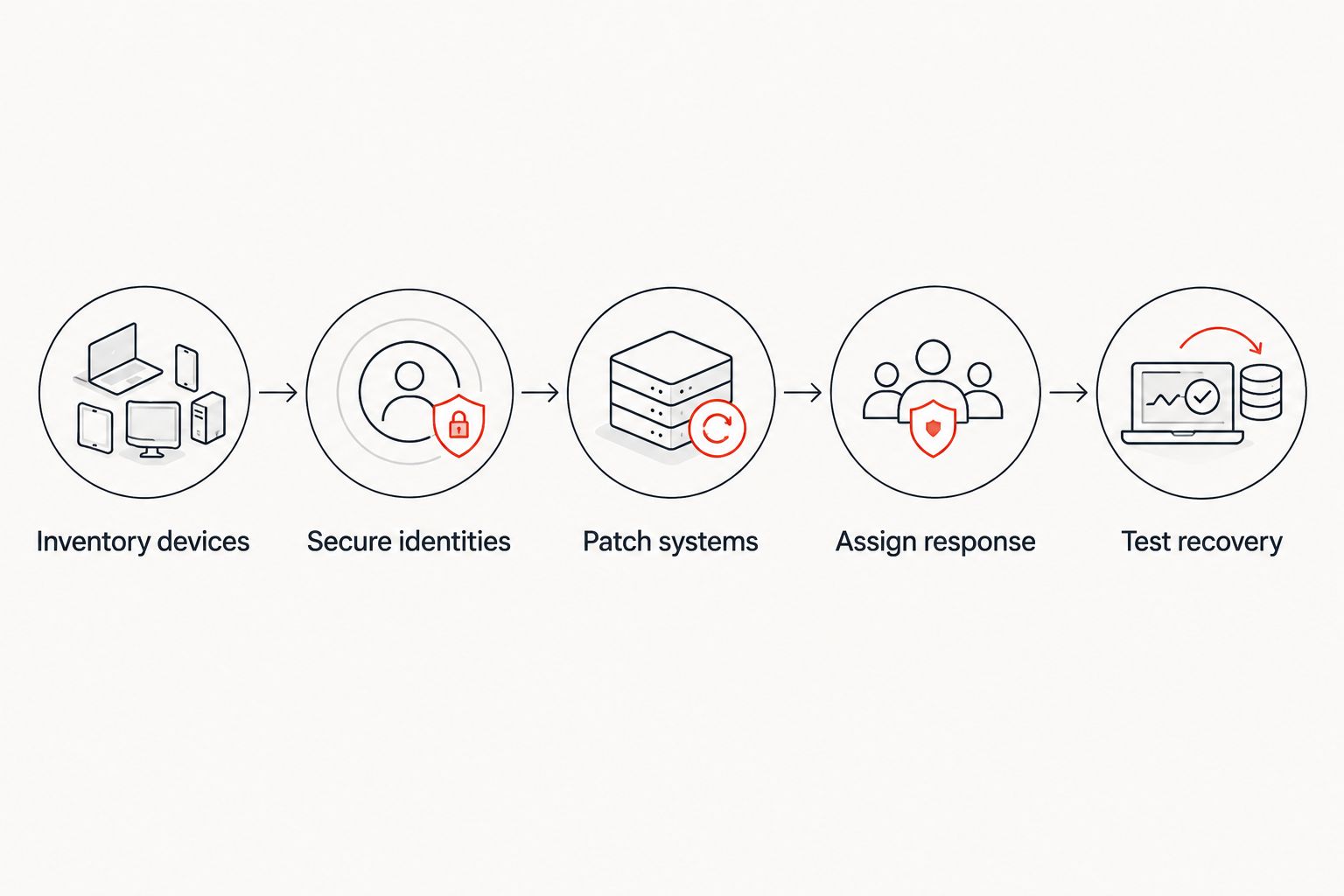
How to build a layered ransomware defense
Build a sequence that connects prevention to recovery. Each step needs an owner and evidence that it works; otherwise, the sequence exists only in a policy document.
- Inventory devices. Reconcile workstations, servers, remote equipment, and critical applications with the systems your security controls actually cover. Investigate missing or inactive agents.
- Secure identities. Apply multifactor authentication where supported, limit administrative privileges, and separate routine work from privileged administration. Review access to backup and security consoles.
- Patch systems. Prioritize exposed services and exploitable weaknesses. Track exceptions with an owner and a remediation decision rather than leaving them indefinitely unresolved.
- Assign response. Define who investigates alerts, who authorizes containment, and how decisions reach business leadership. Include an escalation route outside normal office hours.
- Test recovery. Restore a critical service in a controlled environment, validate its dependencies, and document what prevented normal operation. Correct those gaps before an incident forces the same decisions.
The sequence matters because each layer supports the next. Device inventory establishes visibility; identity controls restrict access; response limits damage; recovery restores operations after the affected environment is understood.
What should you ask a managed security provider?
Ask questions that separate technology installation from operational responsibility. Discovercybersolutions provides managed IT support, endpoint protection, SOC/MDR, penetration testing, and 24/7 incident response for small and mid-sized US businesses. Those service categories are relevant to layered ransomware defense; your agreement still needs to specify their scope.
Use this checklist when evaluating a provider:
- Which endpoints, accounts, applications, and network systems are covered?
- Who investigates an alert rather than simply forwarding it?
- Can responders isolate a device or restrict an account without separate approval?
- What happens when containment interrupts a critical business application?
- Who owns backup security, restoration testing, and recovery coordination?
- What incident records will leadership receive, and who tracks unresolved findings?
The advantage of managed services is assigned support and response capacity; the limitation is that responsibilities remain agreement-specific. Do not assume every service category includes every task above. Ask for written boundaries and identify what your internal team must still own.
For a 2026 agreement, distinguish service availability from response commitments. A service operating around the clock does not, by itself, state an acknowledgment deadline, containment deadline, or restoration target.
Is EDR enough if you already have antivirus?
No. EDR improves endpoint investigation and response, but it does not replace identity controls, patching, or recovery planning. Evaluate the combined endpoint configuration so your team understands which control prevents activity, which produces evidence, and who acts on the resulting alerts.
Can backups protect you from a ransomware attack?
The 3-2-1 backup rule supports recovery, not ransomware prevention. Protected, tested backups give you a restoration path, but stolen data and compromised accounts still require incident investigation and containment.
Do you need response coverage outside business hours?
24/7 incident response availability is relevant when your business cannot wait until the next workday to address an attack. Specify who receives the escalation and what they are authorized to do; availability alone does not establish a guaranteed containment time.
FAQ
Can endpoint protection alone stop ransomware?
No. Endpoint protection can block threats on covered devices, but it does not independently secure every identity, application, or recovery system. Combine it with identity controls, patching, monitored response, and protected backups.
Is EDR better than traditional antivirus for ransomware defense?
EDR adds endpoint investigation and response capabilities beyond basic antivirus functions. It still needs correct deployment and someone responsible for investigating alerts, and it does not replace the rest of a ransomware defense.
Do I need MDR if my IT team already manages endpoint protection?
MDR is relevant when your IT team needs additional detection, investigation, or response coverage. Compare your team's responsibilities and availability with the proposed service scope rather than assuming managed endpoint software includes incident response.
What's the best backup approach for ransomware recovery?
Use protected backups with tested restoration procedures and administrative separation from production systems. The 3-2-1 rule provides a redundancy pattern, but access controls and recovery tests determine whether those copies are usable during an incident.
Can ransomware still steal data if encryption is blocked?
Yes. Blocking encryption does not prove that data was not accessed or stolen before the block. Investigate affected accounts, systems, and available logs before declaring the incident resolved.
Does 24/7 monitoring mean an attack will be contained immediately?
No. 24/7 monitoring describes coverage availability, not a guaranteed containment deadline. Your agreement must specify escalation, response authority, and any response commitments.
Does Discovercybersolutions offer more than endpoint protection?
Yes. Discovercybersolutions provides managed IT and cybersecurity services, including SOC/MDR, endpoint protection, penetration testing, and 24/7 incident response for small and mid-sized US businesses. Confirm the coverage and responsibilities included in your agreement.
One last thing
A blocked ransomware process is the start of an investigation, not automatic permission to reconnect everything. Determine whether the attacker used other accounts, reached shared systems, or changed access before the endpoint control intervened.
For your next security review, request an end-to-end demonstration: an alert reaches the responsible team, an authorized person makes a containment decision, and a critical service is restored from a protected backup. That exercise exposes the handoffs an endpoint dashboard cannot show.


