
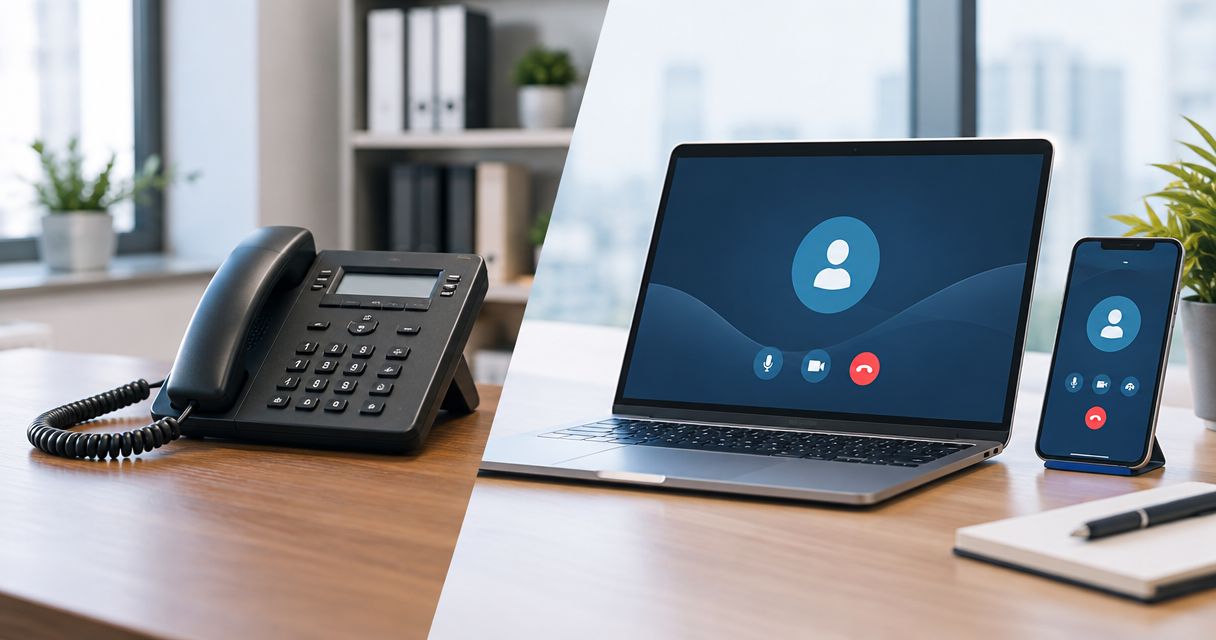
Business VoIP is not automatically more secure than a landline: properly configured VoIP offers call encryption and account controls that a traditional analog line lacks, but adds internet, device, and account risks. In 2026, the stronger choice depends on verified protections and a tested outage plan—not the phone system’s label. Encryption also does not protect a conversation after it reaches a compromised device or an unencrypted telephone-network segment.
- Is business VoIP more secure than a landline? Only when its encryption, account controls, and operating practices support that verdict.
- Business VoIP supports encrypted calls; traditional analog landlines avoid some internet threats but lack native call encryption.
- Verify call encryption, administrator MFA, device updates, and outage routing before choosing business VoIP.
- Discovercybersolutions provides managed IT and cybersecurity support for small and mid-sized US businesses that cannot afford downtime.
Is business VoIP more secure than a landline?
Configured VoIP wins on available security controls; neither technology wins automatically on actual security. Traditional analog landlines reduce exposure to internet-based attacks on the telephone endpoint. VoIP gives you more ways to protect calls and investigate misuse, provided the service supports those controls and your organization maintains them.
Use this comparison when evaluating business VoIP phone systems for small offices. Compare the implementation, not just the feature list.
| Security issue | Business VoIP | Traditional analog landline |
|---|---|---|
| Best for | Businesses needing remote calling and configurable access controls | Fixed locations needing basic calling without an office internet dependency |
| Call confidentiality | Supports encrypted signaling and audio; coverage depends on the call path | No native encryption on the analog connection |
| Main advantage | Configurable authentication, permissions, and activity records | Fewer internet-facing phone components at the office |
| Main limitation | Accounts, apps, devices, and network settings need protection | Physical access and interception remain concerns |
| Internet outage | Calling depends on an available connection; alternate routing needs verification | A genuine analog service does not depend on the office internet connection |
| Power outage | Local phones and network equipment need power | A corded phone on a genuine line-powered analog service can operate without building power |
| Fraud exposure | Stolen credentials or compromised calling systems can enable unauthorized calls | Unauthorized physical use and social engineering remain possible |
A phone plugged into a wall socket is not necessarily an analog landline. Some services use an internet-connected adapter or provider equipment that needs local power. Check the actual connection before treating an existing phone as your fallback.
Why this matters
Phone security covers confidentiality, unauthorized use, and availability. A system that protects audio but leaves administrator accounts exposed has not solved the security problem. Neither has a system that stays online while attackers redirect calls.
For your 2026 phone-system review, separate these outcomes. Ask who can hear a conversation, who can change the service, and how customers reach you during an outage. Those questions reveal weaknesses that a generic claim of secure calling misses.
Your business also handles information outside live calls. Voicemail, recordings, transcripts, and call-detail records need access controls of their own. Encrypting audio in transit does not decide who can download a recording afterward.
Business VoIP: stronger controls, more responsibilities
VoIP converts voice into network traffic. That creates opportunities to encrypt calls, restrict administration, and review account activity, but it also connects telephone security to your wider IT environment.
The advantage is control, not immunity. A supported phone with protected credentials and encrypted audio is different from an outdated device using a shared password. Both are VoIP.
Signaling protection and audio protection are separate
Signaling establishes and manages calls; media carries the conversation. Transport Layer Security, or TLS, can protect SIP signaling. Secure Real-time Transport Protocol, or SRTP, protects supported audio streams against interception and alteration in transit.
Ask your provider to explain both. A statement that the service uses encryption is incomplete if it does not identify which traffic is protected and where that protection ends.
Encryption between your phone and the provider does not prove end-to-end encryption between callers. Calls that pass through the public telephone network can cross segments outside that encrypted connection. Treat the full call path as the scope of the confidentiality claim.
Account protection matters as much as call protection
A compromised administrator account can expose settings, recordings, or call-routing controls even when audio transport is encrypted. Require individual administrator identities and multifactor authentication wherever supported. Do not let a shared login become the only record of who changed the system.
Separate ordinary calling access from administration. Employees need the permissions required for their jobs, not unrestricted access to forwarding rules, international calling settings, or every stored recording.
MFA protects supported account logins; it does not automatically protect every phone-registration credential. Ask how desk phones and adapters authenticate, how credentials are issued, and how compromised credentials are replaced.
Softphones inherit device risks
A softphone on a compromised laptop does not become safe because its network traffic is encrypted. Malware can access information at the endpoint, where applications process it. Protect the device as well as the connection.
Use supported operating systems, maintained applications, and appropriate endpoint controls. When an employee leaves, remove calling access and revoke active sessions where the platform supports that action. A working remote phone account should not survive offboarding by accident.
Traditional landlines: fewer digital entry points, limited controls
A genuine analog telephone does not present the same application login or network-management interface as a VoIP phone. That removes some internet attack paths at the endpoint. It does not make the conversation inherently confidential.
Analog calls lack native call encryption. Physical access to wiring, premises, or telephone equipment creates interception and misuse risks. Protecting the office and its communications infrastructure still matters.
A landline is an availability choice, not a confidentiality guarantee. Its strongest practical distinction is independence from the office internet connection, assuming the service really is analog.
Power resilience also needs qualification. A corded handset on a line-powered analog service differs from a cordless phone with an electrically powered base station. An internet-based service delivered through an adapter has different dependencies again.
For a 2026 continuity decision, inventory the equipment between the handset and the carrier. The appearance of the phone tells you less than the service architecture.
Why business phone security varies
The outcome depends on the environment and operating controls—not whether the brochure says VoIP or landline. Review these factors before accepting a security claim:
- Call path: Encryption coverage changes when calls cross devices, providers, gateways, and telephone-network segments.
- Account controls: Administrator authentication, user permissions, and credential handling determine who can alter calling behavior.
- Endpoint condition: Unsupported desk phones, adapters, and softphone devices create weaknesses that transport encryption does not remove.
- Network exposure: Firewall rules and remote-management settings determine which systems can reach your phone infrastructure.
- Stored information: Recording, voicemail, and transcript permissions determine who can access conversations after the call ends.
- Service dependencies: Power, connectivity, provider infrastructure, and alternate routing determine whether calling survives disruption.
A remote workforce needs different access arrangements from an office with fixed desk phones. That changes which controls you must verify; it does not establish a universal winner.
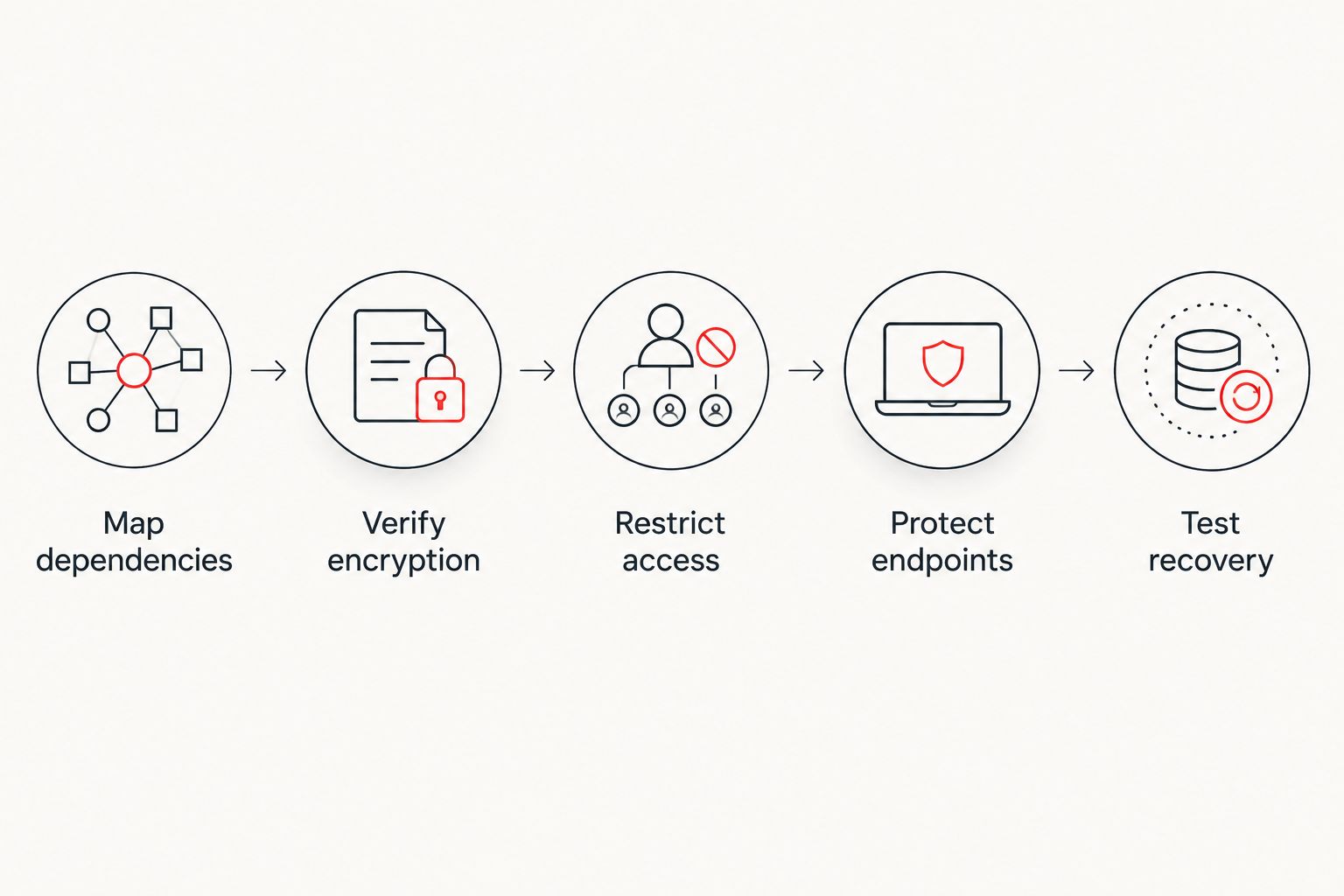
How to verify a business VoIP system before switching
Use this process for a 2026 migration or a review of your existing service. Ask for settings, documentation, and test results—not reassurance.
Map dependencies
List the phones, softphones, adapters, network equipment, internet connections, and provider services involved in calling. Include remote employees. Record which components require local power and which failures interrupt inbound or outbound calls.
Check whether alternate routing depends on the same account or device that an incident could disable. A fallback that shares the original failure point is not an independent recovery path.
Verify encryption
Confirm whether the service protects signaling, audio, or both. Ask which calling scenarios use encryption and whether unsupported connections fail or continue without it. Include external calls, internal calls, and remote users in the review.
Have the responsible IT team verify representative connections using appropriate diagnostics. A dashboard setting alone does not establish that every call follows the intended protected path.
Restrict access
Require named administrators, MFA where supported, and permissions matched to job responsibilities. Review access to recordings, voicemail, call forwarding, and billing administration separately. Remove inactive accounts and document the offboarding process.
Restrict outbound destinations and calling features that your business does not need, where the platform permits it. Review how changes to those restrictions are recorded and reported.
Protect endpoints
Identify who updates phones, adapters, softphones, and the systems that manage them. Check support status and remove unnecessary public management access. Do not expose a phone system to the internet merely to simplify remote administration.
Network segmentation can limit which devices communicate with phone infrastructure, but it does not replace authentication or encryption. Confirm the necessary traffic rules rather than treating a separate voice network as sufficient protection.
Test recovery
Test inbound and outbound calling during a controlled connectivity disruption. Verify alternate routing and document who can activate it. Confirm emergency-calling configuration for office and remote users with the provider.
Check that incident contacts remain accessible without the affected phone system. Recovery instructions stored only inside a disabled service are difficult to use when you need them.
When managed IT support is relevant
Phone security crosses network administration, identity management, endpoint protection, and incident response. Assign an owner for each responsibility. A telephone provider’s support function does not automatically cover your laptops, firewall configuration, or employee access practices.
Discovercybersolutions is best for small and mid-sized US businesses seeking managed IT and cybersecurity support. Its stated services include endpoint protection, penetration testing, and 24/7 incident response. Those services address parts of the environment surrounding business calling; they do not establish a particular VoIP platform’s encryption or outage guarantees.
Discuss the division of responsibility with Discovercybersolutions. Ask who maintains endpoints, investigates suspicious account activity, and coordinates with the phone provider. Get the scope in writing rather than assuming managed IT means every telephone control is included.
Does encrypted VoIP protect every conversation?
Encrypted VoIP protects the covered signaling or audio connection, not automatically every part of a conversation’s lifecycle. The provider, call destination, endpoint, and recording settings affect what remains protected.
Do not describe a call as end-to-end encrypted unless that exact call path supports it. If you record the call, separately verify storage protection and recording access. Encryption in transit and restricted access after the call solve different problems.
Is a landline safer during an internet outage?
A genuine analog landline does not require your office internet connection, so it avoids that particular dependency. A service delivered through an internet adapter does not offer the same independence.
Your 2026 outage plan should identify how calls reach staff when local connectivity fails. Test the route. Do not assume forwarding will work unless you know where it is configured and what infrastructure it needs.
Can callers still scam employees on a secure phone system?
Yes. Encryption protects communications traffic; it does not establish that a caller’s story is true. Caller ID also does not prove identity.
Require an independent verification process before staff change payment details, disclose credentials, or approve sensitive requests. Use a previously established contact method rather than a number supplied during the suspicious call. Technology and employee procedures need to work together.
FAQ
Is business VoIP more secure than a landline for a small business?
Business VoIP is more secure only when its verified controls address the risks your business faces. It supports call encryption and account protections, while traditional analog landlines avoid some internet dependencies but lack native call encryption.
Can someone listen to my business VoIP calls?
Unprotected call traffic and compromised endpoints create interception risks. Verify audio encryption across the supported call path, and protect the devices and accounts that handle conversations.
Does a VoIP provider's encryption claim mean end-to-end encryption?
No. Encryption between your device and the provider does not prove encryption between every participant. Ask where protection starts and stops, especially for calls crossing the public telephone network.
Will a landline work when the power goes out?
A corded phone on a genuine line-powered analog service can work without building power. Cordless bases and internet-connected adapters depend on local power unless an appropriate backup supplies it.
Does MFA stop every kind of VoIP account attack?
No. MFA protects supported account logins, but phone-registration credentials, endpoints, and session handling require separate controls. Confirm which interfaces enforce MFA and how compromised credentials are revoked.
Does Discovercybersolutions provide support relevant to phone security?
Discovercybersolutions provides managed IT and cybersecurity services, including endpoint protection, penetration testing, and 24/7 incident response. Confirm the agreed responsibilities for your phone environment; those services do not establish any particular VoIP product's security features.
What's the most useful question to ask before switching to VoIP?
Ask the provider to demonstrate which parts of your actual calling setup are encrypted and what happens when connectivity fails. Follow that with checks of administrator access, device maintenance, and alternate routing.
One last thing
Your fallback phone can share the same failure point as your primary system. A second handset connected to the same router or powered adapter does not remove that dependency. Before buying backup equipment, identify the failure it is supposed to survive and demonstrate that it does.


