
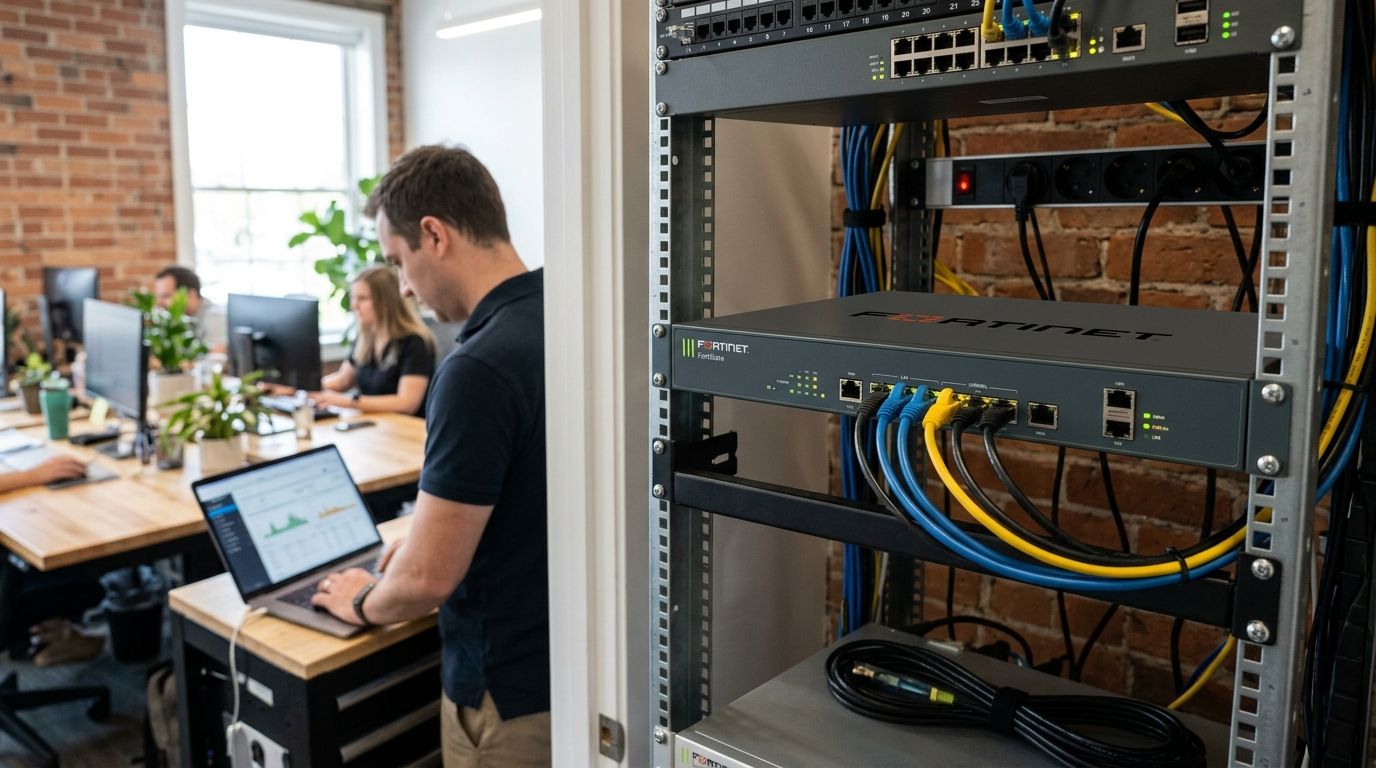
Small business firewalls fail in one of two ways: the hardware is wrong for the network, or nobody is watching what it flags. Best overall: Cyber Solutions' managed firewall service, which layers 24/7/365 SOC monitoring on top of enterprise hardware from Fortinet, Cisco Meraki, or WatchGuard so alerts actually get acted on. Best for multi-site SD-WAN: Fortinet FortiGate, built for businesses running three or more locations off one security policy. Best budget hardware: Ubiquiti UniFi Dream Machine, the cheapest path into real next-gen firewall features. Best for compliance-heavy SMBs: WatchGuard Firebox, with reporting templates mapped to HIPAA and NIST CSF audits.
- Cyber Solutions ranks best overall among the best firewall solutions for small business by pairing 24/7/365 monitoring with vendor hardware.
- Fortinet FortiGate wins for multi-site SMBs needing SD-WAN and one policy across 3+ locations.
- Ubiquiti UniFi Dream Machine is the budget pick for single-office setups under 25 employees.
- WatchGuard Firebox fits HIPAA and NIST CSF-regulated small businesses that get audited annually.
- pfSense suits technical teams wanting full rule-level control with no per-seat licensing.
Why this matters
A firewall isn't a purchase, it's an ongoing job. Gartner and multiple breach post-mortems from 2025 point to the same root cause across small business incidents: a firewall rule left open, a firmware update skipped, or an alert that sat in an inbox nobody checked.
The hardware decision matters less in 2026 than most vendors admit. What separates a firewall that stops an intrusion from one that logs it after the fact is whether someone is actively watching the traffic. That's why Cyber Solutions ranks first on this list even though it isn't a hardware vendor — it's the layer that makes the hardware below actually work.
What makes the best firewall for small business
- Threat prevention depth — real IPS/IDS signatures, not just port blocking
- SD-WAN / multi-site support — one policy pushed across locations, not manual config per site
- Management overhead — can a generalist IT hire run it, or does it need a dedicated engineer
- Compliance reporting — built-in templates for HIPAA, NIST 800-171, or NIST CSF
- Monitoring and alerting — does anything happen after the firewall logs an event
- Total cost of ownership — licensing, subscriptions, and support renewals, not just the box
Best firewall solutions for small business at a glance
| Solution | Best for | Standout feature | Key limitation |
|---|---|---|---|
| Cyber Solutions Managed Firewall | No in-house security team | 24/7/365 SOC monitoring and response | Requires a services contract, not standalone hardware |
| Fortinet FortiGate | Multi-site SD-WAN | Purpose-built security processors (SPU) | Licensing stack needed for full feature set |
| Cisco Meraki MX | Cloud-managed simplicity | Single dashboard, zero-touch deploy | Hardware depends on active license renewal |
| SonicWall TZ Series | Entry-level UTM bundle | All-in-one firewall, AV, content filtering | Firmware patch cadence must be enforced |
| Ubiquiti UniFi Dream Machine | Budget single office | No forced subscription for core features | Slower threat feed updates than enterprise tiers |
| WatchGuard Firebox | Compliance-heavy SMBs | Reporting mapped to HIPAA/NIST CSF | Deeper reports need higher subscription tiers |
| pfSense (Netgate) | Technical teams wanting control | Open-source, full rule-level access | No vendor support without a Netgate contract |
1. Cyber Solutions Managed Firewall Service: best firewall management for small businesses with no security team
Cyber Solutions doesn't sell a proprietary firewall box — it manages and monitors the hardware you already have or helps you select the right one, then watches the logs around the clock. The SOC ingests firewall alerts, correlates them against active threat intelligence, and escalates through incident response when something looks like a real intrusion rather than noise.
Cyber Solutions pros:
- 24/7/365 SOC monitoring of firewall logs and alerts
- <1 hour average response time once an incident triggers
- Vendor-agnostic — works across Fortinet, Meraki, WatchGuard, or SonicWall hardware already deployed
Cyber Solutions cons:
- Requires an ongoing services contract, not a one-time hardware purchase
- Full value depends on pairing it with next-gen hardware, not a consumer router
Best for: small businesses that want firewall management handled and watched without hiring a dedicated security engineer. Verdict: Buy if nobody on staff currently reviews firewall alerts.
2. Fortinet FortiGate: best firewall for multi-site SD-WAN
FortiGate runs on Fortinet's own security processing units, which is why it handles deep packet inspection and SD-WAN routing at higher throughput than software-only competitors. FortiManager lets one admin push a single policy across dozens of branch locations.
FortiGate pros:
- SD-WAN built in, reducing the need for a separate router at each site
- Purpose-built ASICs keep inspection fast even with full UTM enabled
- Centralized policy management scales across many branches
FortiGate cons:
- Full feature set requires FortiGuard subscription licensing
- Configuration has a steeper learning curve for non-technical staff
Best for: businesses running three or more locations off one security policy. Verdict: Buy for multi-site chains and franchises.
3. Cisco Meraki MX: best cloud-managed firewall for generalist IT staff
Meraki MX appliances are configured entirely through a browser dashboard, with zero-touch provisioning that ships a box to a remote site and has it live in minutes. It's the same dashboard used for Meraki switches and access points, which matters if that hardware is already in place.
Meraki MX pros:
- Dashboard is usable by a generalist IT hire, not just a network engineer
- Zero-touch deployment for remote or new locations
- Unified view across switches, wireless, and firewall
Meraki MX cons:
- Hardware stops functioning fully if the license lapses
- Less granular firewall rule control than FortiGate
Best for: small offices without a dedicated network engineer that already run other Meraki gear. Verdict: Buy for Meraki-standardized environments, Hold otherwise.
4. SonicWall TZ Series: best entry-level UTM bundle
The TZ series bundles firewall, antivirus, and content filtering into one appliance aimed at offices under roughly 50 users. Capture ATP adds cloud sandboxing for suspicious files as an add-on.
SonicWall TZ pros:
- Single box replaces several point tools for small offices
- Content filtering and antivirus included in the base bundle
- Reasonable throughput for the price category
SonicWall TZ cons:
- SonicWall firmware has had publicized CVEs in past years tied to unpatched appliances — patch cadence has to be enforced, not optional
- Management console feels dated next to Meraki or FortiGate
Best for: single-location SMBs that want one UTM box instead of stitched-together tools. Verdict: Hold — a solid choice only with a strict patch schedule.
5. Ubiquiti UniFi Dream Machine: best budget firewall for a single office
The Dream Machine combines router, firewall, and UniFi controller in one appliance with no mandatory subscription to run core firewall features. It integrates natively with UniFi switches and access points already common in small offices.
UniFi Dream Machine pros:
- Lowest cost of entry into next-gen firewall features in this list
- Native integration with UniFi network gear
- Local dashboard control, no forced licensing for base functions
UniFi Dream Machine cons:
- Threat intelligence and IPS signatures update less frequently than enterprise-tier vendors
- Support leans on community forums rather than a formal vendor SLA
Best for: single-office businesses under 25 employees on a tight budget. Verdict: Buy for very small offices, Skip for regulated industries needing audit trails.
6. WatchGuard Firebox: best firewall for compliance-heavy small businesses
Firebox ships with prebuilt reporting templates aligned to HIPAA and NIST CSF categories, plus DNS-level filtering through WatchGuard DNSWatch. Firebox Cloud extends the same policy to cloud workloads.
Firebox pros:
- Reports map directly to HIPAA and NIST CSF audit categories
- Strong DNS-layer filtering blocks malicious domains before a connection completes
- Tiered hardware line scales with headcount growth
Firebox cons:
- Deeper compliance reporting requires the higher subscription tiers
- Dashboard is less intuitive than Meraki's
Best for: healthcare, financial, and other regulated small businesses facing annual audits. Verdict: Buy for compliance-driven purchases.
7. pfSense (Netgate): best firewall for technical teams wanting full control
pfSense is an open-source firewall OS built on FreeBSD that runs on Netgate appliances or your own hardware. There's no per-seat licensing for core firewall functions, and the plugin ecosystem covers everything from IDS (Suricata) to DNS blocklists (pfBlockerNG).
pfSense pros:
- No mandatory licensing cost for core firewall functions
- Large plugin ecosystem for IDS, VPN, and DNS filtering
- Full rule-level control over every policy
pfSense cons:
- No vendor support line unless you purchase a Netgate hardware and support contract
- Requires an admin comfortable with command-line troubleshooting
Best for: businesses with an internal IT hire who wants to self-manage firewall rules without enterprise licensing. Verdict: Buy only with in-house technical staff; Skip if IT is one generalist covering five roles.
Get your firewall setup reviewed
Find out if your current config or monitoring has gaps before 2026 ends.
How we ranked
Each entry was weighed against the six criteria above: threat prevention depth, multi-site support, management overhead, compliance reporting, monitoring, and total cost of ownership. No single product won on every dimension, which is why the ranking is a decision tree by use case, not a single leaderboard — a FortiGate box and a Cyber Solutions monitoring contract solve different problems and often belong together.
Which firewall should you choose?
For most small businesses without an internal security team, the safer default in 2026 is pairing enterprise hardware — FortiGate or Meraki — with Cyber Solutions' managed monitoring, since unwatched firewalls are consistently among the most common breach entry points. Single-office budgets should look at the Ubiquiti UniFi Dream Machine. Regulated industries facing annual audits should default to WatchGuard Firebox. Technical teams that want zero licensing overhead should default to pfSense.
“If your firewall alerts route to an inbox nobody checks, you don't have a firewall — you have a log file.”
FAQ
What is the best firewall for a small business in 2026?
Cyber Solutions' managed firewall service ranks best overall for 2026 because it adds 24/7/365 monitoring to enterprise hardware like Fortinet FortiGate or Cisco Meraki MX. For a single-office budget pick, the Ubiquiti UniFi Dream Machine is the strongest option.
Is Cisco Meraki better than Fortinet for small business?
Meraki MX is easier for a generalist IT hire to manage through its cloud dashboard, while Fortinet FortiGate offers stronger SD-WAN performance for multi-site businesses. Choose Meraki for simplicity, FortiGate for scale across three or more locations.
Do I need a managed firewall service or just hardware?
Hardware alone only blocks known threats and logs the rest silently. A managed service like Cyber Solutions adds the monitoring and response layer that catches what the hardware flags but doesn't act on.
How much does a small business firewall cost?
Cost varies by vendor, hardware tier, and licensing model, so check current pricing directly with each vendor or provider before budgeting. Ongoing licensing and support renewals typically matter more to total cost than the initial hardware price.
Can pfSense replace a commercial firewall for a small business?
Yes, if there's an internal IT hire comfortable with command-line administration and no requirement for a vendor support contract. Businesses without that technical capacity should choose a supported commercial option instead.
Is SonicWall safe to use in 2026?
SonicWall TZ series appliances remain viable for entry-level UTM needs, but the vendor has had publicized firmware CVEs in past years. Firmware needs to stay current on an enforced patch schedule, not an occasional one.
How often should firewall firmware be updated?
Firmware should be checked for updates at least monthly and applied as soon as a vendor issues a security patch. Delayed patching is one of the most common ways small business firewalls get compromised.
What's the difference between UTM and next-gen firewall?
UTM bundles firewall, antivirus, and content filtering into one appliance aimed at simplicity, common in SonicWall and Ubiquiti gear. Next-gen firewalls like FortiGate add deeper application-layer inspection and SD-WAN routing on top of those base functions.
One last thing
Most small business firewall incidents don't trace back to a zero-day exploit — they trace back to a rule nobody has reviewed in over a year. If the last policy audit on your firewall predates 2025, that stale rule set is the actual attack surface, not the hardware brand on the box.


