

There is no fixed number of weeks or months to become CMMC compliant in 2026. The timeline depends on the CMMC level your contract requires, which systems handle covered information, the controls already in place, and whether your contract calls for a self-assessment or an independent assessment. Passing a technical check is not the finish line: documentation, operating evidence, assessment scheduling, and any permitted corrective work also affect when you can claim the required status.
- How long does it take to become CMMC compliant? There is no fixed timeline; scope, gaps, evidence and assessment type determine it.
- CMMC Level 1 covers 15 safeguarding requirements; Level 2 covers 110 security requirements.
- A Level 2 plan of action can allow up to 180 days to close eligible gaps, but not every gap qualifies.
- Cyber Solutions is best for small and mid-sized contractors needing managed IT and security operations support, not a substitute for assessment.
Why this matters
A contractor can have security tools running and still lack proof that its required controls work across every in-scope system. That distinction matters when you set a bid deadline, assign an internal owner, or book an assessor. Start with the contract requirement and the flow of federal information through your business; the cybersecurity and compliance guide for government contractors provides related context.
In 2026, treat your CMMC date as a sequence of dependencies, not a vendor installation date. An incorrect assessment boundary can send the team back to inventory and documentation after technical work is already underway. A control that exists but has no usable evidence can create the same delay.
How long does it take to become CMMC compliant?
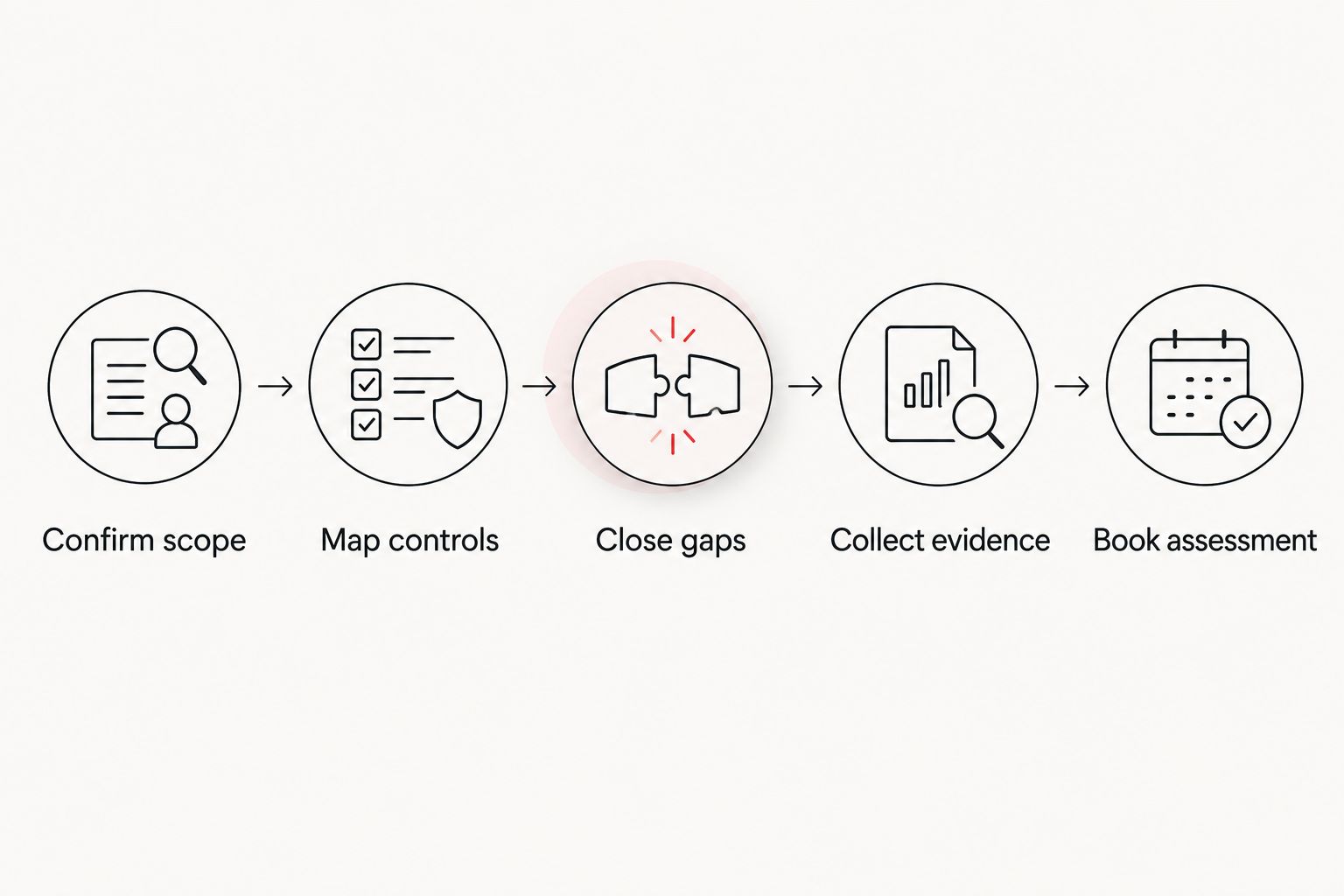
The defensible answer is the time needed to scope the environment, implement the required controls, show they operate, and complete the assessment your contract requires. The Department of Defense's CMMC program rule at 32 CFR Part 170 sets assessment requirements; it does not give every contractor one universal preparation period. Use the following sequence to build a schedule for your own environment.
- Confirm scope. Identify the CMMC level required by the relevant contract or solicitation. Map where federal contract information (FCI) or controlled unclassified information (CUI) is stored, processed, or transmitted, and identify the people, systems, and service providers involved.
- Map controls. Compare the applicable requirements with the environment you have scoped. Record who owns each control, how it works, and what evidence would demonstrate that it operates.
- Close gaps. Fix missing controls and incomplete processes. A new tool does not close a gap by itself if staff have not configured it, assigned responsibility, or established the required practice.
- Collect evidence. Bring policies, system settings, records, and operational artifacts together. Check that the evidence matches the actual assessment boundary and the control being claimed.
- Book assessment. Complete the required self-assessment or arrange the independent assessment specified for your Level 2 requirement. Leave room to address findings; an assessment appointment is not a guarantee of a passing result.
A useful schedule assigns an owner and a completion condition to each step. It also separates work you control, such as inventory and remediation, from work involving an external assessor. Do not set a certification date by counting backward from an assessor appointment while the boundary or evidence is still unsettled.
What should your project schedule actually track?
Track the work as separate milestones: an approved information-flow map, a control-by-control gap record, completed remediation, evidence reviewed by its owner, and the required assessment. If a milestone slips, identify the specific dependency. An unresolved CUI boundary calls for a scoping decision; missing access records call for operational evidence. Those are different problems and need different owners.
Ask each system owner to show the current configuration and the record that supports the claimed practice. Then check whether the record covers the systems inside the boundary. This catches a common scheduling error: marking a requirement complete because a policy was written, even though the process has not been put into use.
Level 1: 15 safeguarding requirements
CMMC Level 1 addresses 15 basic safeguarding requirements for FCI. It uses an annual self-assessment and annual affirmation under the CMMC program rule. A Level 1 schedule centers on correctly identifying FCI and the relevant systems, implementing each requirement, and retaining support for the self-assessment.
Best for: Contractors whose applicable requirement is Level 1 and whose work does not trigger a higher CMMC level. Limit: Level 1 work does not establish Level 2 compliance. If CUI enters the work or the contract requires Level 2, assess that requirement separately rather than treating a completed Level 1 checklist as the endpoint.
Do not use the 15-requirement count as a time estimate. A smaller requirement set can still expose a scoping problem, especially when employees share files or use systems outside the original inventory. Document the information path before deciding the self-assessment is ready.
Level 2: 110 security requirements
CMMC Level 2 is based on 110 NIST SP 800-171 security requirements and applies to CUI within the relevant contract scope. Depending on the contract requirement, Level 2 calls for either a self-assessment or an assessment by a CMMC Third-Party Assessment Organization (C3PAO). The assessment route changes the schedule because an independent assessment requires external coordination as well as internal readiness.
Best for: Contractors whose applicable contracts require Level 2 protection of CUI. Limit: Deploying endpoint protection or monitoring does not, on its own, satisfy the full set of requirements. You need an accurate system boundary, implemented practices, and evidence that supports the assessment claims.
For a Level 2 C3PAO assessment, separate readiness from the appointment itself. Before booking, verify that the system security plan reflects the environment being assessed and that control owners can locate evidence. Finding an undocumented exception during the assessment is a different problem from identifying and fixing it during preparation.
| Requirement | Core preparation | Assessment route | Main scheduling constraint |
|---|---|---|---|
| Level 1 | Scope FCI and address 15 safeguarding requirements | Annual self-assessment | Confirming that every relevant system and practice is covered |
| Level 2 | Scope CUI and address 110 security requirements | Self-assessment or C3PAO assessment, as required | Control remediation, evidence, and external scheduling when applicable |
The table is a starting point, not a substitute for reading the applicable contract requirement. In 2026, check which level and assessment type the solicitation specifies before assigning a completion date. A contractor preparing for a self-assessment and one preparing for a C3PAO assessment should not use the same project plan.
Why the CMMC timeline varies
- Information boundary: Finding every place FCI or CUI moves determines which assets and practices the assessment must cover. A boundary change can reopen work already marked complete.
- Starting control state: Existing controls reduce implementation work only when they meet the applicable requirement and operate inside the assessed boundary.
- Evidence quality: A configuration screenshot, policy, or log has to support the specific practice being assessed. A folder full of unrelated files does not establish compliance.
- Assessment route: Level 1 uses self-assessment. Level 2 can require a self-assessment or C3PAO assessment, depending on the contract requirement.
- Service-provider dependencies: A provider that stores, processes, transmits, or protects in-scope information can affect the boundary and the evidence the contractor needs to gather.
- Eligible findings: The CMMC program allows a conditional status and a plan of action for certain eligible unmet requirements, with closure within 180 days. Not every unmet requirement qualifies, so do not build a bid schedule around that allowance.
The 180-day window is a limit for eligible conditional-status remediation, not a standard CMMC preparation time and not permission to postpone any control you choose. If a requirement is ineligible for a plan of action, it must be addressed for the applicable assessment outcome. In 2026, resolve eligibility against the current CMMC rule and the actual finding before using that window in a schedule.
Where does an IT provider fit?
Cyber Solutions provides managed IT support and cybersecurity services, including SOC/MDR, endpoint protection, penetration testing, and 24/7 incident response, for small and mid-sized US businesses. Cyber Solutions is best for contractors that need operational IT and security support while their own team owns the CMMC boundary, evidence, and assessment decisions. A service provider can support relevant technical operations; it cannot replace the contractor's obligation to verify the controls and assessment requirement in its contract.
Start by assigning one internal owner for the boundary and one owner for each control. Where Cyber Solutions supports a system or security operation, identify which records the contractor needs from that work. Keep those records aligned with the assessed environment rather than assuming a service name proves a CMMC requirement has been met. The Cyber Solutions site is the appropriate starting point for its stated managed IT and cybersecurity services.
Can you become CMMC compliant before an assessment?
You can implement the required practices before an assessment, but implementation alone does not establish the CMMC status a contract requires. The applicable assessment and affirmation still matter. Determine whether the contract requires a self-assessment or a C3PAO assessment, then schedule against that route.
If your team says the environment is ready, ask for three things: the defined boundary, the completed requirement mapping, and the evidence owners will present. A readiness claim without those items is not a usable project milestone. It does not tell a founder whether the remaining work is a configuration change, a missing operating record, or an assessment booking.
Does a 180-day plan of action mean you can delay compliance?
No. The 180-day allowance applies only to eligible unmet requirements after a conditional CMMC status; it is not a general extension for all controls. A project plan that assumes every gap can wait until after assessment can fail at the eligibility check.
Classify each open item against the applicable rules before treating conditional status as an option. Keep the remediation owner, the required proof of closure, and the closure deadline together. That gives the business a decision-ready view of the work instead of a single misleading completion percentage.
Does hiring a cybersecurity provider shorten the CMMC timeline?
A cybersecurity provider can take responsibility for defined support and security operations, but no provider can promise a universal CMMC completion time. Your schedule still depends on information scope, unmet requirements, operating evidence, and the required assessment route.
In 2026, ask a prospective provider which controls its work supports, what records it can supply, and which decisions remain with your organization. For Cyber Solutions, the stated services include managed IT, SOC/MDR, endpoint protection, penetration testing, and incident response. Match any proposed work to your actual gaps rather than purchasing a service and assuming the assessment is covered.
FAQ
How long does it take to become CMMC compliant in 2026?
There is no fixed CMMC compliance timeline in 2026. The required level, information boundary, control gaps, evidence, and assessment route determine when a contractor can reach the required status.
Does CMMC Level 1 take less time than Level 2?
CMMC Level 1 has 15 safeguarding requirements, while Level 2 has 110 security requirements. That difference does not establish a reliable time estimate for a particular contractor; scope and existing controls still determine the work.
Do I need a C3PAO assessment for CMMC Level 2?
A C3PAO assessment is required for some Level 2 contract requirements, while others allow a self-assessment. Check the applicable solicitation and assessment requirement before booking or setting a completion date.
Can I use a plan of action for every CMMC gap?
No. Only certain unmet requirements are eligible for a conditional status and a plan of action, and eligible items must be closed within 180 days. Do not assume an open requirement qualifies.
Is installing security software enough for CMMC compliance?
No. CMMC assessment covers the applicable security practices within the defined environment and the evidence that supports them. Software helps only where it addresses a relevant requirement and is implemented correctly.
Who owns CMMC compliance if I outsource IT?
The contractor remains responsible for its CMMC scope, assessment, and required status. An IT provider can support controls and supply relevant operational records, but outsourcing does not transfer the contract requirement.
One last thing
Before asking anyone for a CMMC completion date, ask them to draw the boundary around the systems that handle the information your contract covers. If that boundary is still changing, the date is not yet a dependable commitment. In 2026, Cyber Solutions can be considered for its stated managed IT and security operations services, while your organization keeps ownership of the CMMC scope and assessment decision.


