

Instead of manually screenshotting quiz-completion reports every quarter and stitching together an audit binder by hand, connect your security awareness training platform to an automated evidence pipeline so completion logs, phishing test scores, and policy attestations land in your compliance record the moment they happen.
- Automating security awareness training compliance evidence cuts audit prep from days to under an hour.
- KnowBe4, Proofpoint, and Ninjio completion logs sync to a compliance repository via webhook or API, no manual export needed.
- Auditors reject undated, unsigned training logs more than any other single artifact in 2026 reviews.
- Cyber Solutions builds this pipeline for NIST 800-171, HIPAA, and SOC 2 clients on top of existing training tools.
- A phishing-failure trigger that auto-enrolls remediation training gives you a corrective-action trail, not just a pass rate.
Why this matters
Every major framework (NIST 800-171, HIPAA Security Rule, SOC 2) requires documented, recurring security awareness training as a control, not a one-time checkbox. Auditors don't want a claim that training happened; they want a timestamped, attributable record tied to a named employee and a course version.
Most small and mid-sized businesses run training through a security awareness training platform but keep the proof in a spreadsheet someone updates when they remember. That's the gap auditors flag first, and it's the gap that turns a routine SOC 2 or NIST 800-171 review into a three-week scramble.
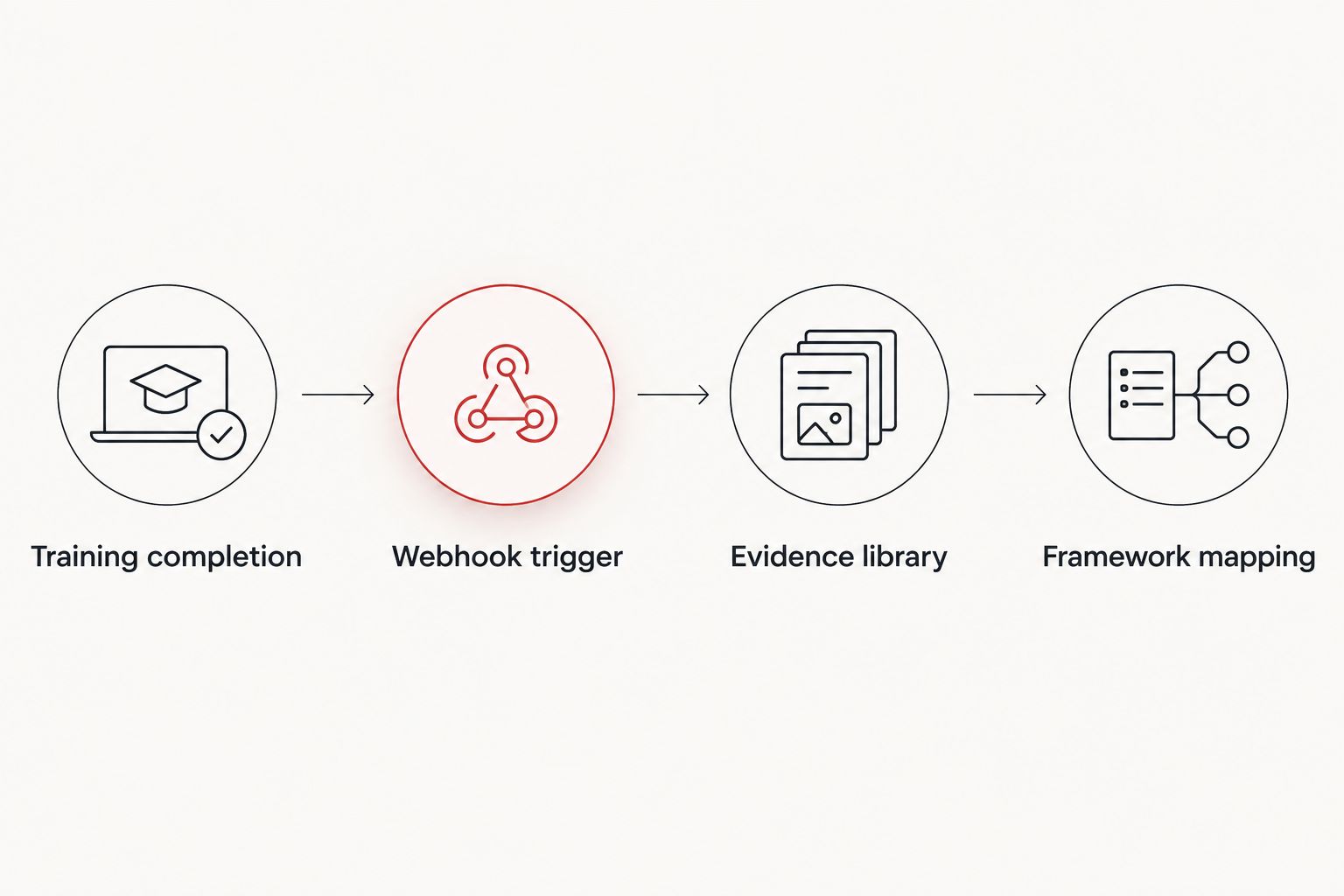
Automating the handoff between training completion and compliance evidence removes the spreadsheet entirely. The training platform fires an event, the event lands in a mapped control, and the evidence is dated and current the day it happens — not the day before the audit.
“If your training evidence lives in a spreadsheet, it isn't evidence, it's a liability waiting for an auditor to find it.”
Before you start
- Admin access to your training platform (KnowBe4, Proofpoint Security Awareness, Ninjio, or similar) with API or webhook permissions enabled — most platforms gate this behind an admin or owner role.
- A compliance evidence repository — a GRC tool like Secureframe or a comparable platform, or at minimum an access-controlled folder structure that accepts automated uploads.
- The gotcha: most training platforms only retain completion logs for 12-24 months by default. Set retention to match your longest compliance lookback window (three years for many SOC 2 and NIST 800-171 requirements) before you run the first sync, not after an auditor asks for a history you no longer have.
Set up your training platform's completion trigger
- In your training platform's admin console, go to Reports and open Automation (some platforms label this Integrations).
- Create a trigger for Training Completed and a separate trigger for Phishing Simulation Result.
- Set both triggers to fire on every individual completion, not a weekly digest — batched exports lose the exact timestamp auditors check first.
Expected result: the platform shows an active webhook or API connection with a Connected status and a test event visible in the activity log.
Configure your evidence destination
- In your GRC or compliance tool, open the Evidence Library (or equivalent module) and create a folder or control mapped specifically to security awareness training.
- Under Data Sources, select Add Integration and paste the webhook URL or API key generated in the previous step.
- Map the fields you need: learner name, course title, completion date, quiz score, and policy version acknowledged.
Expected result: a test completion event appears in the evidence library within minutes, timestamped and attributed to a named employee — not a generic "training batch" entry.
Map completions to your compliance framework
- Under Controls or Framework Mapping, tag the training evidence stream to the relevant control — for example, NIST 800-171 control 3.2.1, HIPAA's Security Awareness Training requirement, or SOC 2 control CC1.4.
- Set a freshness rule so any control without a completion logged in the last 12 months flags automatically instead of surfacing silently at audit time.
Expected result: the framework dashboard shows the training control as Evidence current, with a live completion count instead of a static PDF from last year.
Renewal and phishing-failure workflow
A second, adjacent workflow catches the employees who fail rather than pass — and it's the one auditors weigh more heavily, because it shows a corrective-action trail instead of a clean scoreboard.
- Create a second trigger: Phishing Simulation Failed.
- Connect that trigger to auto-enroll the employee in a remediation module inside the same training platform.
- Log the remediation completion under a distinct evidence tag, such as "Remediation — Phishing," separate from routine annual training.
Expected result: any employee who fails a simulation has a documented, dated remediation record in the evidence library within 24-48 hours, with no manual follow-up required.
Let Cyber Solutions build the pipeline
Managed IT and compliance evidence automation for SMBs, done in weeks not quarters.
Troubleshooting
- Completion dates show blank or wrong: the training platform exports in UTC while your GRC tool expects local time. Set the timezone in the integration settings before backfilling records, not after.
- Webhook stops firing after a platform update: API keys frequently expire on contract renewal. Regenerate the key and re-paste it into the GRC integration rather than assuming the old one still works.
- Contractors or temp staff missing from the evidence trail: the sync often pulls only from your primary employee group. Check whether contractors sit in a separate sub-group that isn't included in the trigger.
- Duplicate completion records for one employee: this happens when two platforms both fire for a consolidated account. Single-source each employee to one training platform to stop the duplication.
- Evidence library shows the control as stale despite recent training: the freshness rule may be reading the wrong field — confirm it's checking completion date, not enrollment date.
Customize your workflow
Once training evidence flows automatically, extend the same logic to other controls: incident response drills, penetration test remediation, and endpoint coverage reports can all feed the same evidence library on the same freshness rules. The penetration testing to incident response workflow closes a similar loop for technical findings instead of training completions.
For businesses without a dedicated compliance owner, a fractional security lead can manage the framework mappings and freshness rules without adding headcount — that's typically where a vCISO service earns its cost, by owning the evidence pipeline instead of leaving it to whoever remembers to run the export.
FAQ
What counts as compliance evidence for security awareness training?
Compliance evidence for security awareness training is a timestamped, attributable record showing which employee completed which course and version, plus phishing simulation results. A generic completion percentage without individual attribution does not satisfy most auditors in 2026.
How often does security awareness training need to happen for compliance?
Most frameworks including SOC 2, HIPAA, and NIST 800-171 expect annual training at minimum, with phishing simulations run more frequently. Some auditors flag any control without a completion logged in the past 12 months as stale.
Can I automate compliance evidence without a GRC platform?
Yes, an access-controlled shared folder with a naming convention and automated file drops from your training platform's API can work, though a GRC tool like Secureframe adds framework mapping and freshness alerts automatically.
Is KnowBe4 or Proofpoint better for compliance evidence automation?
Both KnowBe4 and Proofpoint Security Awareness support webhook and API exports suitable for automated evidence pipelines; the better fit depends on your existing GRC tool's native integrations, which is worth checking before choosing either.
What happens if an employee fails a phishing simulation repeatedly?
A well-built workflow auto-enrolls repeat failures in remediation training and logs each remediation completion as separate evidence, giving auditors a documented corrective-action trail rather than just a failing score.
Do contractors need to complete security awareness training too?
Most frameworks require training evidence for anyone with system access, including contractors and temp staff, so their completions need to flow into the same automated pipeline as full-time employees.
How long should training compliance evidence be retained?
Retention should match your longest audit lookback window, often three years for SOC 2 and NIST 800-171 reviews, which exceeds most training platforms' default 12-24 month retention setting.
One last thing
The evidence gap auditors flag most in 2026 isn't missing training, it's missing remediation proof. A clean 98% completion rate means nothing if the 2% who failed a phishing test have no documented follow-up — build the remediation trigger before you worry about the pass-rate dashboard.


