

Cybersecurity for government contractors in 2026 means proving NIST SP 800-171 and CMMC 2.0 compliance before you can bid, not scrambling to fix it after you win the contract. Prime contractors and subcontractors handling Controlled Unclassified Information (CUI) face flow-down clauses, mandatory 72-hour incident reporting, and third-party assessments that most commercial-focused IT vendors have never worked with.
- Cybersecurity for government contractors centers on NIST SP 800-171, CMMC 2.0, and DFARS 252.204-7012 in 2026 -- miss one and you lose bid eligibility.
- CMMC 2.0 Level 2 requires a third-party C3PAO assessment for most contracts touching CUI; Level 1 stays a self-assessment.
- A System Security Plan and a POA&M are required paperwork, not optional extras, for any contractor storing CUI.
- DFARS requires reporting a cyber incident within 72 hours of discovery -- monitoring has to be fast enough to catch it.
- Cyber Solutions runs NIST 800-171 gap assessments and 24/7 incident response for contractors without an internal compliance team.
Why cybersecurity matters for government contractors in 2026
The CMMC 2.0 final rule is phasing into new DoD solicitations through 2028, and by 2026 most primes already require subcontractors to show a completed self-assessment or Level 2 certification before a subcontract gets signed. Miss that step and you're out of the bid pool before price even comes up.
The review at Cyber Solutions covers the same compliance gaps repeatedly: no documented System Security Plan, CUI sitting in unencrypted SharePoint folders, and incident response plans that don't mention the 72-hour DFARS clock at all. None of those are exotic problems. They're paperwork and configuration gaps that show up the moment an assessor asks for evidence.
A missed CMMC assessment doesn't just cost you the current contract -- it flags your SPRS score for every prime evaluating you on the next one. That's the part contractors underestimate until it's already happened.
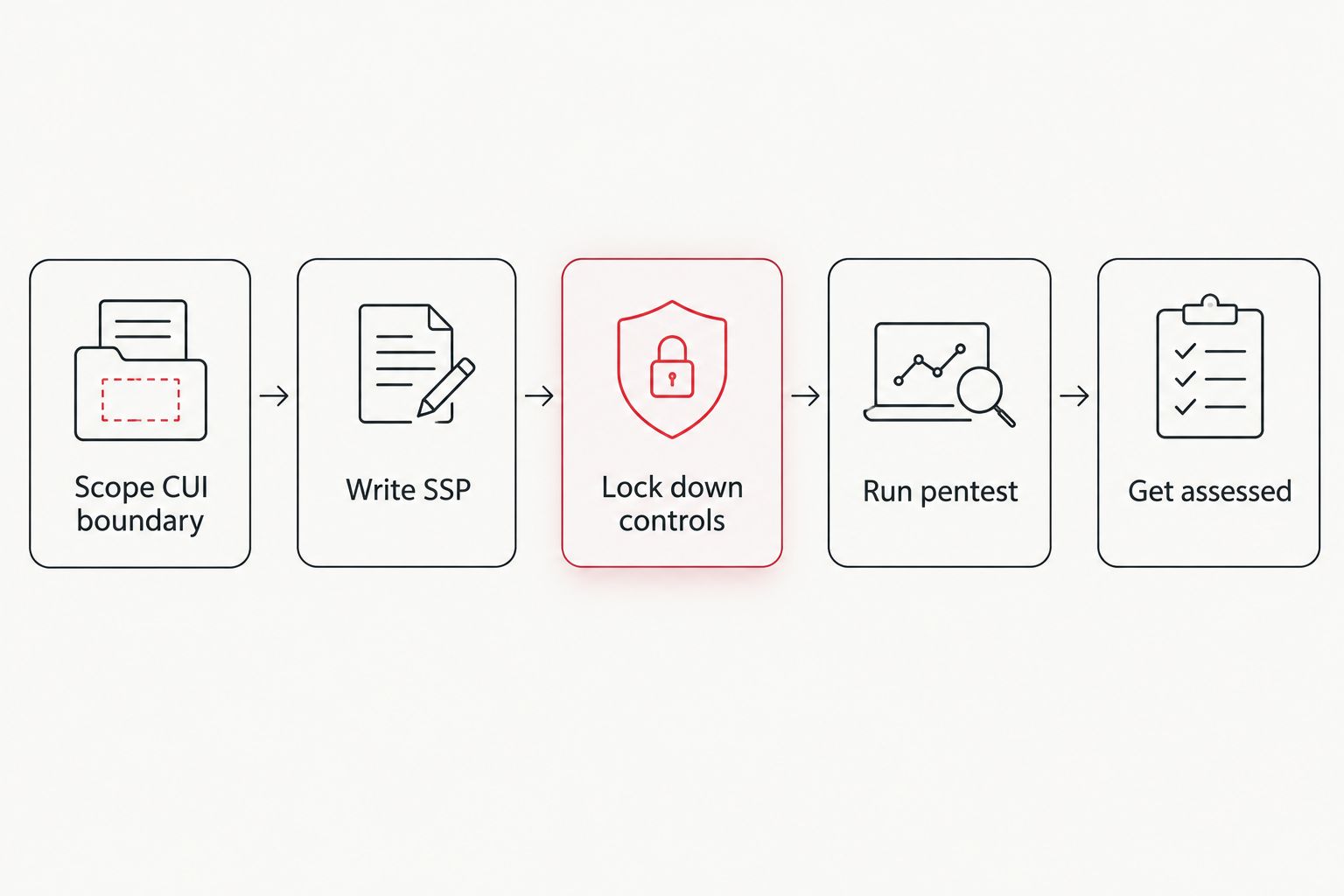
Step 1: Determine which CMMC level applies to your contract
Start with the contract itself, not a generic compliance checklist. Every DoD contract touching CUI carries specific clause language that tells you the scope.
- Check the solicitation for DFARS clause 252.204-7012 and FAR 52.204-21
- Read the statement of work for explicit CUI handling language
- Confirm whether the contract requires Level 1 (self-assessment) or Level 2 (C3PAO-assessed)
- Check SPRS for whether a self-assessment score is already required to bid
- Ask your prime directly what flows down to you as a subcontractor
Step 2: Scope your Controlled Unclassified Information boundary
The boundary decision drives every dollar and every hour you spend after this point. Get it too wide and you're securing systems that never touch CUI; get it too narrow and the assessor rejects the scope.
- Inventory every system, application, and device that touches CUI
- Segment CUI systems onto a separate network segment from general business systems
- Map data flow from ingestion through storage to disposal
- Exclude out-of-scope systems from the assessment boundary explicitly, in writing
- Document the finished boundary in the System Security Plan
Step 3: Write your System Security Plan and POA&M
Many contractors draft the SSP themselves using the NIST SP 800-171A assessment guide, and that's a legitimate path if someone owns it full-time. Where teams stall is turning the SSP into a living document instead of a one-time PDF that never gets updated.
- Document the status of each of the 110 NIST SP 800-171 Rev 2 controls
- Log every unmet control in a Plan of Action and Milestones with a remediation date
- Assign an owner to each open POA&M item, not just a due date
- Update the SSP every time the CUI-boundary architecture changes
- Keep evidence artifacts on file for the assessor, not just a completed checklist
Contractors that need a faster path to a defensible SSP without hiring a dedicated compliance lead can compare options on the NIST 800-171 compliance software and services page.
Step 4: Lock down endpoint, identity, and network controls
This is where most of the actual security spend lands, and it's also where a weak MFA rollout or a flat network turns into a failed assessment.
- Enforce multi-factor authentication on every account with access to CUI
- Deploy endpoint detection and response (EDR) on all in-scope devices
- Encrypt CUI at rest and in transit, not just on laptops that leave the building
- Segment CUI network zones with firewalls and VLANs, verified, not assumed
- Remove local admin rights from end-user machines in the CUI boundary
The firewall and network segmentation choices contractors make here get compared side by side on the firewall solutions for small business networks page.
Step 5: Stand up 24/7 monitoring and incident response
DFARS gives you 72 hours from discovery to report a cyber incident touching CUI. That clock is short enough that after-hours coverage is not optional if you're actually in scope.
- Centralize logs from the CUI boundary into a SIEM, not scattered device logs
- Write an incident response plan that names who reports to DIBNet and when
- Run a tabletop exercise simulating a CUI breach at least once a year
- Designate a single point of contact for DoD incident reporting
- Retain logs for the retention period your contract specifies, not a default 30 days
Contractors weighing whether to build this in-house or hand it to a provider can compare options on the incident response companies for small businesses page.
Get your CUI boundary assessed
Gaps show up at assessment time, not before, unless someone checks first.
Step 6: Run a penetration test before your assessment
A C3PAO assessor checks documentation and control implementation. They don't attack your network the way a real adversary would, which is exactly why a pentest belongs on the calendar before the assessment, not after.
- Test the external attack surface, including VPN and remote access paths
- Test the CUI network segment separately from the rest of the environment
- Confirm segmentation actually holds under active attack, not just on a diagram
- Remediate every finding before the C3PAO shows up, not during the assessment window
- Retest annually or after any major architecture change
Compare firms that specialize in this scope on the penetration testing companies for small businesses page.
Step 7: Train employees who touch CUI
A generic annual phishing video doesn't cover CUI marking rules or the fake-RFQ emails that specifically target government contractors. This step gets skipped or minimized more than any other on the list.
- Cover CUI marking and handling rules specific to your contract type
- Train on phishing patterns that mimic real RFQ and contract correspondence
- Run training on a recurring schedule, not a once-a-year click-through
- Track completion records as evidence for the assessor
- Include subcontractor staff who have access to your in-scope systems
Step 8: Prepare for the C3PAO assessment or self-assessment
Budget weeks for a Level 2 assessment, not days. Contractors that treat this as a quick audit consistently run over their internal timeline.
- Run a mock assessment against the NIST SP 800-171A assessment objectives
- Gather every evidence artifact the assessor is likely to request in advance
- Post your self-assessment score to SPRS before the contract deadline
- Bring in a vCISO to own the process if no one internally can run it full-time
- Plan for weeks of assessor engagement, not a single-day audit
Contractors without a full-time security executive can compare that option on the vCISO services for small and mid-sized businesses page.
Compliance options compared
| Option | Best for | Key limitation |
|---|---|---|
| DIY with the NIST SP 800-171A checklist | Contractors with an internal lead and time to spare | Gaps surface during the real assessment, not before |
| Compliance automation software | Contractors who want a live, SPRS-ready control dashboard | Tracks controls; doesn't remediate them for you |
| MSSP with vCISO for government contractors | Contractors with no internal security team needing monitoring and boundary work handled | Ongoing engagement, not a one-time project |
| National consulting firm | Large primes with dedicated compliance budgets | Slow and costly for a subcontractor under 50 employees |
| C3PAO assessment-prep specialist | Contractors weeks from a scheduled Level 2 assessment | Doesn't cover monitoring or incident response after the audit |
Common mistakes government contractors make
- Treating CMMC as a one-time checkbox. Assessors check evidence over time, not a snapshot taken the week before the audit.
- Storing CUI in unencrypted SharePoint or personal email. The boundary only holds if CUI never leaves it unencrypted.
- Ignoring flow-down clauses to subcontractors. A sub's failed control becomes the prime's liability on the next assessment.
- Underestimating how long a Level 2 assessment takes. Missing the SPRS posting deadline can knock you out of bid eligibility for that cycle.
- No incident response plan mapped to the 72-hour DFARS clock. Discovering a breach and reporting it in time are two different problems.
FAQ
What's the difference between CMMC 2.0 Level 1 and Level 2?
Level 1 is a self-assessment covering basic safeguarding requirements for federal contract information. Level 2 requires a third-party C3PAO assessment against the full 110 NIST SP 800-171 controls for contracts handling CUI.
Is NIST 800-171 the same as CMMC?
No. NIST SP 800-171 is the control set; CMMC 2.0 is the certification framework the DoD uses to verify contractors actually implemented those controls. CMMC Level 2 assessments are scored directly against NIST SP 800-171.
How much does CMMC certification cost for a small contractor in 2026?
Cost depends on assessment scope, boundary size, and whether remediation work is needed first. Get a scoped quote from a C3PAO or a compliance-focused managed provider rather than relying on a flat estimate.
Do subcontractors need CMMC certification too?
Yes, if the subcontract flows down CUI handling requirements from the prime. The specific level required depends on what data the subcontractor actually touches, not just the prime's certification level.
How long does a CMMC Level 2 assessment take?
Plan for weeks, not days, once the C3PAO engagement starts. Preparation -- SSP, POA&M, and remediation -- typically takes far longer than the assessment window itself.
What happens if I don't report a cyber incident within 72 hours?
You're out of compliance with DFARS 252.204-7012, which can affect current contract standing and future eligibility. The 72-hour clock starts at discovery, which is why 24/7 monitoring matters more than after-the-fact review.
Can a managed IT provider handle CMMC compliance for a small government contractor?
Yes, for contractors without an internal security team, an MSSP or vCISO can own the SSP, monitoring, and assessment prep. Confirm the provider has direct NIST SP 800-171 and CMMC experience before signing.
What is a POA&M and do I need one?
A Plan of Action and Milestones documents every unmet NIST SP 800-171 control and the remediation timeline for it. It's required alongside the SSP for any contractor with open control gaps.
One last thing
Most C3PAO assessment failures trace back to step one on this list: a CUI boundary that was scoped wrong before anyone bought a single tool. Fix the boundary documentation first in 2026, then spend on controls -- reversing that order is the single most common reason contractors redo the assessment.


