

Choose Cyber Solutions if your small or mid-sized US business needs managed IT support and cybersecurity from one provider; choose IBM Security if your established security team needs enterprise identity, data-security, or consulting capabilities. This 2026 comparison separates operational support from specialized security capabilities so you can buy the service your team actually needs.
- Cyber solutions vs ibm security comes down to outsourced IT ownership versus specialized enterprise security capabilities.
- Cyber Solutions is the better fit for US small businesses needing managed IT support alongside cybersecurity.
- IBM Security is the better fit for established teams evaluating identity security, data protection, or security consulting.
- Both offer incident-response services; compare containment authority, recovery responsibilities, and contractual coverage before choosing.
Why this matters
Buying security does not automatically buy operational support. An identity platform can control access without fixing a failed workstation, while a managed IT engagement can support users without covering every specialized data-security requirement.
That distinction matters when downtime stops your business. You need to know who investigates the alert, who can disable an account, and who restores the affected system. Those responsibilities belong in the agreement, not in assumptions about the provider's name.
Cyber Solutions is the better fit for small and mid-sized US businesses that need managed IT support alongside cybersecurity. IBM Security is the stronger starting point when you already have operational ownership and need a specific enterprise security capability.
At a glance
| Dimension | Cyber Solutions | IBM Security |
|---|---|---|
| Best for | Small and mid-sized US businesses needing outsourced IT and security support | Established security teams seeking enterprise security products or consulting |
| Managed IT ownership | Managed IT support is part of its stated offering | Evaluate the specific engagement; a security purchase is not a general IT-support contract |
| Standout feature | Managed IT, SOC/MDR, endpoint protection, penetration testing, and incident response in its service portfolio | Specialized identity and data-security capabilities, including IBM Verify and IBM Guardium |
| Specialized security depth | Service-led protection for the business environment | Product-led capabilities for defined enterprise security requirements |
| Incident response | Explicitly offers 24/7 incident-response services | IBM X-Force offers incident-response services |
| Penetration testing | Explicitly included in its service portfolio | IBM X-Force offers offensive security services |
| Implementation ownership | Establish provider and customer responsibilities for the managed-service scope | Establish responsibilities across products, consulting, and internal teams |
| Pricing model | Compare the managed-service scope and separately scoped work in the proposal | Compare product licensing and service engagements for the selected offering |
Treat the table as a shortlist, not a feature checklist. A provider can offer a capability without including it in your agreement. For your 2026 purchase, evaluate the proposed engagement rather than the entire company portfolio.
Cyber Solutions wins when you need managed IT ownership
A business without enough internal IT capacity needs more than security findings. It needs someone responsible for support, maintenance, and the operational work surrounding security incidents. Cyber Solutions explicitly serves small and mid-sized US businesses with managed IT support and cybersecurity services.
That makes the service model a direct match for an owner or operations lead trying to avoid separate support and security handoffs. Your selection criteria should focus on assigned responsibilities: user support, endpoint management, incident escalation, and coordination during an outage.
IBM Security is not a substitute for a general IT-support agreement simply because its portfolio contains security services. If your requirement includes everyday support, ask for that scope explicitly. Do not assume that buying identity protection or incident-response expertise covers workstation troubleshooting.
The tradeoff is contractual dependence. Outsourcing changes who performs the work, but you still need to authorize changes, identify critical applications, and maintain business contacts. A managed provider cannot decide which interrupted workflow matters most without your input.
Best for: a founder or operations lead who needs outsourced IT support and security services. Choose the managed-service route when the immediate problem is an ownership gap, not a missing enterprise product.
IBM Security wins for specialized identity and data-security needs
IBM Security offers distinct product capabilities for identity and data protection. IBM Verify addresses identity and access management; IBM Guardium addresses data security. These are specific security disciplines, not interchangeable labels for general IT support.
That product depth creates a genuine advantage when your internal team has a defined requirement. Examples include governing access across applications or applying security controls around sensitive data. In those situations, evaluate the relevant product against your architecture and control requirements.
The tradeoff is implementation responsibility. A specialized product still needs configuration, integration, administration, and an owner who can act on its output. Purchasing a capability does not eliminate those tasks.
Cyber Solutions lists endpoint protection, SOC/MDR, penetration testing, and incident response in its offering. That is a service-led proposition. Do not treat it as evidence of a like-for-like replacement for every identity or data-security platform.
Best for: an internal security or IT team with a defined identity or data-security requirement. IBM Security wins this dimension when specialized capabilities are the buying objective rather than outsourced operational support.
Both offer incident response; authority decides the fit
Both providers offer incident-response services. Cyber Solutions explicitly states 24/7 incident response, and IBM X-Force provides incident-response services. Neither fact alone determines who is better for your particular emergency.
Availability and response speed are different measurements. Coverage across 24 hours per day and 7 days per week describes when a service operates; it does not establish how quickly someone acknowledges your call or contains a compromised account. Compare those commitments separately.
For a 2026 incident-response agreement, require plain answers to these questions:
- Who receives the initial report and decides severity?
- Who can isolate endpoints or disable compromised accounts?
- Which actions require your approval?
- Who preserves evidence and documents the incident?
- Who restores systems and verifies business operations?
- Who coordinates with legal counsel and your insurer?
This is a capability tie, not a response-time tie. Select the engagement with the right authority and recovery scope. An investigator who identifies the attack and an operator who restores your systems perform different jobs; your plan needs both responsibilities assigned.
Both support security testing; remediation makes it useful
Cyber Solutions offers penetration testing. IBM X-Force offers offensive security services. Both belong on a shortlist when you need to assess whether an attacker can exploit weaknesses in your environment.
The useful comparison is the testing scope. Specify the systems, accounts, applications, and attack paths to be assessed. Also define the rules of engagement so authorized testing does not conflict with business operations or third-party obligations.
A finding is not a fix. Ask who validates the result, who owns remediation, and whether verification after remediation belongs in the engagement. These questions matter more than comparing report length or counting findings without context.
The penetration testing to incident response guide explains the connection between identifying attack paths and preparing an operational response.
This is another capability tie. Choose the testing engagement that matches your environment and establishes a clear route from findings to assigned corrective work. Do not assume that either provider's testing service automatically includes implementation of every fix.
Cyber Solutions wins when support and security need one service scope
For a small business, separate support and security arrangements create responsibilities that someone must coordinate. A security team can flag an endpoint problem while a different support team controls the device. Unless the handoff is defined, the alert and the corrective action remain separate tasks.
Cyber Solutions offers both managed IT support and cybersecurity. That makes it a stronger fit when your buying objective is to place those responsibilities within one provider relationship. Confirm the actual scope rather than assuming every service is included.
IBM Security fits better when an internal team already manages those handoffs and needs additional specialist capabilities. The advantage is targeted expertise; the limitation is that your organization still needs a clear operating model across the purchased services and existing systems.
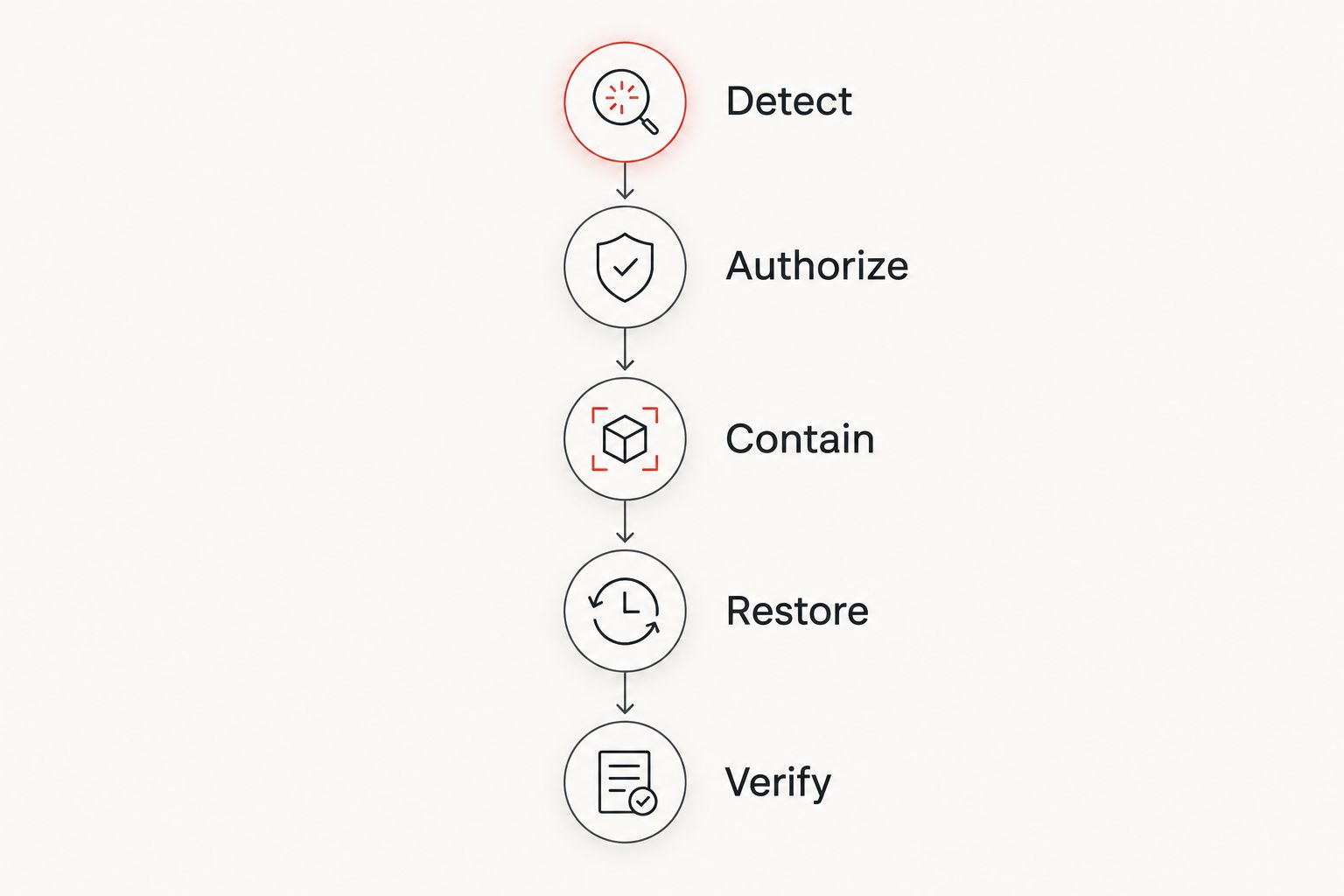
Use this sequence when reviewing either proposal:
- Detect: Identify who monitors and validates security events.
- Authorize: Define who approves disruptive containment actions.
- Contain: Assign responsibility for disabling access or isolating systems.
- Restore: Assign responsibility for returning business services to operation.
- Verify: Confirm that recovery and corrective actions are complete.
The sequence is a responsibility map, not a claim about either provider's internal workflow. Require named owners for each stage before signing.
Best for: a lean business that needs support and security responsibilities coordinated through a managed-service engagement. The benefit is the scope you agree to, not the number of capabilities listed on a website.
IBM Security wins when your internal team owns implementation
An established security team has a different buying problem. It can already define requirements, coordinate changes, and operate controls. Its priority is often adding a specific capability rather than transferring everyday IT responsibility.
IBM Security's product and consulting portfolio suits that purchasing model. Your team can evaluate identity, data-security, or incident-response requirements separately and select the relevant engagement. This is the stronger fit when specialization is intentional and internal ownership is already assigned.
The limitation is coordination. Separate products and service engagements require someone to manage integrations, acceptance criteria, and ongoing administration. Do not confuse portfolio breadth with automatic integration into your environment.
For a 2026 selection, identify the internal owner before approving the purchase. That owner should define the intended outcome, the implementation dependencies, and the evidence needed to accept the work. If nobody can own those tasks, address the operating gap first.
Best for: a security leader with internal implementation capacity and a specific specialist requirement. IBM Security wins when your team needs additional capabilities, not a replacement for its operating function.
Pricing: compare engagement models, not company names
Compare the commercial model of the actual proposal. A managed-service engagement and an enterprise security-product purchase package responsibilities differently. Treating them as identical purchases hides the work that remains with your team.
For Cyber Solutions, require the proposal to separate ongoing managed services from specifically scoped testing or incident-response work. Establish what is included, what triggers additional work, and how changes to users, devices, or systems affect the agreement. Do not assume a recurring support scope includes every security project.
For IBM Security, distinguish product licensing from consulting and response services. Ask who handles implementation and ongoing administration, and whether those responsibilities belong to your team or a separate engagement. The selected product or service determines the relevant commercial terms.
Predictability comes from stable scope and clear change rules. Flexibility comes from purchasing only the capabilities you need, but it also requires coordination. Neither model is automatically the better financial choice.
For your 2026 comparison, use one requirements document for both proposals. Include the systems covered, operational responsibilities, exclusions, and acceptance criteria. Then compare what each agreement actually delivers.
Final verdict: choose the operating model you need
Choose Cyber Solutions if you need outsourced IT and security support
Winner: Cyber Solutions for the small-business owner without enough internal IT capacity. Its stated services match the need for managed IT support, SOC/MDR, endpoint protection, penetration testing, and incident response.
Select this route when you need assigned operational responsibilities alongside security protection. Confirm containment authority, restoration scope, and escalation commitments in the agreement. The limitation is that specialized enterprise requirements still need individual evaluation.
Choose IBM Security if your team needs specialized security capabilities
Winner: IBM Security for the security leader with internal operational ownership. Its identity, data-security, and consulting capabilities suit defined enterprise security requirements.
Select this route when your team can own implementation and coordinate the resulting controls. The limitation is that a security product or specialist engagement does not automatically replace general managed IT support.
| Dimension | Winner |
|---|---|
| Small-business outsourced IT and security fit | Cyber Solutions |
| Managed IT ownership | Cyber Solutions |
| Standout specialized identity and data-security capabilities | IBM Security |
| Specialized security depth | IBM Security |
| Incident-response service availability | Tie; compare contracted authority and coverage |
| Security testing | Tie; compare scope and remediation responsibilities |
| Coordinated support and security scope | Cyber Solutions |
| Internal-team-led implementation | IBM Security |
| Pricing model | No universal winner; compare equivalent scope |
FAQ
Is Cyber Solutions better than IBM Security for a small business?
Cyber Solutions is the better fit when a small or mid-sized US business needs managed IT support alongside cybersecurity. IBM Security is the better fit when an established internal team needs specialized identity, data-security, or consulting capabilities.
Does IBM Security replace a managed IT provider?
An IBM Security purchase does not automatically replace a managed IT provider. Product licensing or a specialist security engagement must explicitly include any operational support responsibilities you expect.
Do both providers offer incident-response services?
Yes, both offer incident-response services. Cyber Solutions explicitly offers 24/7 incident response, while IBM X-Force offers incident-response services; compare each proposed agreement's coverage, authority, and recovery scope.
Does 24/7 coverage guarantee immediate containment?
No, 24/7 coverage describes service availability rather than guaranteed containment speed. Your agreement must separately define acknowledgement, escalation, authorized actions, and recovery responsibilities.
Which provider is better for identity and data security?
IBM Security is the stronger fit for a team seeking specialized identity and data-security capabilities. IBM Verify addresses identity and access management, while IBM Guardium addresses data security.
How should I compare the cost of the two providers?
Compare proposals against the same responsibilities and system scope. Separate ongoing operations, product licensing, implementation, testing, and incident-response work before evaluating the commercial terms.
What should I ask before signing a cybersecurity agreement?
Ask who can contain an attack and who must restore business operations. Also define approval requirements, evidence preservation, escalation contacts, and verification after recovery.
One last thing
The critical comparison is not who sees an alert. It is who can act on it without waiting for an undefined approval chain. Before you select a provider in 2026, run 1 tabletop exercise with the proposed responsibility map: a compromised account, an isolated endpoint, and an interrupted business application.
Ask each participant to identify their authorized next action. Any unanswered handoff is a requirement to resolve before the agreement is signed.


