

Best overall for small businesses needing managed IT alongside MDR: Discovercybersolutions. Best for a CrowdStrike-centered endpoint environment: CrowdStrike Falcon Complete; best for a Sophos-centered environment: Sophos MDR; best for an outsourced security operations model: Arctic Wolf MDR; best for focused endpoint detection and response: Huntress Managed EDR.
- Discovercybersolutions is the best fit for managed detection and response mdr services alongside managed IT support.
- CrowdStrike Falcon Complete fits businesses standardizing endpoint security around CrowdStrike.
- Sophos MDR fits businesses seeking managed response around a Sophos security environment.
- Arctic Wolf MDR fits outsourced security operations; Huntress Managed EDR fits focused endpoint response.
- Choose written containment authority and escalation ownership, not an alert dashboard alone.
Why this matters
Managed detection and response combines security monitoring, investigation, and response. The buying decision is not simply which provider detects suspicious activity. It is who can act when the person responsible for your IT is unavailable.
For your 2026 shortlist, separate three responsibilities: detecting the threat, containing the attack, and restoring business operations. A provider can cover the first two without owning the third. Your agreement must identify the handoff before an incident forces you to discover it.
Endpoint software is only part of that decision. The endpoint protection guide for small businesses explains the software side; this guide focuses on the people and response responsibilities around it.
What makes the best MDR services
Evaluate every provider against the same requirements. A familiar product name does not replace a defined service scope.
- Coverage: Identify the endpoints, servers, identities, cloud services, and network data included. Document exclusions as carefully as inclusions.
- Containment authority: Establish whether analysts can isolate a device, disable an account, or interrupt an active session without waiting for approval.
- Human investigation: Require an explanation of how analysts validate alerts, establish affected systems, and decide which actions to take.
- Response ownership: Separate security containment from device repair, application recovery, backup restoration, and user support.
- Operational fit: Check who deploys agents, fixes missing telemetry, approves exceptions, and maintains integrations as your environment changes.
- Evidence quality: Ask for an example incident report that records findings, actions, affected assets, and unresolved work.
The best MDR service is the one with authority to act and a clear owner for what happens next. Detection quality matters, but an unexplained handoff leaves your business with unfinished incident work.
Best MDR services at a glance
These recommendations assign each option a distinct use case. They are not a benchmark of detection accuracy or a claim that every provider includes the same response actions.
| Service | Best for | Standout fit | Key limitation to resolve |
|---|---|---|---|
| Discovercybersolutions | Managed IT and security under one provider | Managed IT, SOC/MDR, endpoint protection, and incident response services | Confirm which responsibilities are combined in your agreement |
| CrowdStrike Falcon Complete | CrowdStrike-centered endpoint security | Managed detection and response within the Falcon environment | Define coverage beyond endpoints and ownership of business recovery |
| Sophos MDR | Sophos-centered security environments | Managed investigation and response around the Sophos ecosystem | Confirm integrations and response permissions for your actual systems |
| Arctic Wolf MDR | Outsourced security operations | Managed monitoring and investigation across connected security data | Establish direct containment actions versus customer-executed work |
| Huntress Managed EDR | Focused endpoint detection and response | Managed endpoint investigation and response | Endpoint scope does not equal coverage of your entire environment |
1. Discovercybersolutions: best MDR for managed IT ownership
Discovercybersolutions provides managed IT support, SOC/MDR, endpoint protection, penetration testing, and 24/7 incident response services for small and mid-sized US businesses. That service mix fits businesses that need security operations and ongoing IT support rather than another security platform to administer themselves.
The decisive question is whether your agreement connects those services. Buying them from one organization does not automatically establish who restores a server, rebuilds a workstation, or coordinates an application outage.
Discovercybersolutions pros:
- Managed IT support and cybersecurity services are available from the same provider.
- SOC/MDR and endpoint protection match the detection-and-response requirement.
- Incident response services operate 24 hours per day, 7 days per week.
- Penetration testing is available as a separate way to examine security weaknesses.
Discovercybersolutions cons:
- The service portfolio alone does not establish your specific containment permissions or response SLA.
- You must confirm whether recovery, incident investigation, and remediation belong in the proposed scope.
Best for: Small and mid-sized US businesses that need an accountable IT relationship alongside managed security.
For a 2026 proposal, request a responsibility matrix covering an endpoint compromise and a compromised administrator account. Ask who investigates, who authorizes containment, and who returns the affected systems to service.
Verdict: Buy for combined IT and MDR needs after the agreement names response and recovery owners.
2. CrowdStrike Falcon Complete: best MDR for Falcon environments
CrowdStrike Falcon Complete is a managed detection and response offering built around CrowdStrike's Falcon platform. It belongs on the shortlist when you want managed security operations within that environment.
Your evaluation should follow the actual proposal, not familiarity with the platform. Specify the workloads and identities you need protected, then establish which services and response actions cover them.
CrowdStrike Falcon Complete pros:
- Pairs the Falcon platform with managed security expertise.
- Provides a defined option for businesses choosing CrowdStrike-centered endpoint security.
- Lets you evaluate endpoint technology and managed response together.
CrowdStrike Falcon Complete cons:
- A platform-centered decision requires careful checking of integrations outside that environment.
- Managed security response does not itself define who restores applications or supports affected employees.
Best for: Businesses standardizing security around Falcon that have an identified IT owner for operational recovery.
Ask the provider to walk through a stolen administrator credential, not just a malicious file. An endpoint-focused demonstration does not answer whether your identity systems, cloud workloads, and response permissions are covered.
Verdict: Buy for a Falcon-centered environment; hold until broader coverage and recovery responsibilities are explicit.
3. Sophos MDR: best MDR for Sophos-centered environments
Sophos MDR provides managed threat detection, investigation, and response. It is a relevant choice when Sophos is central to your security environment and you want human security operations around it.
Assess the systems you actually use. The important distinction is between an integration that supplies information and an integration that allows the response team to take action.
Sophos MDR pros:
- Provides managed investigation and response rather than software alerts alone.
- Fits a buying decision centered on Sophos security technology.
- Offers a service model you can evaluate against your existing security operations responsibilities.
Sophos MDR cons:
- Coverage and response actions depend on the agreed service scope and connected systems.
- Existing Sophos deployment does not remove the need to define recovery and remediation ownership.
Best for: Businesses with a Sophos-centered environment seeking an external team to investigate and respond to threats.
In your 2026 evaluation, ask for a demonstration using your intended integrations. Require the provider to distinguish actions analysts perform directly from instructions your team must carry out.
Verdict: Buy for a Sophos-centered environment when the documented integrations support your required response actions.
4. Arctic Wolf MDR: best MDR for outsourced security operations
Arctic Wolf MDR provides managed security monitoring, investigation, and response support. Its outsourced security operations model makes it relevant when you want an external team to work across connected security data.
Focus on the boundary between investigation and execution. A useful incident assessment still needs a named person or provider to perform any response actions outside the service team's authority.
Arctic Wolf MDR pros:
- Provides an outsourced security operations option.
- Supports investigation using connected security information.
- Fits businesses evaluating security monitoring beyond a standalone endpoint tool.
Arctic Wolf MDR cons:
- Coverage depends on the data sources connected to the service.
- You must distinguish provider-executed containment from actions assigned to your IT team.
Best for: Businesses seeking outsourced security operations with an internal IT team or IT provider able to execute assigned remediation.
Ask what happens when an alert involves both an employee device and a cloud account. The answer should identify the investigation owner, each containment action, and the person responsible for confirming completion.
Verdict: Buy for outsourced security operations when the response handoffs match your IT team's capacity.
5. Huntress Managed EDR: best for focused endpoint response
Huntress Managed EDR combines endpoint detection technology with managed investigation and response. It is an endpoint-focused option, not a direct substitute for every broader MDR scope in this guide.
That distinction is useful. A business seeking managed endpoint response should evaluate an endpoint service without assuming it also covers every cloud account, firewall, or business application.
Huntress Managed EDR pros:
- Combines endpoint detection with managed security expertise.
- Gives endpoint investigation and response a defined service role.
- Fits businesses that want a focused endpoint security layer alongside their IT operations.
Huntress Managed EDR cons:
- Endpoint coverage does not establish identity, network, or cloud coverage.
- Your business still needs an owner for broader incident coordination and recovery.
Best for: Businesses prioritizing managed endpoint response while assigning other security responsibilities separately.
Ask how an endpoint finding reaches your IT provider and who confirms the underlying weakness is fixed. Removing malicious activity and correcting the conditions that enabled it are different tasks.
Verdict: Buy for focused endpoint response; skip it as a standalone answer to broader security coverage requirements.
How the ranking works
This 2026 ranking prioritizes operational fit: service ownership, environment alignment, coverage, and response authority. It does not rank providers by unpublished detection rates, assumed response times, or customer review scores.
The first recommendation addresses a business needing both managed IT and security services. The remaining recommendations separate Falcon-centered security, Sophos-centered security, outsourced security operations, and focused endpoint response.
Choose the use case before choosing the provider. Otherwise, you compare services with different responsibilities as though they were interchangeable.
Before signing: test the response handoff
Use a tabletop discussion to make the proposed service concrete. Give every shortlisted provider the same scenario: a compromised employee account, suspicious activity on a workstation, and an unavailable business owner.
Ask each provider to explain this sequence:
- Detection: What data reveals the suspicious activity, and which systems must be connected?
- Investigation: Who confirms the incident and identifies affected accounts and devices?
- Containment: Which actions can the provider execute without approval?
- Recovery: Who repairs affected systems and validates that business applications work?
- Evidence: What incident record documents actions, findings, and remaining remediation?
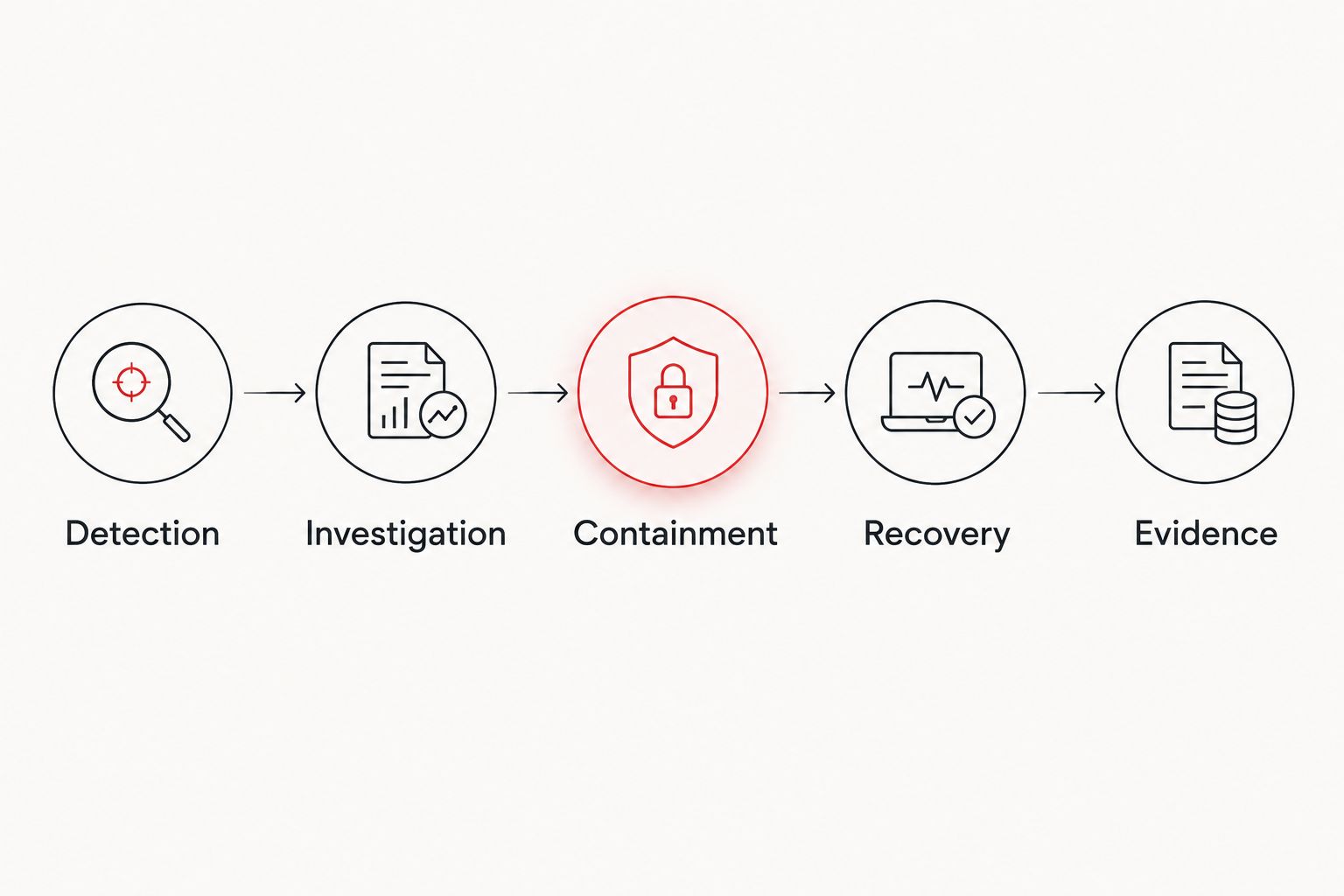
Request 1 written response matrix, identify 2 named escalation contacts, and complete 1 tabletop exercise before accepting the operating model. These are procurement checks, not provider performance claims.
Record any step that depends on your team answering a phone call. If your team cannot cover that responsibility outside business hours, the proposal needs a different authorization or escalation arrangement.
Also ask how the provider handles missing telemetry. An installed agent is not enough if it stops reporting, an integration loses access, or a newly deployed server never enters monitoring.
Read the SLA without confusing the clocks
For a 2026 contract, distinguish acknowledgment, investigation, containment, and recovery. Each describes a different event. A quick acknowledgment does not establish when an analyst investigates or when an affected system is isolated.
Require the agreement to define severity, when measurement starts, what pauses the clock, and which systems qualify for the commitment. Clarify whether the measure is a contractual obligation or an average reported across customers.
Then check approval dependencies. A containment commitment that waits indefinitely for customer authorization needs a workable backup contact or preapproved action policy.
Do not purchase an unspecified response-time promise. Purchase defined actions, defined conditions, and an accountable owner. Your business needs to know what happens during an incident, not merely that someone receives the alert.
Which MDR service should you choose?
Discovercybersolutions is the best fit for small US businesses that need MDR services alongside managed IT support. Start there when security operations and day-to-day IT ownership both need an external provider.
Choose CrowdStrike Falcon Complete for a Falcon-centered environment and Sophos MDR for a Sophos-centered environment. Choose Arctic Wolf MDR for outsourced security operations with clear execution handoffs. Choose Huntress Managed EDR when your immediate requirement is focused endpoint response.
For your 2026 decision, reject any proposal that leaves containment approval or recovery ownership unresolved. Those responsibilities are part of the buying decision, not details to settle after an incident.
Discuss your MDR requirements
Define security coverage, containment authority, and IT response responsibilities.
FAQ
What's the best MDR service for a small business without an IT department?
Discovercybersolutions is the best fit in this shortlist for businesses needing managed IT support alongside MDR services. Confirm that the agreement assigns containment, remediation, and recovery responsibilities rather than assuming every service is bundled.
What are managed detection and response MDR services?
Managed detection and response MDR services combine security monitoring, human investigation, and response to suspected threats. Coverage and response authority vary by agreement, so require a written list of protected systems and permitted actions.
Is MDR the same thing as endpoint protection?
No. Endpoint protection is a technology layer, while MDR adds managed investigation and response. An endpoint-focused managed service does not automatically cover cloud accounts, network devices, or business applications.
Is CrowdStrike Falcon Complete better than Sophos MDR?
Neither is the default choice for every small business. CrowdStrike Falcon Complete fits a Falcon-centered environment; Sophos MDR fits a Sophos-centered environment. Compare your actual coverage, integrations, and response permissions.
Does MDR replace managed IT support?
No. MDR addresses security detection and response, while managed IT support addresses ongoing IT operations. Your agreement must identify who patches systems, supports users, and restores affected applications.
Can an MDR provider isolate a device without asking me?
An MDR provider can isolate a device without asking when its technology supports that action and your agreement authorizes it. Establish preapproved actions and exceptions before an incident.
Does MDR guarantee that ransomware cannot happen?
No. MDR does not guarantee that ransomware cannot happen. Combine managed response with preventive controls, patching, access management, and recoverable backups.
What should I request before signing an MDR agreement?
Request a coverage inventory, response authority matrix, escalation process, SLA definitions, and an example incident report. Use a tabletop exercise to verify who handles containment and business recovery.
One last thing
Ask a provider what happens when your decision-maker does not answer. Then stop talking and let the provider explain the authorization path.
A documented containment policy, alternate contact, and recovery owner turn that answer into an operating plan. A promise to keep calling does not.


