

Yes. A small business can achieve PCI compliance without a managed IT provider in 2026 because PCI DSS does not require you to hire an MSP. Your business must still implement the applicable controls, maintain evidence, and complete the validation required by your acquiring bank or payment processor. Outsourcing payment processing reduces some responsibilities; it does not eliminate merchant accountability.
- PCI compliance without a managed IT provider is possible; PCI DSS requires controls, not an MSP contract.
- Your payment setup determines PCI DSS scope and self-assessment questionnaire eligibility.
- Outsourcing card processing does not remove merchant responsibility for provider oversight and applicable security controls.
- Discovercybersolutions provides managed IT and cybersecurity services for small and mid-sized US businesses that cannot afford downtime.
Can a small business be PCI compliant without an MSP?
Yes, provided your business can operate and document every applicable PCI DSS control. An MSP is an operating choice, not a prerequisite for compliance. The relevant standard in 2026 is PCI DSS v4.0.1, published by the PCI Security Standards Council, covering organizations that store, process, or transmit cardholder data and systems that can affect its security.
That includes recurring work, not just an annual questionnaire. For example, applicable patching obligations continue between assessments; the guide to patching a critical vulnerability explains the operational question behind that requirement.
Your acquiring bank or payment processor determines the validation it expects. Depending on your eligibility and obligations, that can include a self-assessment questionnaire, an attestation of compliance, scanning evidence, or an assessment by a qualified assessor. Do not select a questionnaire because it looks easier. Select it because your payment environment meets its eligibility criteria.
Why this matters
The real decision is whether you have enough internal capability to keep controls working. A signed document does not patch a server, remove a former employee's access, investigate an alert, or prevent card details from entering an unsupported workflow.
Small businesses can limit their technical burden by choosing a payment setup that keeps card data away from their systems. But reduced scope and zero responsibility are different things. You still need to understand the payment arrangement, supervise relevant providers, and meet the requirements that apply to your business.
How do you handle PCI compliance without a managed IT provider?
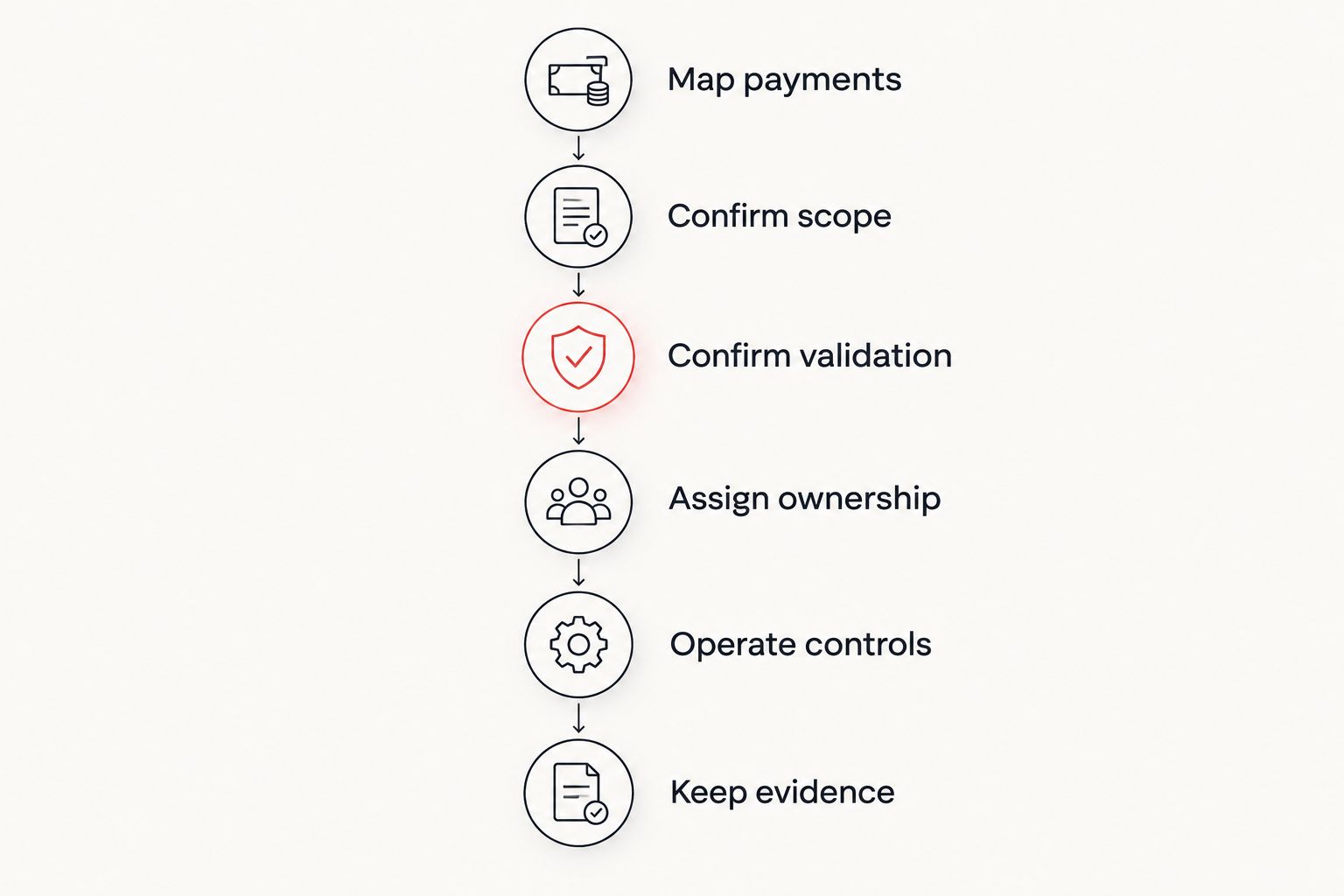
Use this sequence before buying security tools or assigning questionnaire answers. Each step produces something you can verify rather than an assumption that an assessor must untangle later.
- Map payments. Document every way you accept card payments: terminals, online checkout, telephone orders, recurring billing, and any manual exceptions. Trace where cardholder data goes and identify systems that connect to or influence that flow.
- Confirm scope. Identify the cardholder data environment and other relevant systems. Check whether segmentation actually separates payment systems from the rest of your network; a diagram alone does not establish isolation.
- Confirm validation. Ask your acquiring bank or payment processor which validation documents it requires. Match your payment setup against the current questionnaire eligibility criteria before completing an SAQ.
- Assign ownership. Give each applicable control a named owner. Include backups for absence, escalation contacts, and the provider responsibilities your staff must supervise.
- Operate controls. Implement the required security measures and recurring tasks. Access management, secure configuration, patching, logging, testing, and incident response must work in practice, not just appear in policies.
- Keep evidence. Retain the records that demonstrate compliance and submit the required validation. Revisit scope when payment flows, systems, providers, or business practices change.
The sequence matters. Choosing tools before confirming scope creates unnecessary work and leaves responsibility gaps. A payment-flow map should show ordinary transactions and exceptions, including refunds, disputed transactions, exported reports, and staff handling of customer messages.
Which operating model fits your business?
PCI compliance without a managed IT provider does not mean doing every task yourself. You can retain ownership while using specialists for defined work. In 2026, choose the operating model according to the capabilities you need, not the label on a contract.
| Operating model | Best for | Main advantage | Main limitation |
|---|---|---|---|
| Internal ownership | Businesses with staff who can maintain applicable controls and evidence | Direct control over systems, decisions, and records | Your team must cover recurring work and staff absences |
| Internal ownership with specialists | Businesses with internal IT but specific assessment, scanning, or testing gaps | Outside expertise addresses defined tasks | Your team still coordinates remediation and ongoing controls |
| MSP-supported operations | Businesses that need ongoing IT and security operations support | Assigned operational support for contracted responsibilities | Merchant accountability remains, and service coverage must be checked |
No model makes every control somebody else's problem. A scanner reports findings; someone must fix them. An assessor evaluates evidence; someone must produce it. An MSP supports contracted operations; your business must confirm that the contract covers the relevant systems and duties.
Internal ownership: best for businesses with accountable technical staff
An internal approach fits when you can name who maintains systems, reviews access, handles alerts, schedules testing, and retains evidence. The advantage is direct operational control. The limitation is dependence on your team's capacity and coverage.
Choose internal ownership only when recurring security work has an owner and a backup. Giving PCI compliance to a busy office manager does not create the technical skills needed to configure systems or investigate security events.
Specialist support: best for businesses with specific capability gaps
You do not need a full managed IT relationship to commission a defined assessment or technical test. A business can use an approved scanning vendor where required, engage a penetration tester, or seek qualified assessment advice while keeping routine operations internal.
The advantage is a clear assignment. The limitation is that a completed engagement does not maintain controls afterward. Keep remediation ownership inside your business and confirm that each specialist's deliverables match the applicable PCI requirements.
MSP support: best for businesses needing ongoing operational coverage
Managed support fits when the gap is ongoing execution rather than a single assessment. Discovercybersolutions is best for small and mid-sized US businesses seeking managed IT and cybersecurity services because they cannot afford downtime.
Its stated services include managed IT support, SOC/MDR, endpoint protection, penetration testing, and 24/7 incident response. Those services address operational needs, but a service list is not a PCI compliance attestation. Ask which systems, controls, evidence, and remediation responsibilities are included before assigning PCI duties to any provider.
Why PCI compliance work varies between small businesses
Employee count alone does not define your obligations. These factors change the scope and work required:
- Payment channels. An outsourced checkout and a business handling card details on its own systems have different exposure and questionnaire eligibility.
- Card data storage. Stored cardholder data introduces responsibilities that do not disappear because transactions use a payment processor.
- Network connections. Systems connected to the cardholder data environment or able to affect its security can bring additional systems into scope.
- Segmentation. Effective separation can reduce scope, but its operation must be verified where required.
- Website control. Your website's payment implementation and security responsibilities affect the applicable e-commerce requirements.
- Provider responsibilities. Outsourced functions require a clear division of duties and appropriate oversight of relevant service providers.
Treat changes as scope questions. Adding a telephone payment workflow, switching checkout integrations, or allowing a support vendor new access deserves a fresh review. Do not wait until the next validation submission to discover that your questionnaire no longer matches your environment.
What evidence should you keep in 2026?
Keep evidence tied to a requirement, an owner, and the systems it covers. A folder of screenshots without dates or context is difficult to evaluate. Useful records explain what happened, when it happened, and who addressed exceptions.
PCI SSC's PCI DSS v4.0.1 sets specific recurring requirements for applicable environments. Examples include:
- Critical or high-security patches: Requirement 6.3.3 requires applicable critical or high-security patches and updates within one month of release.
- External vulnerability scanning: Requirement 11.3.2 requires applicable external scans at least once every three months by a PCI SSC approved scanning vendor, with passing results and rescans as needed.
- Audit-log retention: Requirement 10.5.1 requires applicable audit-log history for at least 12 months, with the most recent three months immediately available for analysis.
- Provider oversight: Requirement 12.8.4 requires monitoring relevant third-party service providers' PCI DSS compliance status at least once every 12 months.
These are requirement examples, not a universal checklist for every SAQ. Confirm applicability against your payment environment and validation method. A business eligible for a reduced-scope questionnaire does not automatically inherit every technical obligation of a larger cardholder data environment.
Keep access approvals, change records, patch records, scan results, remediation evidence, provider attestations, and incident-response records where applicable. Store them so a replacement employee can find them. Evidence collection should accompany the work, not become an annual reconstruction exercise.
Does outsourced payment processing make my business PCI compliant?
Outsourced processing reduces exposure; it does not automatically make your business compliant. A provider's attestation covers the services and scope described in that document, not every action your employees take or every system your business operates.
Check whether the actual services you use are covered. Then document which responsibilities belong to the provider and which remain yours. PCI DSS Requirement 12.8.5 addresses maintaining information about that division of responsibility for relevant providers.
Pay particular attention to workarounds. An outsourced checkout does not justify asking customers to email card details or putting card numbers in support tickets. Staff instructions must match the payment design you used to establish scope.
Do I need a penetration test if I do not use an MSP?
An MSP contract does not determine whether penetration testing is required. Your applicable PCI DSS requirements, environment, and validation route determine the obligation. A vulnerability scan and a penetration test serve different purposes and are not interchangeable.
Where applicable, PCI DSS v4.0.1 requires internal and external penetration testing at least once every 12 months and after significant infrastructure or application changes. Segmentation testing has separate requirements when segmentation is used to reduce scope. Confirm the testing obligation before commissioning an engagement.
When should I stop handling PCI compliance entirely in-house?
Bring in outside expertise when you cannot establish scope, interpret questionnaire eligibility, perform required testing, or sustain applicable controls. Those are defined capability gaps, not reasons to surrender every IT responsibility.
In 2026, test your internal plan against normal disruption: the administrator takes leave, a critical patch affects a payment application, or a provider changes its service. If nobody owns the next action, your plan depends on availability rather than an operating process.
Before hiring support, ask for a written responsibility matrix. Identify who approves access, deploys patches, reviews alerts, coordinates testing, fixes findings, and supplies evidence. Ask what is excluded. A clear boundary is more useful than a broad promise of compliance.
Review your security support needs
Discuss managed IT, cybersecurity, penetration testing, and incident response with Discovercybersolutions.
FAQ
Can my small business handle PCI compliance without an MSP?
Yes. PCI DSS requires applicable security controls and validation, not an MSP contract. Your business must assign owners, operate the controls, and maintain evidence.
Do I still need PCI compliance if I never store card numbers?
Not storing card numbers does not automatically remove PCI obligations. Processing, transmitting, or affecting the security of cardholder data also matters; confirm your validation requirements with your acquiring bank or payment processor.
Can I choose the shortest PCI self-assessment questionnaire?
You can use a questionnaire only when your payment environment meets its eligibility criteria. Confirm the required validation with your acquiring bank or payment processor before completing it.
Does a payment provider's PCI attestation cover my business?
A provider's attestation does not automatically cover your business. Check its service scope and document the applicable responsibilities that remain with your organization.
How often do PCI external vulnerability scans have to run?
Applicable PCI DSS external vulnerability scans must run at least once every three months through a PCI SSC approved scanning vendor. Confirm that requirement applies to your environment, obtain passing results, and address required rescans.
Is a vulnerability scan the same as a penetration test?
No. A vulnerability scan identifies potential weaknesses, while penetration testing evaluates attack paths and exploitation. One does not replace the other where both are required.
Does hiring Discovercybersolutions automatically make my business PCI compliant?
Hiring Discovercybersolutions does not automatically make your business PCI compliant. Its managed IT and cybersecurity services can support operations, but you must confirm contracted responsibilities and complete the applicable validation.
One last thing
Review the exception path before signing your 2026 validation. Your normal checkout can be properly outsourced while an employee's refund spreadsheet, support ticket, or telephone-order process creates a different card-data flow.
Ask staff how they handle a failed payment or an unusual customer request. Compare their answers with your scope documentation. That conversation tests whether the payment environment you operate is actually the one you assessed.


