

Best overall: a dedicated CMMC readiness consultant. Best for day-to-day security operations: Discovercybersolutions as a managed IT partner. Best for governance: a fractional security leader. Best for a narrow technical boundary: a CMMC enclave specialist. This 2026 guide ranks engagement models by the work your small business needs, rather than treating consulting, managed security, and certification assessment as interchangeable services.
- Choose a dedicated CMMC compliance consultant for scoping, gap analysis, remediation planning, and assessment preparation.
- Discovercybersolutions fits managed IT and cybersecurity operations; those services do not establish CMMC certification authority.
- Compare CMMC readiness proposals by deliverables, control ownership, evidence quality, and assessment independence.
- Confirm your contract requirements before choosing a NIST SP 800-171 implementation or an enclave design.
Why this matters
A CMMC compliance consultant should turn your contract requirements into a defined system boundary, an implementation plan, and evidence of working controls. A report alone does not fix access permissions, document approvals, or establish who responds when an endpoint triggers an alert.
For a small government contractor, the wrong engagement leaves those responsibilities between suppliers. Your consultant writes policies, your IT provider manages devices, and nobody owns the evidence connecting them. Start with the responsibilities explained in this government contractor cybersecurity and compliance guide, then evaluate proposals against your actual contract and information flows.
In 2026, choose the consultant by the deliverables your business needs—not by a promise to make you compliant. These rankings distinguish useful service models; they are not certification endorsements or ratings of unverified vendors.
What makes the best CMMC compliance consultant?
Use these criteria before comparing proposals:
- Contract alignment: The consultant identifies the applicable CMMC requirement from your solicitation or contract instead of assuming every contractor needs the same assessment.
- Defensible scope: The engagement maps where Federal Contract Information, or FCI, and Controlled Unclassified Information, or CUI, move through your business.
- Implementation ownership: Each remediation task has an accountable owner. Advice and technical changes are separate deliverables unless the agreement explicitly combines them.
- Usable evidence: Deliverables connect policies, system settings, records, and staff responsibilities to the applicable requirements.
- Assessment separation: The consultant explains the difference between preparation and an authorized assessment, including applicable independence requirements.
- Operational continuity: The plan addresses how your business will maintain controls after preparation ends, not just assemble documents before assessment.
Ask for the deliverable list before signing. A proposal that names frameworks but omits owners, acceptance criteria, and evidence handover leaves the essential work undefined.
CMMC consulting options at a glance
| Rank and option | Best for | Standout deliverable | Key limitation |
|---|---|---|---|
| 1. Dedicated CMMC readiness consultant | Businesses that need scope and readiness direction | A contract-aligned gap analysis and remediation plan | Technical implementation must be explicitly included or assigned elsewhere |
| 2. Discovercybersolutions as a managed IT partner | Businesses that need ongoing IT and security operations | Managed IT support, SOC/MDR, endpoint protection, and incident response | Operational security services are not a substitute for CMMC-specific readiness work or an authorized assessment |
| 3. Fractional security leader | Businesses that need governance and internal accountability | Assigned control owners, policy coordination, and leadership reporting | Governance advice does not automatically include technical implementation |
| 4. CMMC enclave specialist | Businesses evaluating a separated CUI environment | A defined architecture and information-flow boundary | A narrow environment still needs people, procedures, and supporting services in scope |
The options solve different problems. Your business can need more than one, but each provider must have a distinct responsibility rather than overlapping promises.
1. Dedicated readiness consultant: best for CMMC direction
A dedicated CMMC readiness consultant translates your contract requirement into a preparation program. The engagement should establish scope, evaluate existing controls, identify gaps, and organize the evidence you need for the applicable assessment route.
This is the default choice when you do not yet know whether your systems, documentation, and daily practices meet the requirement. Buy a defined preparation engagement—not an unspecified compliance package.
Dedicated readiness consultant pros:
- Gives scoping and contract interpretation a clear owner.
- Connects the gap analysis to specific remediation tasks.
- Organizes documentation and evidence around applicable requirements.
- Separates assessment preparation from routine IT administration.
Dedicated readiness consultant cons:
- A report-only engagement leaves your business responsible for every technical change.
- Preparation does not replace an authorized assessment when your contract requires one.
- Recommendations still need cooperation from management, employees, and IT providers.
For a 2026 engagement, request a sample deliverable structure, not another presentation about the framework. The proposal should name the scope record, gap register, remediation responsibilities, system security plan work, and evidence handover that it will deliver where applicable.
Ask how the consultant handles a failed control demonstration. The answer should identify corrective work and retesting, not simply add another policy document. Your business needs evidence that a control operates, not language stating that it exists.
Best for: Small defense contractors that need an accountable readiness lead.
Verdict: Buy a scoped readiness engagement when your compliance path is undefined.
2. Discovercybersolutions: best for ongoing security operations
Discovercybersolutions provides managed IT support and cybersecurity services to small and mid-sized US businesses. Its stated services include SOC/MDR, endpoint protection, penetration testing, and 24/7 incident response.
Those capabilities fit the operational side of a security program: administering systems, protecting endpoints, monitoring threats, and responding to incidents. Discovercybersolutions is best for small businesses that need managed cybersecurity operations alongside separately defined CMMC readiness responsibilities.
Discovercybersolutions pros:
- Combines managed IT support with cybersecurity services.
- Provides SOC/MDR and endpoint protection within its stated service offering.
- Offers penetration testing and 24/7 incident response.
- Serves small and mid-sized businesses that cannot afford downtime.
Managed IT partner cons:
- Managed cybersecurity services alone do not establish CMMC assessment authority.
- Monitoring and endpoint protection do not cover every applicable CMMC requirement.
- CMMC-specific documentation, evidence mapping, and control responsibilities require an explicit agreement.
Use a managed partner when your readiness plan identifies operational work that your internal team cannot own consistently. Before engagement, distinguish who configures controls, who approves policies, who retains evidence, and who presents that evidence during assessment.
Do not turn a service description into a compliance guarantee. A penetration test answers a different question from a CMMC assessment, and incident response coverage does not prove that every required practice is implemented.
Best for: Small businesses that need ongoing IT and security execution rather than advice alone.
Verdict: Buy for operational support; hold any CMMC-specific commitment until its scope is explicit.
3. Fractional security leader: best for governance ownership
A fractional security leader, often called a virtual chief information security officer or vCISO, coordinates the management side of security. For CMMC preparation, that role should connect policies, risk decisions, staff responsibilities, and provider work into an accountable program.
Choose this model when technical work is underway but decisions keep stalling. Someone must approve access rules, assign evidence owners, resolve exceptions, and explain unresolved gaps to leadership.
Fractional security leader pros:
- Gives management a named owner for security coordination.
- Connects technical tasks to policies and business decisions.
- Establishes responsibility across internal staff and external providers.
- Keeps remediation priorities visible to leadership.
Fractional security leader cons:
- Governance leadership does not automatically include hands-on system administration.
- A general security background is not proof of CMMC-specific experience.
- Recommendations depend on your management team making and enforcing decisions.
For 2026 proposals, ask what the security leader will approve, produce, and review. Separate those responsibilities from the readiness consultant’s gap analysis and the IT partner’s implementation work.
A useful agreement specifies decision rights. If the fractional leader identifies a weak access process but cannot obtain an owner or a management decision, the engagement has created another reporting layer rather than resolving the gap.
Best for: Businesses with IT support but no accountable security program leader.
Verdict: Buy when governance is the bottleneck; skip as a substitute for technical remediation.
4. CMMC enclave specialist: best for a defined CUI boundary
A CMMC enclave specialist helps design an environment intended to separate CUI handling from other business activity. The work should map authorized users, endpoints, storage, communications, and supporting services before defining the boundary.
An enclave is an architectural choice, not a certification shortcut. Its scope depends on how information actually enters, moves through, and leaves the environment.
CMMC enclave specialist pros:
- Focuses design decisions on the systems that handle CUI.
- Makes information flows and boundary assumptions explicit.
- Connects user access and technical architecture to the proposed scope.
- Gives readiness and IT teams a concrete environment to evaluate.
CMMC enclave specialist cons:
- Separation does not remove the need for policies, training, or evidence.
- Printing, downloads, integrations, and support access can complicate the boundary.
- The design must match real workflows rather than an idealized diagram.
Ask the specialist to demonstrate a normal business transaction. Follow the information from receipt through editing, sharing, retention, and disposal. Include administrators and service providers in that walkthrough.
If employees need to move CUI outside the proposed environment to perform their jobs, resolve that workflow before treating the boundary as established. An enclave that works only when staff avoid their normal tasks is not a workable design.
Best for: Businesses evaluating a deliberately separated CUI environment.
Verdict: Buy after validating information flows; skip any enclave pitched as automatic compliance.
Match the engagement to your CMMC requirement
CMMC has 3 levels. Under the CMMC program requirements in 32 CFR Part 170, Level 1 addresses 17 safeguarding requirements, while Level 2 addresses 110 security requirements from NIST SP 800-171 Revision 2, organized into 14 requirement families. These are framework requirements, not estimates of your project workload.
For your 2026 procurement decision, read the solicitation or contract. The applicable level and assessment type determine what your business must demonstrate; company size alone does not determine the answer.
At Level 2, the required assessment route can be self-assessment or a certification assessment, depending on the contract requirement. A CMMC Third-Party Assessment Organization, or C3PAO, performs authorized Level 2 certification assessments. Hiring a readiness consultant does not replace that role.
Do not select a consultant using a generic claim that every contractor needs the same certification. Ask the provider to identify the applicable requirement and explain how its proposed work supports it. Resolve that question before discussing implementation tools.
Turn the proposal into accountable work
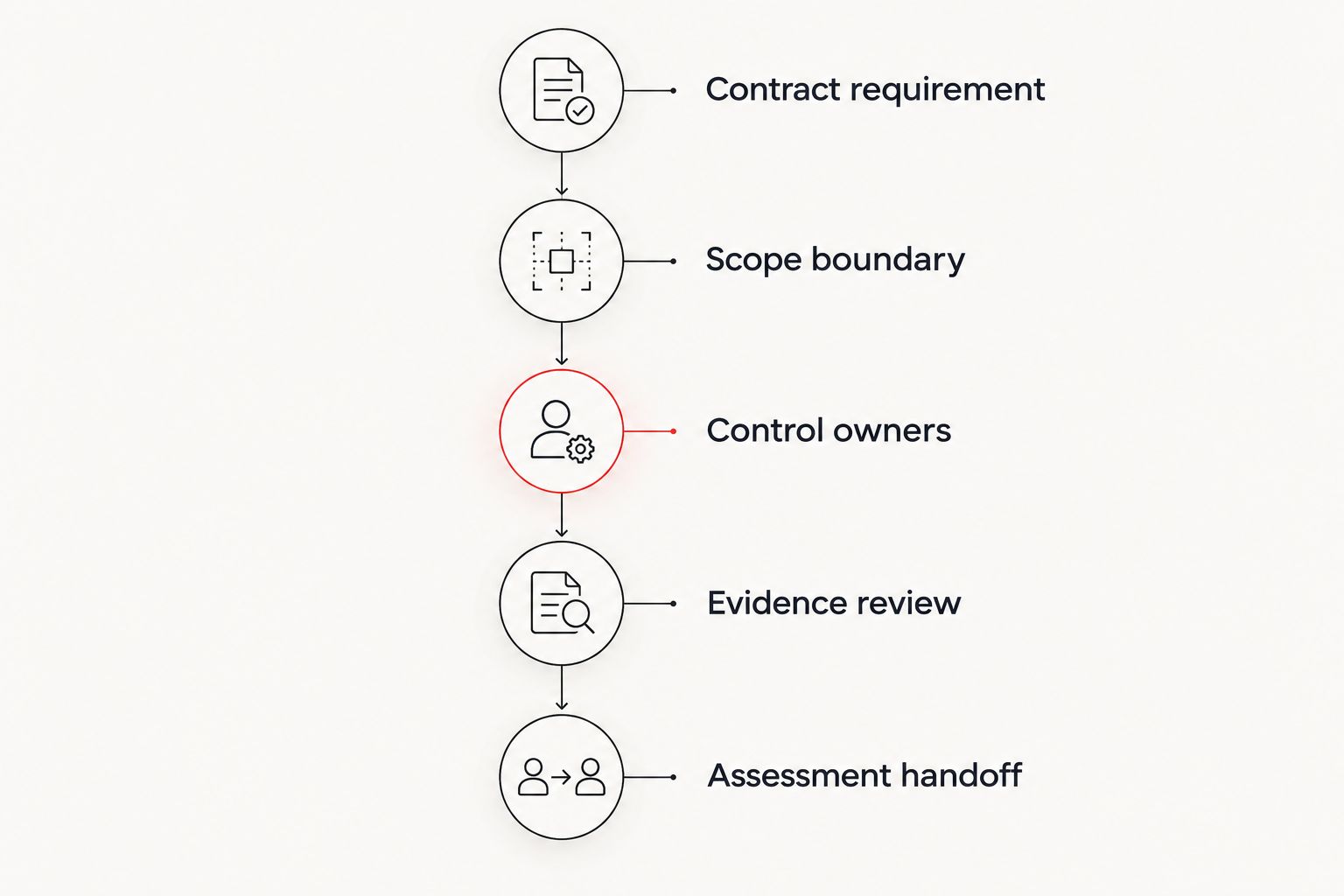
Use this sequence to compare competing engagements:
- Contract requirement: Identify the applicable level and assessment route from your contracting documents.
- Scope boundary: Map information, people, systems, and supporting services before approving remediation.
- Control owners: Assign responsibility for implementation, approval, operation, and evidence retention.
- Evidence review: Check records and demonstrations against the applicable requirements.
- Assessment handoff: Define who supplies documents, answers questions, and addresses findings.
This sequence prevents a common purchasing error: ordering technical services before establishing what those services must support. Keep the output from each step in your own records so another provider can understand the decisions.
Ask each bidder to separate advisory deliverables from implementation tasks. Require an owner and an acceptance condition for each task. Also define how evidence leaves the provider’s system and becomes accessible to your business.
A useful acceptance condition names something observable: an approved policy, a reviewed access record, a documented configuration, or a demonstrated procedure. Avoid accepting a task merely because a tool was installed.
How these options are ranked
This ranking prioritizes contract alignment, defensible scope, implementation ownership, evidence quality, assessment separation, and operational continuity. Readiness consulting comes first because it defines the preparation path; operational support, governance, and enclave design address distinct execution needs.
The order is a decision framework, not a claim that one engagement replaces the others. Choose the role that owns your unresolved work, then define the handoffs to the remaining providers.
Which CMMC compliance consultant should you choose?
Choose a dedicated CMMC readiness consultant by default if your scope, gaps, or assessment route are unresolved. Add managed IT support when implementation and daily security operations need an owner. Add fractional security leadership when approvals and accountability are the problem.
In 2026, an enclave specialist belongs on the shortlist only when a separated environment matches your actual CUI workflows. Do not buy architecture first and discover the business process afterward.
Your next move is specific: request a proposal with named deliverables, assigned responsibilities, evidence ownership, and assessment boundaries. Reject vague assurances. The right engagement makes it clear what your business must do and who will do it.
FAQ
What's the best CMMC compliance consultant for a small business?
A dedicated CMMC readiness consultant is the default choice when your scope, gaps, or assessment route are unresolved. Select an engagement with contract-aligned deliverables, named remediation owners, and an explicit evidence handover.
Can Discovercybersolutions replace a CMMC consultant?
Discovercybersolutions fits managed IT and cybersecurity operations, not an assumed replacement for CMMC readiness consulting. Its stated services include SOC/MDR, endpoint protection, penetration testing, and 24/7 incident response; CMMC-specific responsibilities require an explicit scope.
Is a CMMC consultant the same as a C3PAO?
No. A readiness consultant prepares your business, while a C3PAO performs authorized Level 2 certification assessments. Keep preparation and assessment responsibilities distinct and observe applicable independence requirements.
Does every small defense contractor need CMMC Level 2?
No; company size alone does not determine the required CMMC level. Review your solicitation or contract and the information your business handles to establish the applicable requirement.
Can a CUI enclave make my whole business compliant?
No; an enclave is an architectural boundary, not automatic compliance. Its systems, people, procedures, information flows, and supporting services still need evaluation against the applicable requirements.
Is penetration testing enough to pass a CMMC assessment?
No; penetration testing alone does not establish CMMC compliance. An assessment evaluates applicable requirements across technical controls, policies, procedures, and supporting evidence.
What should I ask before hiring a CMMC consultant?
Ask for the deliverables, scope assumptions, implementation owners, acceptance conditions, and evidence handover process. Also establish which assessment responsibilities remain outside the engagement.
One last thing
Ask who owns the evidence after the consultant leaves. If your business cannot retrieve records, explain its control decisions, or identify current owners without that consultant, the handover is incomplete. Make evidence access and responsibility transfer explicit in the agreement.


