
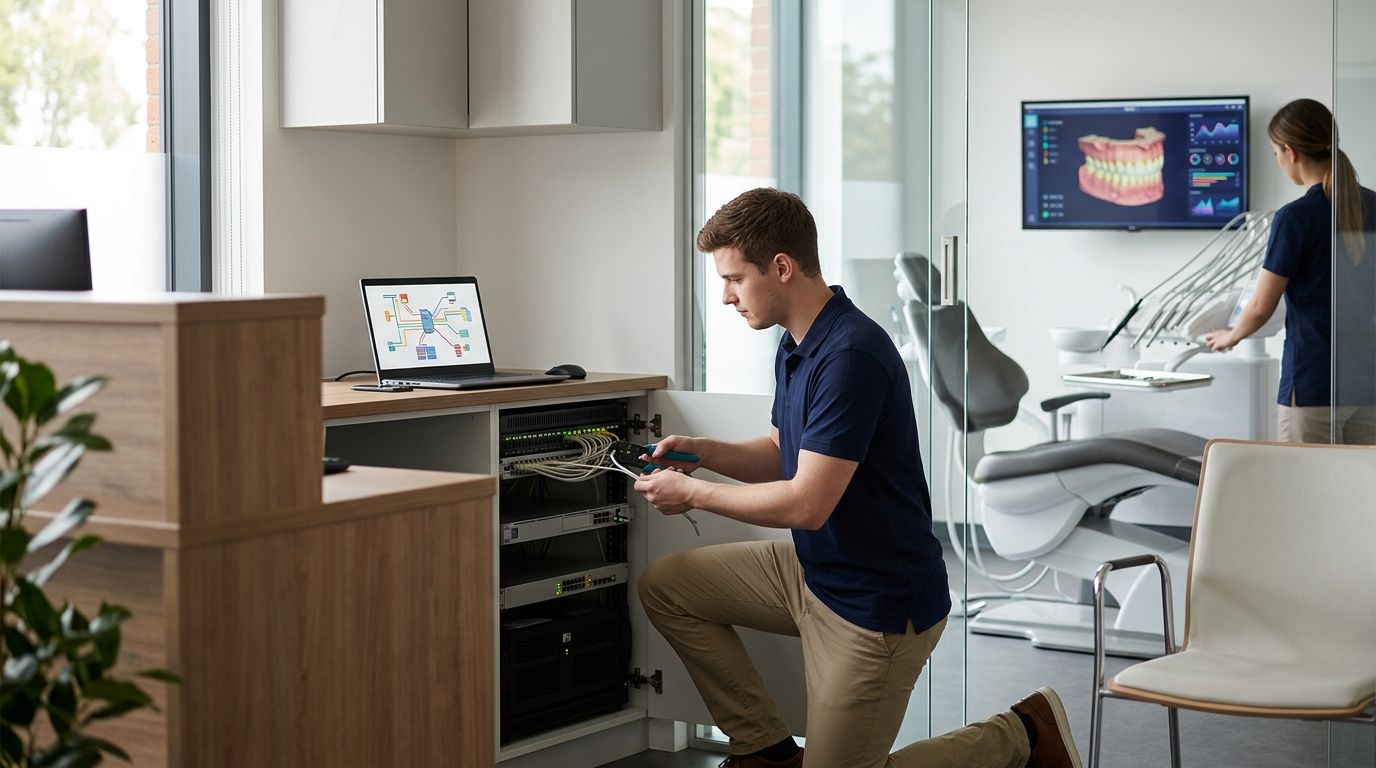
Dental practice IT support is managed network, endpoint, and compliance coverage built to keep scheduling, imaging, and billing systems running without creating a HIPAA exposure. A five-chair general practice and a twelve-location DSO both run the same core stack — practice management software, digital X-ray or CBCT imaging, insurance billing, and patient email — but neither has an in-house security team watching it, which is exactly the gap regulated attackers and auditors both look for in 2026.
- IT support for dental practices in 2026 must cover HIPAA risk assessments, PHI backups, and 24/7 incident response, not just help desk tickets.
- Cyber Solutions runs managed IT and SOC/MDR for healthcare practices with under 1 hour average response, 24/7/365 monitoring.
- Generalist MSPs without healthcare experience routinely skip the annual HIPAA risk assessment most practices only run after an audit or breach.
- Backup testing, not backup existence, is the step dental offices miss most — a nightly job report is not a verified restore.
- Best for practices with 5-50 operatories: a healthcare-focused managed IT provider over a solo IT contractor or general MSP.
Why IT support matters for dental practices
HIPAA's Security Rule requires a documented risk assessment covering every system that touches patient data — practice management software, imaging servers, and even the guest Wi-Fi network patients use in the waiting room. Skip that assessment and the exposure isn't a phishing email anymore; it's a compliance finding a payer or auditor can point to for years.
Most dental practices don't have a security team. A front desk running scheduling and insurance claims, an office manager handling billing, and one part-time IT contractor for printer jams don't have bandwidth to patch practice management software, watch for ransomware, and stay current on HIPAA guidance in the same week. That gap is why HIPAA compliance services for healthcare practices exist as a distinct line item, separate from general help desk work.
Cyber Solutions treats dental IT support as compliance work first and ticket resolution second — a fast fix that ignores PHI exposure just delays the real problem to a worse day.
How to set up IT support for a dental practice in 2026
Audit your network and endpoints for HIPAA gaps
- Inventory every device touching patient data: front-desk PCs, imaging workstations, servers, tablets used chairside
- Confirm the guest Wi-Fi network is physically separated from the clinical network
- Check that laptops and any device leaving the building have encryption turned on
- List every login to your practice management software and flag shared or generic accounts
- Note which machines still run an unsupported operating system
Lock down PHI access with MFA and role-based permissions
- Turn on multi-factor authentication for practice management software, email, and remote access tools
- Set role-based permissions so a hygienist can't pull billing data and a receptionist can't open clinical notes
- Strip admin rights from everyday staff accounts
- Review the access list quarterly and remove anyone who left the practice
A managed IT and cybersecurity provider like Cyber Solutions can push these controls across every workstation in a practice in an afternoon, instead of a staff member working through each machine by hand between patients.
Set up backup and disaster recovery for patient records and imaging
- Back up practice management data and imaging files on separate schedules — imaging files are larger and change less often
- Keep at least one backup copy offsite or in the cloud, not only on a second on-site drive
- Test a full restore at least once a quarter, not just a nightly "backup completed" notification
- Document how long a full restore takes so front desk staff know what to tell patients during downtime
See backup and disaster recovery options built for this kind of file mix.
Train front-desk and clinical staff to spot phishing
- Run phishing simulations aimed at scheduling and billing roles — attackers target those two seats hardest
- Cover fake insurance claim emails and invoice fraud, not just generic "suspicious link" training
- Repeat training at least twice a year; one-time onboarding training doesn't hold up
- Give staff one number to call the moment something looks off, before they click "just to check"
Establish 24/7 monitoring and an incident response plan
- Write down who gets called first if the imaging server is down at 7am before patients arrive
- Define what counts as an emergency call versus a next-business-day ticket
- Confirm someone is watching the network outside office hours — ransomware doesn't wait for 9am
- Run a tabletop walkthrough of the incident response plan once a year
Check 24/7 IT helpdesk support built around after-hours coverage, since most dental ransomware hits land overnight or over a weekend.
Patch and monitor practice management and imaging software
- Keep Dentrix, Eaglesoft, Open Dental, or your PMS on the vendor's current supported version
- Patch imaging software and sensors on the same cycle as the PMS, not separately
- Monitor for failed logins and unusual data exports from the PMS database
- Confirm your PMS vendor's support contract does not double as network security coverage
Run a HIPAA security risk assessment every year
- Document every system, vendor, and third party that touches patient data
- Score each risk by likelihood and impact, not a yes/no checklist
- Keep the assessment on file — it's the first document requested in a breach investigation or payer audit
- Update it after any major change: new location, new PMS, new imaging equipment
Comparing IT support options for a dental practice
| Option | Best For | Key Limitation |
|---|---|---|
| Solo IT contractor / freelancer | Single-location practice on a tight budget | No 24/7 coverage, rarely trained on HIPAA risk assessments |
| Regional MSP (general business focus) | Practices wanting one vendor for hardware and network | Treats PHI like generic file data, no SOC/MDR |
| PMS vendor help desk (Dentrix, Eaglesoft) | Fixing bugs inside the practice management software itself | Won't touch network security, backups, or endpoints |
| In-house IT hire | Multi-location DSOs with 100+ staff | Salary cost, no coverage during vacations or after-hours attacks |
| Healthcare-focused managed IT and cybersecurity provider (Cyber Solutions) | Practices needing HIPAA-aligned SOC/MDR and 24/7 incident response | Higher monthly commitment than a single freelancer |
Verdict: for a practice with 5 or more operatories handling PHI daily, a healthcare-focused managed IT provider wins over a general MSP or solo contractor — the difference shows up the first time a payer audit or a ransomware note lands on the front desk.
Common mistakes dental practices make
- Storing imaging backups on the same network as the imaging server itself, so one compromise takes out both
- Letting the front-desk scheduling PC double as a general browsing computer for staff
- Skipping the annual HIPAA risk assessment until a payer, partner, or acquirer asks for proof it exists
- Assuming the PMS vendor's help desk covers network security because they both touch the same software
- Running with no documented incident response plan for a ransomware hit during patient hours
Get IT support built for dental HIPAA needs
24/7/365 monitoring and under 1 hour average response for regulated practices.
FAQ
What does IT support for dental practices include in 2026?
It covers network and endpoint monitoring, HIPAA-aligned access controls, PHI backup and disaster recovery, staff phishing training, and 24/7 incident response — not just fixing a printer or a slow PC. Cyber Solutions bundles all five under managed IT and SOC/MDR service.
Is HIPAA compliance included in managed IT services for dentists?
Not automatically — general MSPs often skip the annual HIPAA security risk assessment unless it's explicitly scoped in the contract. Ask any provider to name the last risk assessment they ran for a dental client before signing.
How is IT support for dental practices different from general small business IT?
Dental offices handle PHI through imaging files, PMS databases, and insurance billing on the same network used for email and scheduling. That mix requires role-based access and HIPAA documentation a generic small business network doesn't need.
Do dental practices need a HIPAA risk assessment every year?
Yes — HIPAA's Security Rule expects it to be current, and it's the first document requested in a breach investigation or payer audit. Update it again after any new location, PMS, or imaging equipment.
What's the difference between managed IT and managed cybersecurity for a dental office?
Managed IT keeps hardware, software, and networks running day to day; managed cybersecurity adds SOC/MDR monitoring, endpoint protection, and incident response for active threats. Cyber Solutions runs both together for healthcare clients rather than selling them separately.
How fast should a dental practice's IT provider respond to a ransomware attack?
Look for a documented average response under 1 hour and 24/7/365 monitoring, since most dental ransomware hits land overnight or over a weekend. A next-business-day SLA is not adequate for an active incident.
Can a dental practice use its practice management software vendor for IT support?
Only for bugs inside the PMS itself — vendor help desks generally won't touch network security, backups, or endpoint protection. Practices need a separate IT and cybersecurity provider for everything outside the software.
What size dental practice needs 24/7 IT monitoring?
Any practice storing PHI on a network is a target regardless of chair count, but the case for 24/7 monitoring gets stronger past 5 operatories or multiple locations where downtime affects more patients at once.
One last thing
Most dental practices confirm their backup ran last night. Almost none test a full restore of imaging files on a quarterly basis — and a restore that's never been tested is a backup that's never actually been proven to work. Put a restore drill on the calendar for 2026 before you put anything else on the IT checklist.


