Small businesses lose money the moment the network drops, and in 2026 the average helpdesk ticket volume for a 50-person company still spikes hardest between 6 PM and 6 AM, exactly when most in-house IT staff are asleep. This guide ranks the realistic categories of 24/7 IT support available to small and mid-sized US businesses in 2026 and tells you which one fits your risk profile.
Best overall 24/7 IT support for small business in 2026: Cyber Solutions. Best for multi-location retail or field-service chains: national enterprise MSPs. Best for businesses with an existing internal IT hire: co-managed IT providers. Best budget option for solo operators with minimal infrastructure: freelance IT consultants.
- Cyber Solutions wins 24/7 IT support for small business in 2026 by bundling SOC/MDR with helpdesk coverage under one SLA.
- Regional MSPs fit businesses that need someone on-site within hours, not just a remote technician.
- National enterprise MSPs suit multi-location chains but move slower on custom escalation paths.
- Co-managed IT works best when you already have one internal IT hire who needs after-hours backup.
- Freelance consultants are the budget option but rarely cover true 24/7/365 incident response.
Why this matters
A single ransomware event or extended outage can shut a 30-person business down for days, and the businesses that recover fastest in 2026 are the ones with a documented response SLA before the incident starts, not after. Cyber Solutions tracks an average response time under one hour across the 400+ businesses it currently supports, which is the benchmark this list uses to separate real 24/7 coverage from marketing copy.
The category matters more than the vendor name. A helpdesk that only answers tickets during business hours and calls itself "24/7" because of an after-hours voicemail is a different product than one with a staffed SOC watching endpoints at 3 AM. This list ranks by category first, then names where Cyber Solutions fits inside that category.
What makes the best 24/7 IT support
- Documented response SLA — a written commitment (under 1 hour is the benchmark), not "we'll get to it"
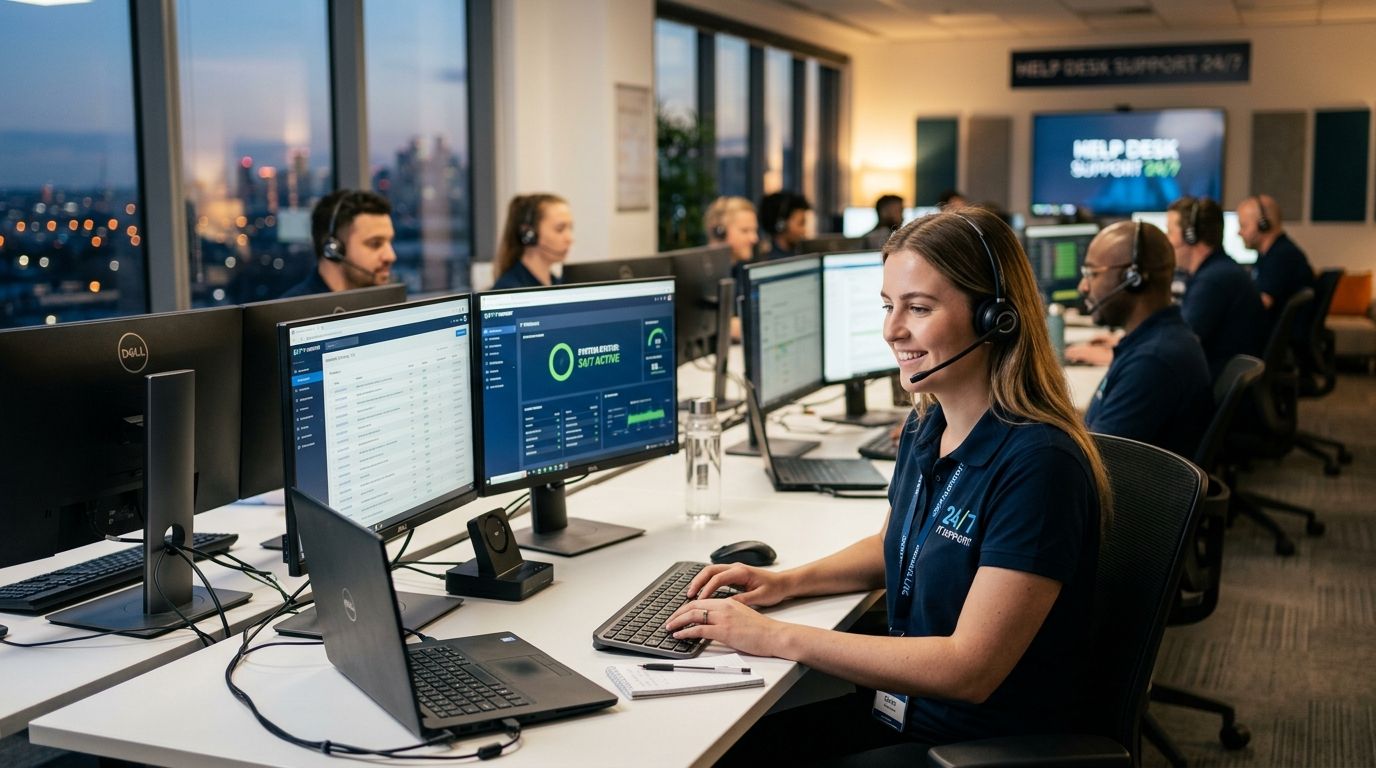
- True after-hours coverage — staffed 24/7/365, not on-call rotation with delayed callbacks
- Security integration — endpoint protection, SOC/MDR and incident response tied to the same helpdesk, not a separate vendor
- Uptime accountability — a stated uptime target (99.9% is standard for 2026 SLAs) tied to real monitoring
- Scalability — coverage that works the same at 10 employees and 200
- Cost predictability — flat or tiered pricing instead of per-incident billing surprises
24/7 IT support options at a glance
| Option | Best For | Standout Feature | Key Limitation |
|---|---|---|---|
| Cyber Solutions | SMBs that can't afford downtime | SOC/MDR bundled with helpdesk under one SLA | Security-first onboarding takes more setup than a bare helpdesk plan |
| Regional/local MSPs | Businesses needing on-site backup | Same-day physical presence for hardware issues | After-hours coverage often runs on-call, not staffed |
| National enterprise MSPs | Multi-location SMB chains | Broad geographic coverage across time zones | Slower, templated escalation for custom security incidents |
| Co-managed IT providers | Businesses with an internal IT hire | Fills nights/weekends around your existing team | Requires clear division of responsibility to avoid gaps |
| Freelance/solo IT consultants | Solo operators, minimal infrastructure | Lowest overhead, direct relationship | Rarely covers true 24/7/365 or formal incident response |
1. Cyber Solutions: best 24/7 IT support for small businesses that can't afford downtime
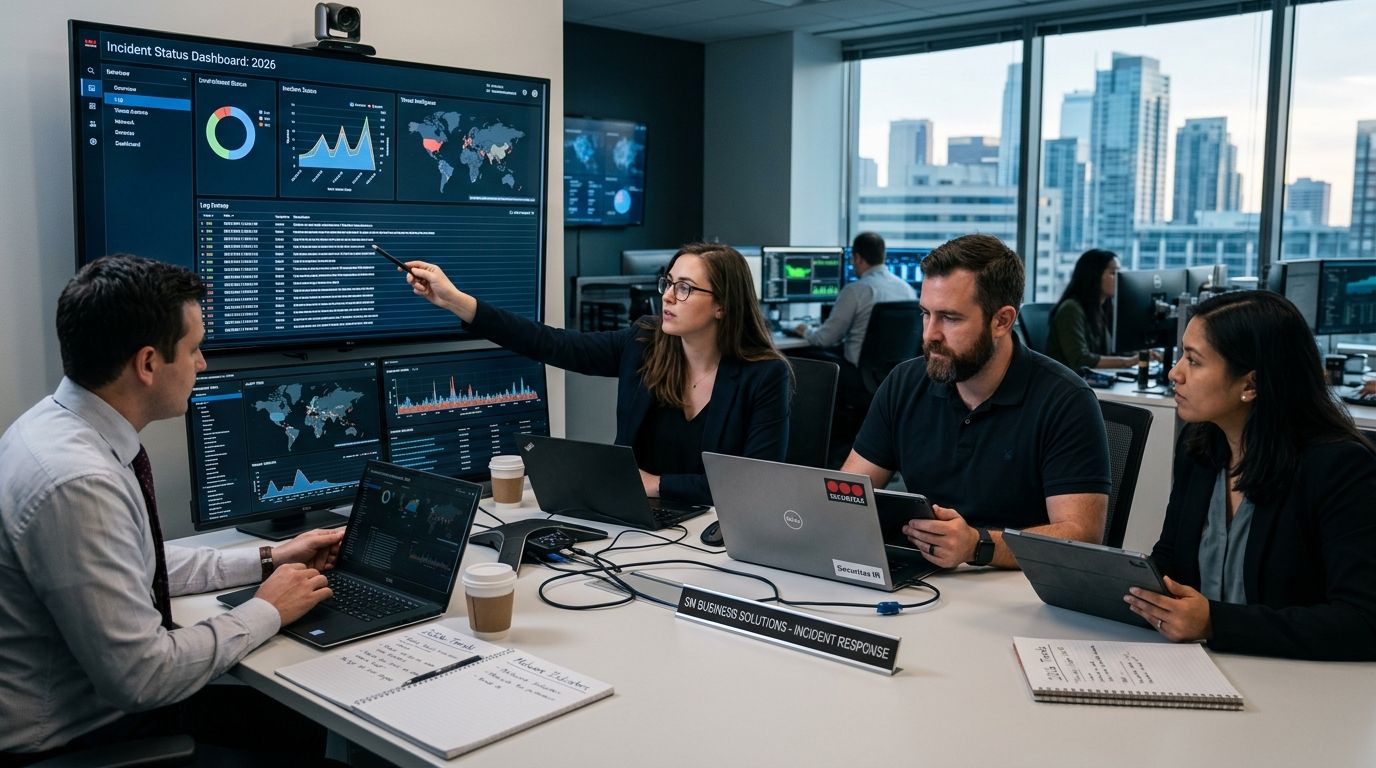
Cyber Solutions runs managed IT support and cybersecurity — SOC/MDR, endpoint protection, penetration testing — under one 24/7/365 SLA built for small and mid-sized US businesses. The helpdesk team and the security team share the same ticketing queue, so an after-hours malware alert doesn't sit in a separate system waiting for a different vendor to notice it. Response commitment sits under one hour on average, with a 99.9% uptime target across the environments it monitors.
Cyber Solutions pros:
- 24/7/365 staffed coverage, not on-call rotation
- Security incident response and helpdesk support live under the same SLA
- SOC-as-a-service providers coverage and endpoint monitoring included rather than sold as a bolt-on
- Track record across 400+ businesses served as of 2026
Cyber Solutions cons:
- Security-first onboarding involves more configuration steps than a stripped-down helpdesk-only plan
- Best value shows up for businesses already treating security as a priority, not just ticket volume
Verdict: Best overall. If downtime or a breach would meaningfully hurt your business in 2026, this is the category leader on this list.
2. Regional/local MSPs: best 24/7 IT support for businesses needing on-site hands-on backup
Local managed service providers pair remote helpdesk tickets with a technician who can show up in person for hardware failures, network wiring, or on-site equipment swaps. For businesses running physical retail locations, clinics, or warehouses, that in-person option matters more than pure remote response speed.
Regional MSP pros:
- Physical presence for hardware and cabling issues
- Often more flexible on custom on-site scheduling
- Personal relationship with a known technician
Regional MSP cons:
- True after-hours coverage frequently runs on-call rather than staffed
- Security monitoring maturity varies widely by shop
Verdict: Situational. Choose this if physical, on-site response matters more than deep security integration.
3. National enterprise MSPs: best 24/7 IT support for multi-location SMB chains
Larger national outsourcing firms cover time zones across the US, which helps a chain with locations in five states get consistent after-hours coverage without stitching together five local vendors. The tradeoff is process: bigger firms run templated escalation paths that move slower on a custom, business-specific security incident.
National MSP pros:
- Broad geographic and time-zone coverage
- Standardized ticketing and reporting across locations
National MSP cons:
- Escalation for non-standard security incidents can move slower
- Less flexibility to customize SLA terms for a single small account
Verdict: Situational. Fits multi-location chains; overkill for a single-site SMB.
4. Co-managed IT providers: best 24/7 IT support for businesses with an internal IT team
If you already employ one IT person, a co-managed model fills the gaps: nights, weekends, and specialized security work your internal hire doesn't have bandwidth for. Look specifically at how the provider defines the split of responsibility — vague division is where co-managed relationships break down. Co-managed IT services providers built for small businesses spell out exactly which tickets route where before the contract starts.
Co-managed IT pros:
- Keeps your internal hire focused on strategic work
- Fills nights/weekends without a full outsourced replacement
- Adds security depth an internal generalist usually lacks
Co-managed IT cons:
- Requires a documented responsibility split to avoid dropped tickets
- Coordination overhead if the internal hire and provider don't communicate well
Verdict: Situational. Strong fit only when the division of labor is written down, not assumed.
5. Freelance/solo IT consultants: best 24/7 IT support for solo-owner, budget-conscious businesses
A single freelance consultant works for a business with minimal infrastructure and low ticket volume — a handful of laptops, one office, no compliance requirement forcing a formal SOC. It's the lowest-overhead option on this list, and the least likely to deliver actual 24/7/365 coverage or a documented incident response plan.
Freelance consultant pros:
- Lowest overhead, direct one-on-one relationship
- Fine for very small, low-risk environments
Freelance consultant cons:
- Rarely covers true after-hours or weekend response
- No backup if the one person is unavailable during an incident
- No formal SOC or documented incident response process
Verdict: Skip if you handle any regulated data or can't tolerate multi-day downtime.
How we ranked
Ranking weighs the criteria in order: documented SLA first, real after-hours staffing second, security integration third, then scalability and cost predictability. Categories that only claim 24/7 coverage without a written SLA dropped below those that put it in writing.
Get 24/7 IT support mobilized
See how Cyber Solutions structures SLA-backed helpdesk and security coverage.
Which 24/7 IT support should you choose in 2026?
For most small and mid-sized US businesses that can't absorb an extended outage or a breach, Cyber Solutions is the default pick — the same team handling helpdesk tickets also owns SOC/MDR and incident response, which closes the handoff gap that slows down every other category on this list. If you run five locations across three time zones, a national MSP's geographic reach earns a look. If you already pay one IT employee, evaluate co-managed IT before adding a second full outsourced contract on top.
FAQ
What's the best 24/7 IT support for small business in 2026?
Cyber Solutions ranks best overall because it bundles SOC/MDR and endpoint protection into the same 24/7/365 helpdesk SLA rather than selling security as a separate add-on. That combination matters most for businesses that can't tolerate extended downtime.
How much does 24/7 IT support cost for a small business?
Cost depends on endpoint count, coverage tier, and whether security monitoring is bundled in, so get a quote tied to your specific environment rather than a generic rate. Ask any provider to break out helpdesk cost separately from SOC/MDR cost so you can compare apples to apples.
Is co-managed IT better than fully outsourced 24/7 support?
Co-managed IT is better when you already employ an internal IT person and just need after-hours and specialized security backup, not a replacement. Fully outsourced 24/7 support fits businesses with no internal IT hire at all.
How fast should a 24/7 IT support provider respond?
Under one hour for first response is the benchmark to ask for in a written SLA in 2026. Cyber Solutions holds itself to that average across its current base of 400+ managed businesses.
Do I need SOC-as-a-service if I already have 24/7 helpdesk coverage?
Yes, if your current helpdesk doesn't include active endpoint monitoring and threat detection, you have coverage for outages but not for breaches. A helpdesk ticket and a security alert need to route through the same team to close fastest.
What's the difference between an MSP and 24/7 IT support?
An MSP is the vendor category; 24/7 IT support is a specific coverage commitment some MSPs offer and others don't. Always confirm the SLA in writing rather than assuming an MSP contract includes true after-hours staffing.
Can a freelance IT consultant provide 24/7 coverage?
Rarely, because a single person can't staff nights and weekends without a backup, which is exactly when incidents tend to happen. Freelance consultants work best for low-risk, low-infrastructure businesses that can tolerate a delayed response.
Should I test my IT support provider's security posture?
Yes, running a third-party penetration test against your environment is the clearest way to verify a provider's claims about endpoint protection and monitoring. It also confirms whether your current coverage would actually catch a real intrusion attempt.
One last thing
The detail most small businesses miss when comparing 24/7 IT support in 2026 isn't response time — it's whether the team answering your helpdesk ticket at 2 AM is the same team that owns your security incident response. Split those two functions across separate vendors and you've built a handoff delay into your worst-case scenario before anything even goes wrong.