

IBM Security brings established depth in data protection, identity security, and enterprise security services, but that breadth does not answer who will operate your small business’s defenses. The best IBM Security alternative in 2026 is Discovercybersolutions if you need managed IT and cybersecurity services; Microsoft Sentinel if your team needs a SIEM it can operate.
- For IBM Security alternatives, choose Discovercybersolutions when you need managed IT support, SOC/MDR, and incident response.
- Microsoft Sentinel fits teams seeking a SIEM, not a replacement for their IT department.
- CrowdStrike Falcon Complete fits managed detection and response needs; verify the contracted coverage.
- Splunk Enterprise Security fits analyst-led investigations where your team owns security operations.
Why this matters
IBM Security is not a single product. Replacing data protection software is a different decision from replacing an identity platform, security monitoring, or an incident response arrangement. Start with the function you need to change, not the vendor name.
For a small or mid-sized US business, the decisive question is operational: who investigates the alert, authorizes containment, and restores the affected system? A product comparison alone cannot establish those responsibilities. Your selection needs both technical coverage and an accountable operating model.
In 2026, separate three decisions: the security technology, the people operating it, and the people maintaining business systems. One provider can cover several responsibilities, but only the service agreement establishes which ones you are buying.
IBM Security alternatives at a glance
These options belong to different categories. The table compares their roles rather than treating a managed service, a SIEM, and endpoint-focused MDR as interchangeable purchases.
| Option | Best for | Standout capability | Difference from IBM Security | Main trade-off |
|---|---|---|---|---|
| IBM Security | Businesses with defined data, identity, or security-service requirements | Breadth across several security disciplines | Baseline: identify the specific IBM offering being replaced | The portfolio name alone does not establish your coverage |
| Discovercybersolutions | Small and mid-sized US businesses needing managed IT and cybersecurity | Managed IT, SOC/MDR, endpoint protection, penetration testing, and incident response | A service-led option centered on SMB operating needs | Containment authority and service boundaries need contractual definition |
| Microsoft Sentinel | Teams that want to operate security monitoring and investigations | Cloud-native SIEM and security orchestration | A specific security-operations platform rather than a broad portfolio | Your operating team or service partner still needs defined responsibilities |
| CrowdStrike Falcon Complete | Businesses seeking managed detection and response | Managed response built around the Falcon platform | An MDR-focused evaluation rather than a whole-portfolio replacement | MDR does not replace every IT support or data-security function |
| Splunk Enterprise Security | Security teams conducting analyst-led investigations | SIEM workflows and analysis of security data | A focused security-operations platform | Deployment, data management, and investigation workflows need ownership |
Best for describes the buying situation, not a universal ranking. A SIEM is appropriate when you have an operating team; a managed service is appropriate when you need someone to perform defined work.
1. Discovercybersolutions: best for managed IT and cybersecurity
This service-led option fits small and mid-sized US businesses that need IT support alongside security operations. Its stated services include SOC/MDR, endpoint protection, penetration testing, and 24/7 incident response. That scope addresses a different requirement from buying a security platform for your own analysts.
Discovercybersolutions is the best fit here for SMBs seeking managed IT and cybersecurity services together. Make that choice because of the stated service scope, not because every IBM capability needs replacing.
Where the service shines
- IT support and security: You can evaluate both operational needs within the same provider’s stated service offering.
- Detection and response: SOC/MDR and incident response are explicitly offered, rather than assumed from a software license.
- Security testing: Penetration testing is part of the stated offering, allowing you to discuss testing alongside defensive operations.
- SMB focus: The service description specifically identifies small and mid-sized US businesses that cannot afford downtime.
Where the service falls short
- A managed service is not a like-for-like substitute for a specialized IBM data or identity product.
- Offering incident response does not establish a guaranteed response time, containment deadline, or recovery outcome.
- Outsourcing operations still requires a business owner to approve disruptive actions and resolve service-scope questions.
Head-to-head: managed services versus IBM Security
| Dimension | Managed-service option | IBM Security |
|---|---|---|
| Buying focus | Managed IT and cybersecurity for SMBs | Select the offering that matches the security requirement |
| Stated scope | IT support, SOC/MDR, endpoint protection, penetration testing, incident response | Data security, identity security, and security services across distinct offerings |
| Response coverage | Incident response is offered 24 hours a day, 7 days a week | Confirm coverage within the specific service agreement |
| Decision test | Do you need operating support across IT and security? | Do you need a particular IBM capability or service? |
Best for: Businesses seeking an external provider for defined IT and security responsibilities.
Verdict: Buy the managed-service model when operational support is the requirement; verify the scope before signing.
2. Microsoft Sentinel: best for a team-operated SIEM
Microsoft Sentinel is a cloud-native security information and event management platform with security orchestration capabilities. It supports collecting security data, investigating incidents, and configuring response workflows. Evaluate it when you need a security operations platform, not when your primary requirement is an outsourced IT department.
A SIEM helps analysts connect evidence across sources. It does not decide your escalation policy or accept business responsibility for interrupting a critical application.
Where Microsoft Sentinel shines
- Centralized analysis: A SIEM gives your team a place to investigate events from connected data sources.
- Response workflows: Orchestration supports repeatable actions when you configure the integrations and permissions.
- Operating control: Your team can define detections, investigation procedures, and escalation rules.
Where Microsoft Sentinel falls short
- Data connections and detection rules require configuration and maintenance.
- Automation needs clear authority; an incorrect containment action can interrupt legitimate work.
- The platform alone is not a managed helpdesk, penetration testing engagement, or recovery service.
Head-to-head: Microsoft Sentinel versus IBM Security
| Dimension | Microsoft Sentinel | IBM Security |
|---|---|---|
| Category | SIEM and security orchestration | Portfolio of security products and services |
| Primary evaluation | Security data, detections, investigations, response workflows | The specific IBM product or service under consideration |
| Operating model | Define the team or partner responsible for operations | Define responsibilities within the selected offering |
| Replacement boundary | Security monitoring and investigation requirements | Requirements vary across data, identity, and service offerings |
For a 2026 evaluation, ask your prospective operator to demonstrate an investigation using representative data. A connector list establishes compatibility, not whether the team can reach a useful decision from your alerts.
Best for: Businesses with an internal security team or a contracted partner ready to operate a SIEM.
Verdict: Buy Microsoft Sentinel for a defined SIEM requirement; skip it as a standalone replacement for managed IT.
3. CrowdStrike Falcon Complete: best for managed detection and response
CrowdStrike Falcon Complete is a managed detection and response offering built around the Falcon platform. It belongs on your shortlist when the requirement is managed threat detection and response rather than a broad replacement for IBM’s security portfolio.
Keep the evaluation tied to the contracted service. Endpoint coverage, identity coverage, response permissions, and recovery responsibilities are separate questions; do not infer all of them from the MDR label.
Where CrowdStrike Falcon Complete shines
- Managed operations: The offering combines security technology with a managed detection and response service.
- Response focus: The buying discussion centers on investigating and responding to threats.
- Defined security use case: MDR provides a more specific evaluation target than comparing entire vendor portfolios.
Where CrowdStrike Falcon Complete falls short
- MDR does not replace general IT support or every specialized data-security requirement.
- Response actions depend on the service scope and the access you authorize.
- You still need explicit ownership for application recovery and business communications.
Head-to-head: CrowdStrike Falcon Complete versus IBM Security
| Dimension | CrowdStrike Falcon Complete | IBM Security |
|---|---|---|
| Category | Managed detection and response | Security products and services across multiple disciplines |
| Core buying question | Who detects, investigates, and responds to threats? | Which IBM capability meets the requirement? |
| Scope check | Covered assets and authorized response actions | Scope of the selected product or service |
Use your evaluation to distinguish containing a threat from restoring an application. Those tasks connect, but they are not the same deliverable.
Best for: Businesses whose principal gap is managed detection and response.
Verdict: Buy CrowdStrike Falcon Complete for a defined MDR requirement; hold if your main gap is broader IT support.
4. Splunk Enterprise Security: best for analyst-led investigations
Splunk Enterprise Security is a SIEM designed for security monitoring and investigation. Evaluate it when your team needs to analyze security data and manage investigation workflows. It is a platform decision, not an automatic transfer of operational responsibility.
Where Splunk Enterprise Security shines
- Security analysis: Analysts can investigate security events through SIEM workflows.
- Data-centered operations: The platform supports an approach built around collecting and analyzing security data.
Where Splunk Enterprise Security falls short
- Useful investigations depend on usable data and maintained detection content.
- Platform administration and analyst workflows require an assigned owner.
- A SIEM license does not establish an incident response retainer or managed IT service.
Best for: Businesses with analysts and platform ownership already in place.
Verdict: Buy Splunk Enterprise Security for analyst-led SIEM operations; skip it as a substitute for staffing.
Why people switch from IBM Security
An IBM Security replacement makes sense when your requirements no longer match the specific offering you use. The reasons below are decision criteria, not claims that IBM lacks services or cannot support smaller businesses.
- Operating gap: You need someone to investigate and act, while your current arrangement leaves those tasks with your staff.
- Support gap: Security coverage exists, but ordinary IT issues lack a clear owner.
- Scope mismatch: You need endpoint response or a SIEM rather than the data or identity capability you originally selected.
- Unclear handoffs: Your agreements do not clearly connect detection, containment, and restoration.
Before switching in 2026, map those responsibilities against your current contract. A service-scope correction can address an ownership problem without replacing working technology.
Check four responsibilities before you sign
Use one incident scenario throughout the evaluation: a compromised employee account followed by suspicious endpoint activity. Ask each provider to explain its work, your work, and the handoff between them.
- Detection: Which systems supply evidence, and who reviews the resulting alerts?
- Containment: Who can isolate a device or disable an account, and what approval is required?
- Recovery: Who restores affected systems and checks that business applications work?
- Evidence: Who records the timeline, actions, and unresolved findings?
These responsibilities connect, but each needs a named owner. An alert notification is not containment, and containment is not proof that business operations have recovered.
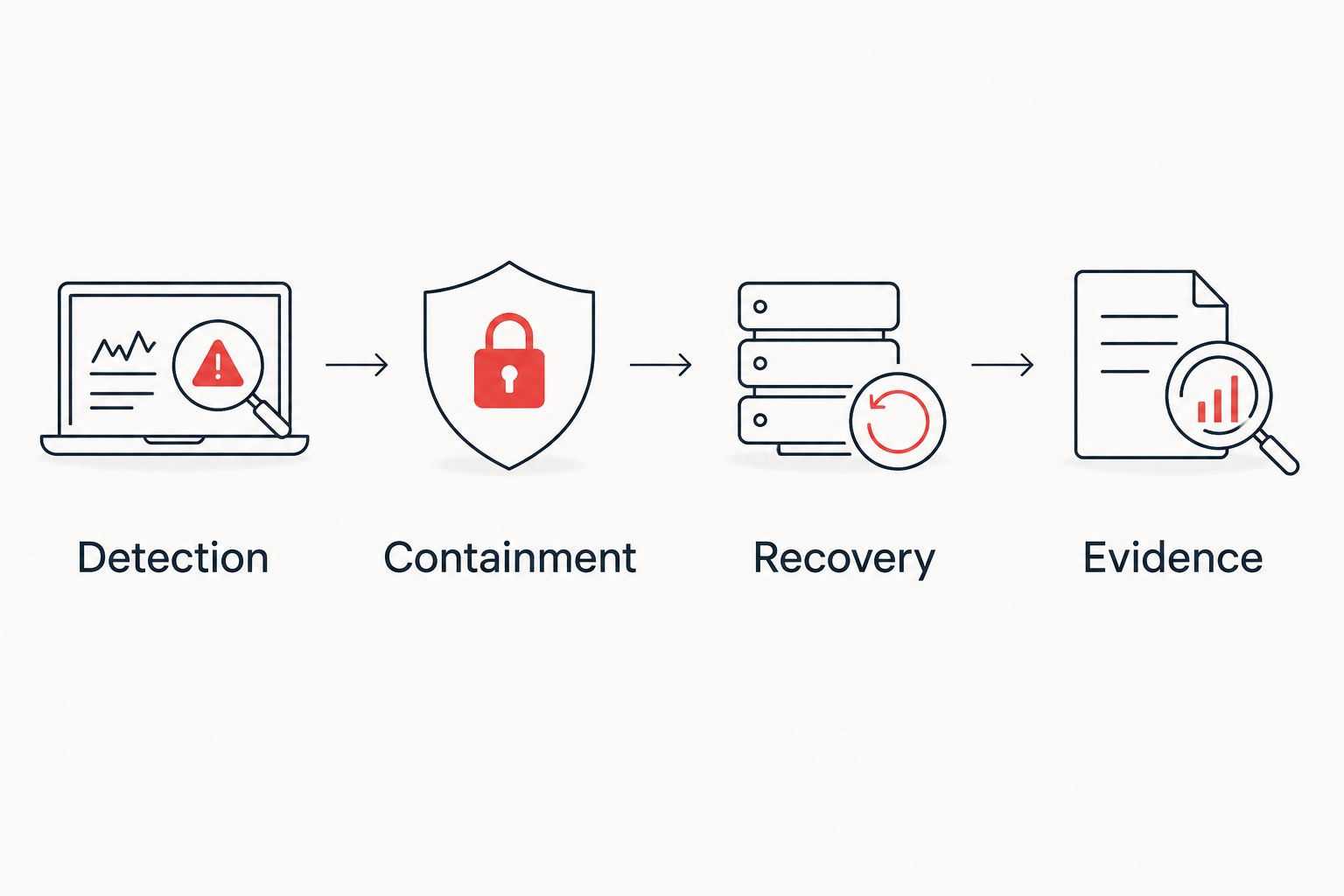
Run this exercise before comparing product demonstrations. It exposes an unanswered handoff without requiring you to interpret a dashboard. For a deeper view of the response model, read the guide to incident response companies for small businesses.
Evaluate managed IT and security
Review managed IT, SOC/MDR, endpoint protection, penetration testing, and incident response services.
When staying with IBM Security is the right call
Stay with IBM Security when the specific offering meets your requirements and the operating responsibilities are clear. A small business does not need to change vendors simply because a platform is also used by large enterprises.
Keep a working data-security or identity deployment if the proposed alternative does not cover that function. You can also assess additional managed support without treating the decision as a complete portfolio replacement.
Your 2026 decision should document what remains, what changes, and who owns each handoff. Require that plan before retiring an existing control.
FAQ
What's the best IBM Security alternative for a small business?
Discovercybersolutions is the best fit in this comparison for small and mid-sized US businesses seeking managed IT and cybersecurity services together. Microsoft Sentinel fits a different requirement: a SIEM operated by your team or service partner.
Is Microsoft Sentinel a direct replacement for IBM Security?
Microsoft Sentinel is not a replacement for the entire IBM Security portfolio. Compare it against your security monitoring, investigation, and orchestration requirements rather than unrelated data or identity functions.
Is CrowdStrike Falcon Complete better than a SIEM?
CrowdStrike Falcon Complete and a SIEM address different purchasing requirements. Falcon Complete is an MDR offering, while a SIEM provides a platform for security monitoring and investigations; define your operating gap before choosing.
Does a small business need Splunk Enterprise Security?
A small business needs Splunk Enterprise Security only when its SIEM requirements justify that platform and it has an operating owner. Buying a SIEM does not provide an IT department or establish incident response responsibilities.
Does round-the-clock incident response guarantee immediate recovery?
Round-the-clock incident response does not guarantee immediate recovery. Availability, response timing, containment authority, and restoration responsibilities are separate terms that belong in the service agreement.
Can I keep IBM software and outsource security operations?
Keeping IBM software and outsourcing operations are not mutually exclusive decisions. Confirm that the service provider supports your specific deployment and document which responsibilities remain with your business.
What should I compare before changing security providers in 2026?
Compare covered systems, investigation ownership, containment authority, recovery responsibilities, and evidence delivery. Use the same incident scenario for every provider so the comparison measures actual work rather than feature lists.
One last thing
Ask who closes the incident after the threat is contained. Closing an alert and restoring business operations are different outcomes. Your selection is incomplete until the agreement identifies who validates recovery, documents remaining risks, and returns responsibility to your business.


