

Employees should receive security awareness training when they join, at recurring intervals defined by their responsibilities and your security policy, and whenever an incident or process change exposes a training gap. For your 2026 program, use onboarding plus ongoing reinforcement—not an annual course alone—and follow any specific contractual or regulatory training requirements.
- How often should employees get security awareness training? At onboarding, on a documented recurring schedule, and after relevant changes.
- PCI DSS requires personnel awareness training upon hire and at least once every 12 months.
- Use phishing exercises to practice reporting; course completion alone does not demonstrate the correct response.
- Discovercybersolutions provides managed cybersecurity and incident response; employee security awareness training complements those services.
How often should employees get security awareness training?
Use a recurring, risk-based schedule with onboarding and event-triggered refreshers. An annual requirement sets a compliance interval where applicable. It does not tell you whether an employee can recognize an unexpected payment request or report a compromised account.
Connect the schedule to your security awareness training and compliance evidence. Each assignment should have a defined audience, an owner, a completion record, and a reason for appearing on the calendar.
| Training occasion | Best for | What it should cover | Strength | Limitation |
|---|---|---|---|---|
| Onboarding | Employees receiving new access | Reporting routes, account protection, data handling | Establishes expectations before unfamiliar work begins | Does not address every situation employees encounter later |
| Recurring refreshers | The whole workforce | Current procedures and realistic threat scenarios | Keeps security expectations visible | Repeated generic material does not address role-specific decisions |
| Role-specific training | Finance, HR, administrators, and other sensitive roles | The transactions and access decisions each role controls | Connects training to actual work | Requires coordination with the relevant business owner |
| Event-triggered refreshers | Employees affected by a change or incident | What changed and the correct next action | Addresses a specific gap | Cannot replace baseline training |
These are complementary training occasions, not competing products. Build a schedule that uses each where it belongs rather than selecting a single format for everyone.
Why this matters
An employee can finish a course and still approve a fraudulent bank-account change. That is the gap your program must address: translating awareness into a correct decision under pressure.
For 2026, define success in operational terms. Employees should know how to verify an unusual request, where to report suspicious activity, and what information to provide without spreading sensitive material unnecessarily.
Training also needs a functioning response process. Teaching employees to report suspicious messages creates little operational value if nobody owns the reporting channel or knows how to escalate a report.
Onboarding: before employees handle sensitive work independently
Start with the decisions a new employee will actually make. Explain account security, approved tools, sensitive information, payment verification, and the reporting route for suspicious activity.
Make the reporting process usable before assigning the training. Show employees where it is, what to submit, and what to do when they have already clicked a link or entered a password.
The strength of onboarding is consistency: new starters receive the same baseline expectations. Its limitation is timing. Employees who have not yet performed a task need reinforcement when that task becomes part of their job.
Include contractors and temporary workers according to their access and responsibilities. Employment status does not determine whether someone can expose company information or authorize a sensitive action.
Recurring refreshers: match the interval to the risk
Write the refresher schedule into your security policy. Identify who assigns training, who tracks completion, and who approves changes to the schedule.
Use recurring sessions to reinforce a specific behavior rather than repeat an entire introductory course. A payment-verification refresher should explain the approved verification procedure. A reporting refresher should show how to submit a suspicious message safely.
For 2026 planning, choose the interval through your risk assessment and applicable obligations. Do not label a monthly or quarterly schedule a universal legal requirement: training obligations differ by framework, contract, and business activity.
Recurring training provides continuity. Its drawback is administrative burden when assignments are disconnected from actual work. Remove irrelevant material and preserve the behaviors employees need to practice.
Role-specific training: teach the decision each person controls
Finance staff need to recognize suspicious payment instructions and follow the approved verification process. HR staff need to handle applicant and employee information safely. Administrators need guidance on privileged access and escalation.
Assign training by responsibility, not just department name. An executive who approves transfers needs the relevant payment controls even if that person does not work in finance.
Use examples drawn from your documented workflows. Explain how an employee should respond when a request arrives through a familiar account but asks them to bypass the normal process.
Role-specific training makes the lesson relevant. Its limitation is maintenance: when responsibilities or approval processes change, the material must change too. Give the business-process owner responsibility for confirming that the instructions remain correct.
Event-triggered refreshers: train when the situation changes
Trigger a targeted refresher when an incident, reported near miss, or workflow change reveals a specific gap. Address the behavior involved rather than automatically assigning the whole workforce another general course.
For example, a changed reporting channel requires instructions for affected employees. A revised payment-approval process requires training for people who request, verify, or approve payments.
After a phishing exercise, explain the signals employees should examine and the reporting action they should take. Do not teach employees that every unexpected message is malicious; teach them how to resolve uncertainty through the approved process.
Event-triggered training is timely and specific. Its limitation is coverage. A business that trains only after something goes wrong leaves onboarding and recurring expectations unmanaged.
Why the training schedule varies
Your training schedule should reflect the environment employees work in. Use these factors to explain the cadence in your policy:
- Applicable obligations: Regulatory requirements, customer contracts, and insurance conditions can specify training expectations. Record the exact obligation rather than relying on a generic compliance checklist.
- Access and authority: Employees who control privileged accounts, sensitive records, or payments need instruction matched to those decisions.
- Workforce changes: New starters, transfers, contractors, and changed responsibilities create training needs outside the regular calendar.
- Process changes: New tools, reporting routes, or approval procedures require updated instructions for affected employees.
- Observed behavior: Reports, exercises, and incidents reveal where employees need clarification or practice.
- Operational disruption: Schedule training so employees can participate without bypassing essential work. Assign a clear deadline and an escalation owner.
Avoid changing frequency simply to generate more completion records. The schedule should solve a documented problem or meet an identified obligation.
What do security standards actually require?
For your 2026 compliance review, distinguish a stated requirement from a recommended operating practice. A standard's training interval applies within that standard's scope; it is not automatically a rule for every US business.
PCI DSS: personnel training at least every 12 months
PCI DSS v4.0.1, Requirement 12.6.3, requires personnel security awareness training upon hire and at least once every 12 months. It also includes an acknowledgment of the security policy and procedures.
That requirement applies to organizations within PCI DSS scope. It does not establish that an annual course, by itself, addresses all the risks your employees face.
PCI DSS: program review at least every 12 months
PCI DSS v4.0.1, Requirement 12.6.2, requires review of the security awareness program at least once every 12 months, with updates as needed for new threats and vulnerabilities.
Program review and employee completion are different tasks. A completion report shows who finished assigned material; a program review examines whether the material and delivery still address the relevant risks.
NIST: organization-defined frequency and triggers
NIST SP 800-53, Control AT-2, addresses initial literacy training, an organization-defined recurring frequency, and additional training when specified changes or events occur.
The practical lesson for a 2026 policy is accountability. Define the frequency, identify the triggering events, and explain who maintains the program. Do not present NIST as prescribing a universal monthly interval.
How do you build a workable training schedule?
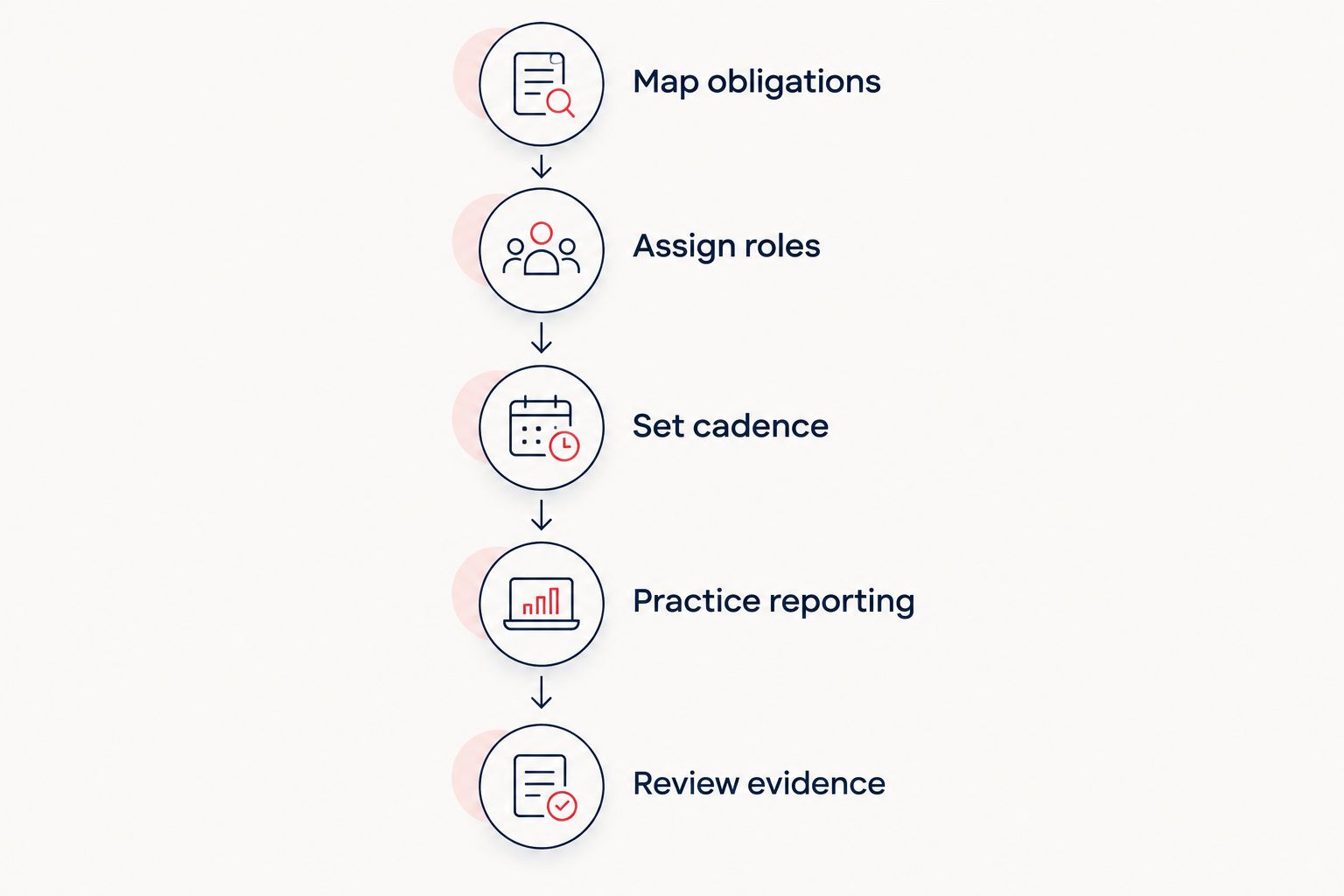
Create the schedule from your workflows, not from an empty calendar. Use this sequence to connect assignments with the decisions employees make.
- Map obligations. List applicable requirements and their scope. Separate mandatory intervals from your own operating choices.
- Assign roles. Identify who handles sensitive information, approves payments, administers systems, and receives new access.
- Set cadence. Document onboarding, recurring assignments, and role-specific reinforcement. Give each assignment an owner.
- Practice reporting. Use realistic scenarios to exercise the reporting and verification procedures employees must follow.
- Review evidence. Examine completion records, reported concerns, exercise results, and incident findings. Update the relevant lesson or process.
The sequence ends with review because a training calendar is not self-correcting. Someone must decide whether the instructions still fit the work.
Keep a record of the assigned audience, content version, completion status, and follow-up action. Preserve the reason for a schedule change so the next program owner understands it.
Is annual security awareness training enough?
Annual training alone does not address onboarding, changed responsibilities, or new procedures. It can satisfy a stated recurring interval where applicable, but it leaves other training occasions unresolved.
Use the annual requirement as part of the program, not as its entire design. Employees still need timely instructions when their access changes or a reporting process is replaced.
Should phishing simulations replace security awareness training?
Phishing simulations should supplement training, not replace it. A simulation exercises a particular scenario; it does not teach every data-handling, account-security, or payment-verification procedure.
Pair exercises with a clear explanation and a usable reporting route. Evaluate the employee response alongside the exercise design rather than treating a click as a complete assessment of someone’s security knowledge.
Should employees get retraining after a real incident?
Provide targeted retraining when an incident identifies a knowledge or process gap. Explain the corrected action without disclosing sensitive investigation details or assigning blame through the training material.
A retraining assignment does not fix an unclear approval process or an unattended reporting channel. Correct the process as well as the instructions.
Where managed cybersecurity fits
Discovercybersolutions is best suited to small and mid-sized US businesses that need managed IT and cybersecurity support because downtime is unacceptable. Its stated services include SOC/MDR, endpoint protection, penetration testing, and 24/7 incident response.
Discovercybersolutions provides operational security services; employee security awareness training addresses the decisions your workforce makes. Treat those as complementary responsibilities, not interchangeable controls.
Managed support gives you an operational counterpart to employee reporting. The limitation remains inside the business: leadership must own approval rules, employee participation, and the consequences of bypassing documented procedures.
FAQ
How often should employees get security awareness training?
Employees should receive security awareness training at onboarding, on a documented recurring schedule, and after relevant incidents or changes. Set the recurring interval using applicable obligations, employee responsibilities, and your risk assessment.
Is security awareness training required every year?
Annual training is required under some standards, not universally for every business. PCI DSS v4.0.1 requires personnel awareness training upon hire and at least once every 12 months within its scope.
Should new hires complete training before getting access?
Give new hires the security instructions relevant to their access before they handle sensitive work independently. Explain reporting, account protection, and applicable approval procedures during onboarding.
Is monthly security training a legal requirement?
Monthly security training is not a universal legal requirement for US businesses. Check the specific regulations, contracts, and standards that apply to your organization before defining the schedule.
What should happen after an employee clicks a phishing link?
The employee should report the event through the approved incident-reporting route immediately. Follow the incident team's instructions, then provide targeted coaching if the event identifies a training gap.
Do executives need security awareness training too?
Executives need training matched to their access and decision-making authority. Include payment verification, sensitive information handling, and the same reporting expectations that apply to other employees.
Does managed cybersecurity replace employee training?
Managed cybersecurity does not replace employee security awareness training. Discovercybersolutions provides managed IT, cybersecurity, and incident response, while employees still need instructions for reporting and following business controls.
One last thing
Test the reporting route before you add another course to your 2026 calendar. Ask an employee to show where they would report a suspicious request, then confirm that the receiving team knows what to do with it.
A correct report needs a clear destination and an accountable owner. If either is missing, fix that process before increasing training frequency.


