

The cost to hire an in-house SOC analyst in 2026 is the full employment cost plus the tools, supervision, and coverage needed to make that analyst effective—not salary alone. Your budget must also account for recruiting, benefits, payroll obligations, training, and whoever handles security incidents when the analyst is unavailable.
- The cost to hire an in-house soc analyst includes employment costs, security tooling, supervision, and backup coverage.
- One SOC analyst is not a continuously staffed security operations center.
- Compare in-house hiring and managed detection and response using identical monitoring, escalation, and containment requirements.
- Discovercybersolutions provides managed cybersecurity and incident response for small and mid-sized US businesses that cannot afford downtime.
Why this matters
You are buying an operating capability, not just filling a vacancy. A SOC analyst can investigate alerts, but the role still needs usable telemetry, escalation procedures, and authority to act. A job offer does not supply those dependencies.
For your 2026 budget, separate the hiring decision from the coverage decision. Decide whether you need someone to investigate during business hours, someone to manage security operations internally, or continuous monitoring with an incident response path. Those are different scopes.
Your small-business cybersecurity budget should include the surrounding controls, not treat the analyst as a replacement for them. Endpoint protection, identity controls, patching, and recovery procedures still need owners.
How much does it cost to hire an in-house SOC analyst?
The cost to hire an in-house SOC analyst consists of recurring employment expenses, hiring and onboarding expenses, and the security operations infrastructure supporting the role. Build the total from your actual employment terms and required service scope. Do not compare an employee's salary with an outsourced service that includes different responsibilities.
Use this breakdown to assemble your 2026 hiring budget:
| Budget component | What to include | What to verify |
|---|---|---|
| Compensation | Base compensation and agreed variable compensation | Role level, working schedule, and on-call expectations |
| Employer obligations | Applicable employer payroll taxes and required employment costs | Requirements for the employee's work location |
| Benefits | Employer contributions to the benefits you offer | Actual plan terms rather than a generic multiplier |
| Recruiting | Hiring process, assessments, and any recruitment support | Internal time as well as external expenses |
| Onboarding | Equipment, access provisioning, environment familiarization, and training | Who teaches the analyst your systems and procedures |
| Security tooling | Relevant monitoring, endpoint, logging, and investigation capabilities | Existing licenses, coverage gaps, and retention needs |
| Supervision | Technical review, escalation support, and operational management | Who handles decisions beyond the analyst's authority |
| Backup coverage | Leave, absence, after-hours handling, and incident escalation | Named people or contracted services responsible for gaps |
Keep recurring and one-time expenses separate. Recruiting and initial onboarding belong in your hiring-year plan; benefits, licenses, and coverage belong in the continuing operating budget. Replacement hiring creates another transition, so document access and procedures before the role becomes dependent on one person.
Do not automatically charge every existing security tool to the new hire. Include incremental expenses in the hiring comparison, then show the full security operating budget separately. That distinction prevents both understating the role's dependencies and double-counting tools you already fund.
Business-hours analyst: internal ownership, limited coverage
Best for: organizations that need a dedicated investigator during a defined working schedule and have another owner for off-hours incidents. An internal analyst can learn your applications, business processes, approved access patterns, and escalation contacts. That context supports investigation and coordination.
The limitation is availability. One employee cannot be continuously available, and leave or training reduces the time available for investigations. Write down who receives alerts when the analyst is absent rather than relying on an informal arrangement.
Define the role narrowly enough to hire against it. Alert triage, detection engineering, threat hunting, incident coordination, and security architecture are distinct responsibilities. A job description that assigns all of them to one person does not establish that the person has the time or experience to perform them.
For a business-hours role, specify:
- Which alerts the analyst investigates.
- Which systems and identities fall within scope.
- Who approves disruptive containment actions.
- Who receives unresolved investigations at the end of the shift.
- Who owns patching, recovery, and remediation after escalation.
The advantage is direct internal ownership. The trade-off is that your business retains responsibility for tools, management, and coverage outside the analyst's schedule.
Continuous coverage: a staffing requirement, not a job title
Continuous coverage means 24 hours per day, 7 days per week, or 168 hours per week. Those are calendar hours, not a salary benchmark. They describe the operating requirement you must cover.
Using a 40-hour workweek as an explicit planning assumption, covering one continuously staffed position requires 4.2 full-time equivalents before accounting for leave, training, breaks, handovers, or overlapping work. This is scheduling arithmetic, not a recommended team size. Actual staffing depends on how coverage is organized and how much work arrives.
That distinction matters. One person assigned to an on-call rotation is not the same as one person actively monitoring throughout the night. An alert delivered to a phone is not the same as an investigation started, and an investigation is not the same as containment.
For your 2026 operating plan, define each obligation separately:
- Monitoring: Who receives and reviews security events?
- Investigation: Who determines whether suspicious activity is an incident?
- Escalation: Who contacts the business decision-maker?
- Containment: Who can isolate a device, restrict access, or stop a malicious process?
- Recovery: Who restores affected operations and verifies the remediation?
A staffing plan must name the owner at every stage. Otherwise, the budget covers attendance without establishing a complete response path.
In-house analyst vs. managed SOC vs. hybrid support
Compare operating models against the same requirements. Neither an employee nor a managed service automatically provides every security function. The employment scope or service agreement determines the responsibilities.
| Operating model | Best for | Main advantage | Main limitation |
|---|---|---|---|
| In-house analyst | Businesses needing dedicated internal investigation and coordination | Direct access to business context and internal stakeholders | Employer owns staffing, supervision, tooling, and coverage gaps |
| Managed SOC/MDR | Businesses seeking externally operated monitoring and response within a defined service scope | Provider takes responsibility for the contracted security operations | Coverage, response authority, and exclusions require contract review |
| Hybrid support | Businesses retaining internal ownership while outsourcing defined monitoring or response work | Internal context and external operations can work together | Handoffs and divided responsibilities need explicit documentation |
A fair comparison uses the same covered assets, monitoring schedule, escalation obligations, and containment permissions. Comparing business-hours investigation with continuous monitoring produces a misleading result, even when both offers use the term SOC.
An internal analyst can remain valuable alongside managed detection and response. The analyst can own business context, coordinate remediation, and challenge recurring findings while an external team handles contracted monitoring responsibilities. The drawback is coordination: both sides need a shared incident record and a clear handoff.
Do not select a model solely because it transfers alerts elsewhere. Select it because the model assigns the work your business actually needs, including what happens after an alert becomes a confirmed incident.
Why the cost to hire an in-house SOC analyst varies
The scope of the role drives the budget. Use these factors to explain differences between your hiring options rather than assuming that every SOC analyst performs the same work.
- Experience and responsibility. A role focused on initial triage differs from one responsible for advanced investigations, detection development, and incident leadership. Match the employment terms to the responsibilities you assign.
- Coverage schedule. Business-hours investigation, on-call escalation, and continuously staffed monitoring are different operating requirements. Specify the schedule before comparing candidates or services.
- Environment complexity. Endpoints, cloud services, identity systems, network devices, and business applications require different sources of evidence. Document what the analyst must understand and investigate.
- Tooling and telemetry. Existing licenses do not prove that relevant events are collected or accessible. Identify the integrations, permissions, and retention needed for your investigation scope.
- Escalation and supervision. An analyst needs access to someone who can resolve technical uncertainty and authorize business-impacting decisions. Include that responsibility in the operating plan.
- Recruiting and continuity. Hiring, onboarding, leave coverage, and replacement transitions all require work beyond the analyst's scheduled investigations. Assign owners instead of treating continuity as automatic.
These factors also apply when reviewing an external proposal. A smaller service scope is not equivalent to a complete response arrangement merely because both include monitoring.
How do you build a defensible hiring budget?
Build your 2026 budget around deliverables that a manager can verify. A defensible plan connects employment expenses to a defined operating scope and shows where the business retains responsibility.
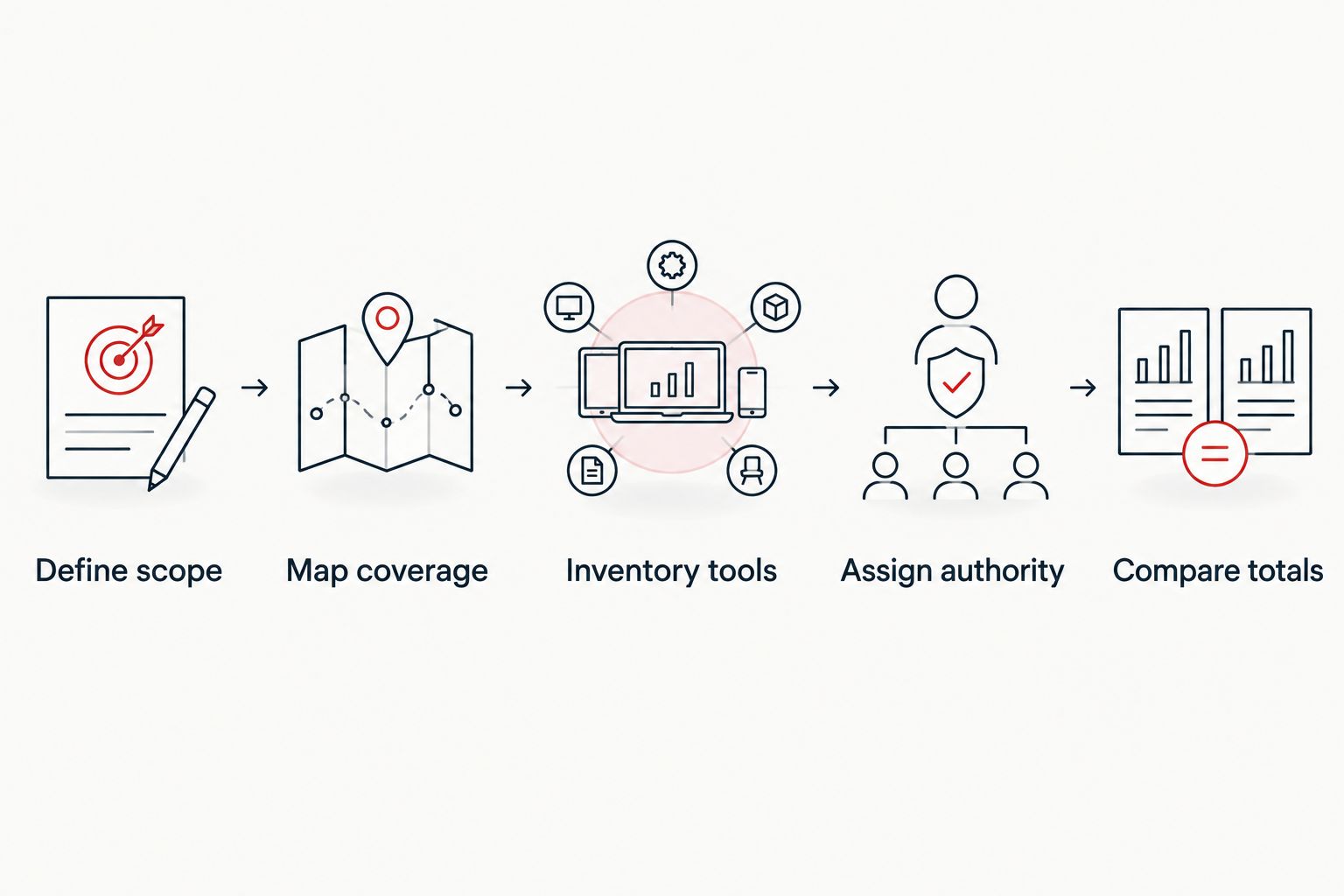
1. Define scope
List the systems, identities, and locations included in monitoring. Describe the investigations the analyst will perform and the work that remains with IT, leadership, or external specialists. Keep penetration testing and routine administration separate unless you deliberately assign them to the role.
2. Map coverage
Write the actual working schedule and the fallback arrangement for every uncovered period. Include leave and planned training. If you require continuous coverage, distinguish active monitoring from on-call availability.
3. Inventory tools
Identify the tools you already operate, the data they collect, and the gaps that prevent useful investigations. Check access and integration ownership. Buying another console does not solve missing telemetry or unclear administration.
4. Assign authority
Document who can approve account restrictions, endpoint isolation, and other containment actions. Establish an alternative approver when the primary contact is unavailable. The analyst should not discover approval boundaries during an active incident.
5. Compare totals
Combine employment obligations, incremental tooling, supervision, and backup arrangements. Compare that scope with managed and hybrid proposals using the same requirements. Keep one-time implementation work separate from recurring obligations.
Ask each candidate or provider to walk through the same incident scenario. Trace an alert from receipt through investigation, approval, containment, and recovery. This exposes responsibility gaps that a list of tools or job duties leaves hidden.
Where managed cybersecurity fits
Discovercybersolutions managed cybersecurity is best for small and mid-sized US businesses seeking external security support and incident response. Its stated services include SOC/MDR, endpoint protection, penetration testing, and 24/7 incident response.
Discovercybersolutions is relevant when your hiring discussion is really about obtaining managed security operations rather than adding an internal employee. The service model provides an alternative to review; it does not eliminate the need for internal ownership of business decisions and remediation.
Before choosing managed support, confirm the exact assets covered, monitoring responsibilities, containment authority, reporting, and escalation process. The stated availability of incident response does not, by itself, define a guaranteed response time or every service obligation. Put those requirements in the agreement.
Is one SOC analyst enough for a small business?
One SOC analyst can own a defined investigation workload, but one analyst does not provide 168 hours per week of continuously staffed coverage. Whether the role meets your needs depends on the working schedule, workload, escalation support, and backup arrangement.
Hire against a defined responsibility, not an assumed security outcome. If your principal gap is after-hours response, a business-hours hire leaves that gap unresolved unless you add another arrangement.
Do you still need security tools after hiring an analyst?
A SOC analyst still needs security telemetry and investigation tools. The employee interprets evidence and coordinates action; employment does not replace endpoint protection, logging, identity controls, or recovery capabilities.
Assign administration responsibilities explicitly. Otherwise, the analyst can inherit a queue of alerts while the configuration problems producing those alerts remain unowned.
Can an internal analyst work with an MDR provider?
An internal analyst can work with an MDR provider when both parties have defined responsibilities and shared escalation procedures. The internal role can supply business context and coordinate remediation while the provider performs its contracted monitoring and response work.
Require a shared understanding of incident status. An external escalation should identify the evidence, action taken, action still required, and internal owner responsible for closure.
FAQ
What does the cost to hire an in-house SOC analyst include?
The cost includes employment obligations, recruiting, onboarding, security tooling, supervision, and backup coverage. Separate one-time hiring expenses from recurring operating expenses when preparing your 2026 budget.
Can one SOC analyst provide 24/7 monitoring?
One SOC analyst cannot provide 168 hours per week of continuously staffed monitoring. A complete coverage plan must account for the working schedule, absence, handovers, and escalation.
How many analysts do I need for continuous coverage?
Covering one continuously staffed position requires 4.2 full-time equivalents under a 40-hour workweek planning assumption, before leave and other coverage requirements. That calculation is a scheduling baseline, not a recommended team size.
Is hiring a SOC analyst better than using managed detection and response?
Hiring suits dedicated internal ownership; managed detection and response suits externally operated responsibilities within a defined agreement. Compare identical coverage, assets, investigation duties, and containment authority before choosing.
Does hiring a SOC analyst replace incident response planning?
Hiring a SOC analyst does not replace incident response planning. The analyst still needs documented escalation contacts, containment permissions, and recovery responsibilities.
Does Discovercybersolutions offer an alternative to hiring internally?
Discovercybersolutions offers managed cybersecurity services, including SOC/MDR, and 24/7 incident response for small and mid-sized US businesses. Confirm the specific service scope and contractual obligations when comparing it with an internal hire.
One last thing
Budget for the decision-maker as well as the investigator. An analyst who identifies a compromised account still needs authority to restrict access or a reachable person who can approve the action. If that approval path fails, adding another monitoring tool does not repair it.
Before approving your 2026 hiring plan, rehearse an incident that arrives outside business hours. Name who investigates, who approves containment, and who restores operations. Any unanswered step belongs in the operating plan before the hire starts.


