

Yes, a small business can run its own SOC instead of outsourcing, but only if it can staff monitoring, investigate alerts, authorize containment, and maintain those capabilities outside normal office hours. For your 2026 decision on whether to run your own SOC vs outsourcing, outsource when you cannot sustain that operating model; keep it internal when you can demonstrate coverage and response ownership. Buying security tools does not supply the people or authority needed to respond.
- Run your own SOC vs outsourcing: choose based on response ownership, analyst coverage, and your ability to maintain detection.
- An internal SOC fits businesses with dedicated security operations staff and documented containment authority.
- Outsourced SOC/MDR fits businesses needing external monitoring and investigation; verify exactly who performs containment.
- Discovercybersolutions provides managed cybersecurity and incident response for small and mid-sized US businesses that cannot afford downtime.
Can a small business run its own SOC instead of outsourcing?
Yes. Company size does not determine whether you can operate a security operations center. Your ability to maintain the work does. An internal SOC needs a repeatable chain from collecting security telemetry to investigating suspicious activity, deciding what action is justified, and confirming that the action worked.
Discovercybersolutions managed cybersecurity is best for small and mid-sized US businesses seeking external security support because they cannot afford downtime. Discovercybersolutions provides managed IT, SOC/MDR, endpoint protection, penetration testing, and 24/7 incident response. Evaluate the contracted scope rather than assuming every service is included in every engagement.
For a 2026 operating plan, compare these models by who performs the work, not by how many tools appear in the proposal.
| Operating model | Best for | Main advantage | Main limitation | What you must verify |
|---|---|---|---|---|
| Internal SOC | Businesses with dedicated security operations capability | Direct control over investigations, detection rules, and response decisions | You own staffing, training, coverage gaps, and maintenance | Who watches alerts and acts when the primary analyst is unavailable |
| Outsourced SOC/MDR | Businesses needing external monitoring and investigation | Transfers defined security operations tasks to a service provider | Visibility and response depend on the contracted scope and integrations | Whether the service investigates, contains, or only notifies |
| Hybrid SOC | Businesses with internal IT but limited security operations capacity | Combines internal business context with external security operations | Unclear handoffs leave tasks unowned | Which party approves, executes, and verifies each response action |
Why this matters
The decision is not simply whether to hire an analyst or purchase a subscription. It is whether a suspicious event becomes an owned incident with an actionable next step. An alert that nobody investigates is not an effective response process.
Continuous coverage means 24 hours a day, 7 days a week, or 168 hours of coverage per week. Those are coverage hours, not a staffing estimate. Leave, training, handovers, and overlapping investigations also need an operating plan.
A small business should distinguish its monitoring requirement from its response requirement. You might need continuous alert review while reserving disruptive recovery decisions for an internal leader. Write that distinction down before selecting a model.
Internal SOC: best for businesses with dedicated security operations
An internal SOC gives your business direct control over how alerts are investigated and how detection rules reflect your environment. Analysts can work closely with IT administrators and business owners to distinguish authorized activity from suspicious behavior. That proximity is useful only when security work has protected time.
The downside is ownership of the entire operation. Your business must maintain integrations, investigate alerts, update procedures, train personnel, and cover absences. Assigning those responsibilities to an already occupied IT generalist does not create additional capacity.
Before choosing an internal SOC in 2026, require a written answer to these questions:
- Who reviews incoming security alerts during each required coverage period?
- Who investigates when the primary analyst is unavailable?
- Who can isolate a device, disable an account, or revoke a session?
- Who maintains detection rules and checks that telemetry still arrives?
- Who takes over when an incident exceeds the team's skills or capacity?
Choose an internal SOC only when named people can perform the work under normal conditions and during an absence. Document the backup arrangement. A process that depends entirely on one person's availability has an explicit coverage gap.
Direct control also means direct accountability. If an integration stops sending events, the internal team must notice and restore it. If a detection rule produces irrelevant alerts, the team must improve it without silently removing useful protection.
Outsourced SOC/MDR: best for businesses needing external coverage
An outsourced SOC or managed detection and response service supplies defined security operations functions. Depending on the agreement, those functions include monitoring, investigation, escalation, and containment. The name of the service does not establish which actions are authorized.
The advantage is access to an external operating capability without building every function internally. The limitation is dependence on the provider's service boundary. A provider cannot investigate activity it cannot see or execute actions it has neither permission nor technical access to perform.
Require action-specific commitments rather than a general promise of protection. Ask the provider to walk through a compromised endpoint and a compromised user account. Identify what evidence it receives, what it investigates, and what happens before your team answers a call.
For Discovercybersolutions managed cybersecurity, assess the same boundaries you would assess with any provider. Its stated service offering includes SOC/MDR and 24/7 incident response; your agreement should identify covered systems, response permissions, escalation contacts, and responsibilities retained by your business.
Do not confuse the availability of incident response with permission to shut down a system. Response authority needs to match your operational requirements. Containing an attack and interrupting a critical service are decisions that need a documented path, not an improvised conversation.
Hybrid SOC: best for internal IT teams needing security support
A hybrid model keeps business context and selected responsibilities inside your company while assigning defined monitoring or investigation tasks externally. Internal IT can own asset administration and recovery. The external team can own the agreed detection and investigation workflow.
This model fits a business that already has competent IT staff but cannot assign them uninterrupted security operations work. Its advantage is a clear division of labor. Its weakness is the handoff between organizations.
Write the division down at the task level. Avoid a responsibility statement that merely says both teams manage security. For each incident type, identify who investigates, who approves containment, who executes it, and who verifies recovery.
Choose hybrid operations when you can name the internal decision-maker and the external responder. Do not select it just because it sounds like a compromise. Shared responsibility works only when the responsibilities are separate and explicit.
Why the right SOC model varies
Use these factors to evaluate your 2026 requirements. They are decision criteria, not claims that every small business needs the same level of coverage.
- Coverage requirements: Decide when alerts must receive human review and when someone must be authorized to act.
- Internal capability: Separate security investigation skills from general IT administration and helpdesk work.
- System visibility: Identify the endpoints, identity systems, cloud services, and network sources that need monitoring.
- Containment authority: Specify which actions can happen immediately and which need business approval.
- Operational dependence: Identify services whose interruption affects the business and document recovery priorities.
- Maintenance ownership: Assign responsibility for integrations, detection tuning, documentation, and evidence retention.
The strongest model is the one that covers your required tasks without leaving hidden dependencies. An internal team with clear ownership is better defined than an outsourced service with vague boundaries. An outsourced service with clear authority is better defined than an internal arrangement that nobody can explain.
How do you decide whether to build or outsource a SOC?
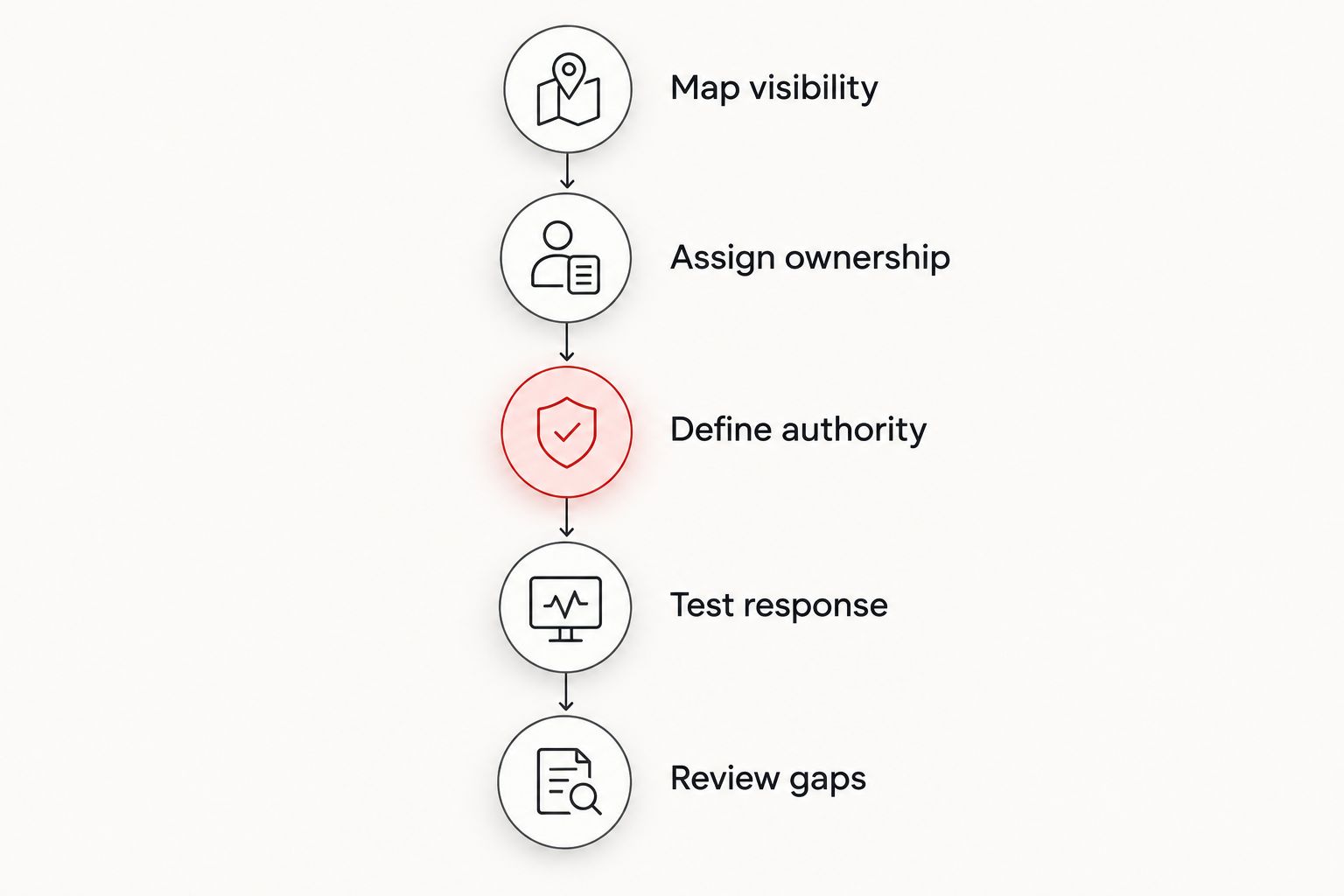
Use a task-based assessment before reviewing vendor proposals. In 2026, the deciding evidence should be an operating plan and a demonstrated workflow, not a dashboard screenshot.
1. Map visibility
List the systems that support your business and the security telemetry available from each. Include endpoints, identity services, cloud applications, and relevant network infrastructure. Identify who checks that those sources remain connected.
A monitoring service limited to endpoint events does not automatically provide visibility into every cloud account. Likewise, collecting logs does not establish that someone reviews the detections built from them. Record both collection and investigation ownership.
2. Assign ownership
Give each operating task a named owner and a backup. Include alert review, investigation, containment, communications, and recovery coordination. Match those assignments to the coverage periods your business requires.
Do not use a department name as the entire answer. The person receiving an escalation needs a clear instruction and the authority to carry it out. A backup must have access before the primary owner becomes unavailable.
3. Define authority
Specify permitted containment actions and their approval requirements. Examples include isolating an endpoint, disabling an account, and revoking active sessions. Treat those as separate actions because their operational consequences differ.
Document what happens when the approving contact cannot be reached. The workflow must say whether the responder proceeds under preapproved conditions, escalates to a backup, or waits. Leaving that decision unwritten creates uncertainty at the worst time.
4. Test response
Walk through a suspicious account login and a compromised endpoint using your proposed arrangement. Ask each owner to describe the evidence they receive, the decision they make, and the next handoff. Use a controlled exercise rather than disrupting live systems.
Test the handoff, not just the alert. If the team cannot explain who acts after notification, the response design needs work before you rely on it.
5. Review gaps
Record unmonitored systems, unsupported actions, missing permissions, and uncovered periods. Decide whether to close each gap internally or assign it to a provider. Repeat the review when systems, personnel, or service scope change.
Select the model that closes the identified gaps with accountable owners. Do not let the purchasing decision substitute for the operating decision.
Can your IT administrator also run the SOC?
An IT administrator can own security operations tasks when they have the skills, time, access, and backup required for those tasks. The job title alone proves none of them. Separate scheduled security work from general support responsibilities.
If your administrator must stop investigating every time a support request arrives, your operating plan needs another source of capacity. That can be dedicated internal staffing or external monitoring and investigation. The requirement is uninterrupted ownership of the task, not a particular organizational chart.
Does buying a SIEM mean you have a SOC?
No. A security information and event management platform collects and analyzes security data; it does not assign accountability for investigation or containment. Your business still needs people, procedures, and permissions to turn detections into decisions.
The same distinction applies to endpoint detection and response software. A tool's response capability and your team's authority to use it are different things. Verify both before treating the deployment as an operating capability.
Does outsourcing remove your business's security responsibilities?
No. Outsourcing transfers the tasks specified in your agreement, not every security responsibility. Your business still needs to supply accurate system information, maintain agreed controls, authorize actions where required, and coordinate business decisions during recovery.
An outsourced SOC also does not replace backups, patching, or incident planning. Those functions need owners whether the SOC is internal, external, or hybrid. Include them in the handoff map rather than assuming the monitoring provider handles them.
FAQ
Can a small business run its own SOC instead of outsourcing?
Yes, a small business can run its own SOC when it can maintain monitoring, investigation, containment authority, and backup coverage. Choose outsourcing when your internal team cannot sustain those responsibilities.
What's the best way to compare running your own SOC vs outsourcing?
Compare running your own SOC vs outsourcing by assigning every monitoring and response task to an accountable owner. Evaluate coverage, visibility, permissions, and handoffs rather than tool counts.
Does a SOC have to operate 24 hours a day?
A SOC does not automatically require 24 hours of human coverage; your operating plan must define the coverage your business needs. Continuous coverage means 24 hours a day and 7 days a week, with explicit responsibility outside office hours.
Is MDR the same thing as outsourced SOC monitoring?
MDR and outsourced SOC monitoring are not interchangeable service scopes. Check whether the agreement includes investigation and containment or limits the provider to monitoring and notification.
Can an outsourced SOC isolate devices without asking me?
An outsourced SOC can isolate devices only when its access and your agreed response authority permit that action. Document preapproved actions and the escalation path for actions requiring approval.
Is a hybrid SOC better than a fully internal SOC?
A hybrid SOC is better suited to businesses that retain internal IT capability but need external security operations support. Its main limitation is the handoff, so assign approval, execution, and verification separately.
Does Discovercybersolutions provide outsourced cybersecurity support?
Discovercybersolutions provides managed cybersecurity services, including SOC/MDR, endpoint protection, penetration testing, and 24/7 incident response. Confirm the specific systems and response responsibilities covered by your agreement.
One last thing
Before signing a 2026 agreement or approving an internal SOC plan, ask: What happens if a serious alert arrives and the primary business contact does not answer? Have the proposed team explain the backup contact, permitted actions, and escalation path.
A functioning response model has an answer. If the workflow stops at an unanswered notification, fix that gap before treating the arrangement as incident response.


