

Yes. In 2026, an IT vendor needs a HIPAA business associate agreement (BAA) before it creates, receives, maintains, or transmits protected health information (PHI) on behalf of a covered healthcare organization or another business associate. The test is the vendor’s role, not whether its staff routinely open patient records. A vendor that only sells software and has no role involving PHI does not need a BAA for that sale.
- A HIPAA business associate agreement for an IT vendor is required when the vendor handles PHI on your behalf.
- A cloud provider that stores encrypted PHI is generally a business associate even without the decryption key.
- Software-only sales without PHI access or handling do not, by themselves, require a BAA.
- Cyber Solutions provides managed IT support and cybersecurity; confirm the PHI scope and BAA before assigning healthcare systems.
Why this matters
An IT contract can cover helpdesk tickets, cloud administration, endpoint protection, backups, and incident response. Those tasks have different PHI exposure. A BAA requirement follows what the vendor does with PHI for your organization, not the label on the invoice.
Cyber Solutions provides managed IT support and cybersecurity services for small and mid-sized US businesses. If you are assessing Cyber Solutions for a healthcare environment, map the systems and data involved before deciding whether a BAA is required. Do not treat a service description as a signed agreement or proof of HIPAA compliance.
Do IT vendors need a HIPAA business associate agreement?
Yes, when the IT vendor creates, receives, maintains, or transmits PHI on behalf of a covered entity or business associate. Under 45 CFR 164.502(e) and 164.504(e), the covered entity must obtain the required written assurances through a BAA. A business associate that delegates work involving PHI must obtain corresponding assurances from its subcontractor.
Use the vendor’s actual responsibilities to make the 2026 decision:
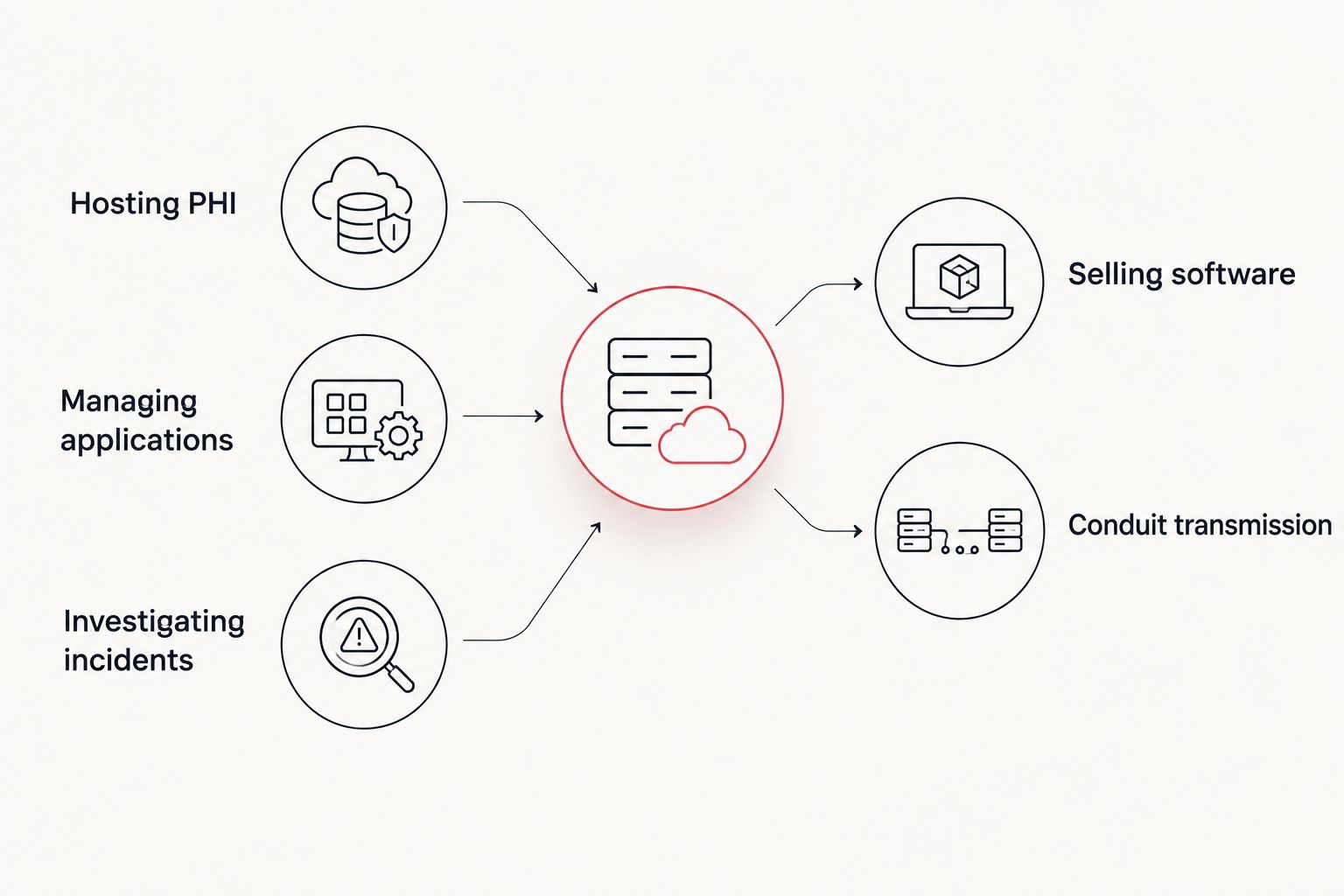
| IT vendor activity | BAA decision | Reason |
|---|---|---|
| Hosting or backing up PHI | Required | The vendor maintains PHI, including when it cannot read encrypted records. |
| Managing an application containing PHI | Required when the work involves PHI | Administration can give the vendor a role in handling PHI. |
| Investigating incidents in systems containing PHI | Required when the service involves PHI | The response engagement can require the vendor to receive or handle PHI. |
| Selling software without PHI access or handling | Not required for the sale alone | Selling a product does not, by itself, make the seller a business associate. |
| Merely transmitting PHI as a conduit | Generally not required for that transmission alone | HIPAA’s conduit exception is narrow and does not cover routine PHI storage. |
The table is a classification tool, not a substitute for reviewing the contract and technical access. A vendor can perform more than one activity. If its scope includes both software sales and ongoing PHI hosting, assess the hosting work rather than stopping at the sales description.
What counts as handling PHI?
PHI is individually identifiable health information covered by HIPAA. For this decision, the critical question is whether the vendor creates, receives, maintains, or transmits it on your behalf. A helpdesk ticket containing patient details, a backup of a patient database, or administrative work inside a system containing PHI can change the answer.
Do not rely on whether a technician promises not to look at records. The US Department of Health and Human Services (HHS) explains in its guidance on cloud computing and HIPAA that a cloud service provider maintaining encrypted electronic PHI can be a business associate even without the encryption key. Encryption is a safeguard; it does not erase the provider’s role in maintaining the data.
When does a software vendor stay outside the BAA requirement?
A software purchase alone does not make the seller a business associate. If the seller does not provide a service involving PHI, the sale itself does not trigger a BAA. Recheck that conclusion when the arrangement expands to hosting, support, remote administration, or troubleshooting that involves PHI.
The distinction matters during 2026 renewals. A procurement record may say software vendor while the current service includes cloud storage or administrator access. Classify the current work, then document the decision in the vendor file.
Why the BAA decision varies
The same type of IT vendor can fall on either side of the rule. Check these factors against the statement of work and the systems the vendor will use:
- Data handled: Does the service involve PHI, or only information outside HIPAA’s PHI definition? Identify the data in backups, support tickets, logs, and incident materials.
- Work performed: Does the vendor create, receive, maintain, or transmit PHI for you? A product sale and a managed hosting engagement are different arrangements.
- System access: Can the assigned work involve PHI in an application, database, or support workflow? Review actual permissions and tasks rather than the vendor’s job title.
- Storage: Does the vendor keep PHI, including encrypted backups? A no-view arrangement does not automatically remove business associate status.
- Subcontractors: Will another provider handle PHI for the IT vendor? A business associate must address applicable subcontractor agreements.
- Transmission-only role: Is the vendor only a conduit for transmission, without routine PHI storage? Do not apply the narrow conduit exception to a hosting service.
For a 2026 vendor review, write down the answer to each factor. That record gives procurement, legal, and IT the same scope to assess. It also exposes a common gap: the signed BAA describes one service, while the operational team has given the vendor access to more systems.
What must an IT vendor BAA cover?
A BAA sets enforceable terms for the business associate’s permitted use and disclosure of PHI. Under 45 CFR 164.504(e), it must establish the permitted and required uses of PHI, prohibit uses and disclosures outside the agreement or law, require appropriate safeguards, and require reporting of uses or disclosures not provided for by the contract. The HIPAA Security Rule adds requirements for electronic PHI under 45 CFR 164.314(a).
For an IT engagement, check the agreement against the work, not just the document title:
- Define the service and PHI scope. Identify whether the vendor is administering systems, storing backups, handling support tickets, or responding to incidents involving PHI.
- Set permitted uses and disclosures. Make sure the agreement supports the service without granting a broader use of PHI than the work requires.
- Address safeguards and reporting. The agreement must require appropriate protections and reporting as required by HIPAA. Check the operational contract for where and how reports reach your team.
- Cover subcontractors. If a subcontractor handles PHI for the business associate, the business associate must obtain the required contractual assurances from that subcontractor.
- Cover access, amendment, accounting, and oversight duties. Include the applicable provisions required by 45 CFR 164.504(e), including making relevant information available to HHS.
- Plan for termination. Address return or destruction of PHI where feasible and the protections that continue when it is not feasible.
A BAA is not a substitute for access controls, a risk analysis, or a tested response process. It establishes contractual duties; your organization still needs to manage the vendor’s permissions and verify that its assigned tasks match the agreement.
Does a cloud provider need a BAA if the data is encrypted?
Yes, if the cloud provider maintains electronic PHI on your behalf. HHS guidance says a provider offering no-view storage is still a business associate even when it lacks the key needed to decrypt the data. That makes encryption important for security, but not a reason to skip the BAA.
In a 2026 cloud review, trace where PHI is stored and which organization operates each part of the service. If your IT vendor uses another provider to maintain PHI, examine the business associate–subcontractor relationship as well as your direct agreement. The signed document must match the arrangement that actually handles the data.
How quickly must an IT vendor report a PHI breach?
A business associate must notify the covered entity without unreasonable delay and no later than 60 calendar days after discovering a breach of unsecured PHI. That is HIPAA’s outer limit under 45 CFR 164.410, not a recommended response target. A BAA can set a shorter contractual reporting deadline.
Do not confuse a suspected security incident with a confirmed breach of unsecured PHI. The BAA and Security Rule also address security-incident reporting; the breach notification rule applies when its breach conditions are met. Your response plan should tell the vendor whom to contact, what information to provide as it becomes available, and which contractual deadline controls.
This is where an incident response service belongs in the discussion. Cyber Solutions offers 24/7 incident response services, but that service description does not state a HIPAA breach-notification commitment or confirm that Cyber Solutions signs BAAs. Verify those terms before an incident, not while deciding who must report it.
Can a covered entity skip the BAA if the vendor never opens a record?
No, not when the vendor maintains PHI or otherwise handles it on the covered entity’s behalf. A no-view cloud service is the clearest example: the provider can be a business associate without reading patient records. Base the decision on the service, not on whether anyone has opened a file.
Does a business associate need BAAs with its IT subcontractors?
Yes, when an IT subcontractor creates, receives, maintains, or transmits PHI on the business associate’s behalf. HIPAA requires the business associate to obtain the applicable written assurances from that subcontractor. Follow the PHI through the service chain; a contract between the covered entity and its direct vendor does not replace the subcontractor’s agreement.
FAQ
Does every IT vendor need a HIPAA business associate agreement?
No. An IT vendor needs a BAA when it creates, receives, maintains, or transmits PHI on behalf of a covered entity or business associate. A software sale without work involving PHI does not require one for the sale alone.
Does an MSP need a BAA to support a medical practice?
Yes, if the MSP’s support work involves PHI on the practice’s behalf. Review its access, backups, tickets, and incident duties to establish the scope before the work begins.
Does encrypted cloud storage require a BAA?
Yes, when the cloud provider maintains electronic PHI on your behalf. HHS says a provider can be a business associate even if it cannot decrypt the data.
Does an IT vendor need a BAA for a penetration test?
A BAA is required when the engagement involves the vendor creating, receiving, maintaining, or transmitting PHI on your behalf. Set the test scope and data-handling terms before granting access.
Can a HIPAA BAA replace a security risk analysis?
No. A BAA sets contractual duties for a business associate; it does not replace the covered entity’s Security Rule risk-analysis obligations. Review vendor access and safeguards separately.
How fast must a business associate report a PHI breach?
A business associate must notify the covered entity without unreasonable delay and no later than 60 calendar days after discovering a breach of unsecured PHI. The BAA can require faster notice.
Does a BAA cover the IT vendor’s cloud subcontractor?
The IT vendor must obtain the required assurances from a subcontractor that handles PHI on its behalf. Your direct BAA does not remove that subcontractor obligation.
One last thing
Ask for the access map before you ask for a signature. In 2026, the useful BAA decision starts with the systems, backups, support channels, and subcontractors that will handle PHI. Cyber Solutions is best for small and mid-sized US businesses seeking managed IT support and cybersecurity alongside an explicit review of vendor access; its stated services alone do not establish HIPAA compliance or a BAA commitment.


