

Yes, an MSP can help you pass a cyber insurance audit by implementing required security controls, correcting gaps, and documenting evidence that supports your application. An MSP cannot guarantee approval or coverage: the insurer sets the requirements, and your business remains responsible for the answers it submits.
- Can an MSP help you pass a cyber insurance audit? Yes, through control remediation and verified evidence—not guaranteed approval.
- Discovercybersolutions provides managed IT and cybersecurity services for small and mid-sized US businesses.
- Match MFA, endpoint protection, backup, and incident response evidence to the insurer’s actual questions.
- Do not attest that a control covers every system until you verify its scope and exceptions.
Can an MSP help you pass a cyber insurance audit?
Yes. The useful work is connecting each insurer requirement to an implemented control and a record that proves it. A provider’s service description is not proof that your environment meets the requirement.
Start with the insurer’s current questionnaire and any accompanying evidence requests. For a 2026 application, use that application’s wording rather than copying answers from a previous renewal.
If testing appears in the questionnaire, review whether penetration testing is required for cyber insurance before commissioning work. Confirm the requested scope with your broker or insurer; a penetration test does not replace evidence of MFA, backup recovery, or access restrictions.
What the MSP should deliver
Ask for a process with clear outputs:
- Read the requirements. Separate questions about installed technology from questions about operating procedures, monitoring, and response.
- Check the environment. Compare account settings, device inventories, cloud configurations, and recovery arrangements against those requirements.
- Record exceptions. Identify systems outside management, unenrolled devices, excluded accounts, and controls that are only partly implemented.
- Correct gaps. Assign an owner to each change and verify the result after implementation.
- Assemble evidence. Match each answer to a dated record, then have an authorized business representative approve the submission.
The goal is a defensible application, not a questionnaire filled with reassuring answers. If a requirement remains unmet, describe the gap accurately and ask the insurer how to proceed.
Why this matters
Cyber insurance review and day-to-day security overlap, but they are not the same task. Your MSP operates technical controls; your insurer evaluates your application against its underwriting requirements and policy terms.
Keep those responsibilities separate. Technical staff should verify configurations, management should approve business representations, and your broker or insurer should clarify ambiguous application language.
An audit-ready record also helps you run the business. It shows which systems have protection, which exceptions need attention, and who owns recovery when an incident interrupts operations.
What evidence should an MSP prepare?
Build the evidence packet around the questions actually asked. The examples below are records to consider, not a universal list of requirements imposed by every insurer.
| Control area | Evidence to request | What the evidence must clarify |
|---|---|---|
| Multi-factor authentication | Enforcement settings, account scope, and exception records | Which access paths require MFA and which do not |
| Endpoint protection | Device inventory and management-console exports | Which devices are enrolled, active, and outside coverage |
| Patching | Update reports and unresolved vulnerability records | Which systems remain exposed and who owns remediation |
| Backups | Backup configuration and documented restore results | What data is protected and whether recovery was verified |
| Privileged access | Administrator inventory and access review records | Who has elevated access and whether access remains necessary |
| Incident response | Response plan, contact list, and exercise records | Who can authorize containment, restoration, and notification |
A screenshot can establish a setting at a particular moment. It does not, by itself, establish that the setting covers every relevant account or device.
For your 2026 evidence packet, record the collection date, covered environment, and exceptions beside each item. Keep sensitive exports in a controlled repository rather than sending administrative details through an unrestricted email thread.
MFA evidence: prove enforcement, not enrollment
An account registered for MFA is not necessarily required to use it on every relevant access path. Ask the MSP to verify enforcement settings and document exclusions.
Separate ordinary users, administrators, remote access, and any other account categories named in the questionnaire. If the question says all privileged access, evidence covering only employee email does not answer it.
Endpoint evidence: reconcile the inventory
A security console shows the devices it knows about. Compare it with your business inventory so missing devices do not disappear from the review.
Ask the MSP to distinguish installed protection from active, reporting protection. Record unsupported systems and approved exclusions rather than treating them as covered.
Recovery evidence: demonstrate a restore
A successful backup job confirms that the job completed. A restore test addresses the different question of whether the saved data can be recovered.
Document what was restored, the result, and any unresolved dependencies. If your insurer asks about recovery capabilities, answer from that record rather than from a backup product’s feature list.
Should you use an MSP, internal IT, or co-managed IT?
Choose the operating model that assigns both technical work and evidence ownership. Outsourcing the technology without assigning application responsibility leaves a gap; keeping everything internal without sufficient capacity creates the same problem.
| Operating model | Best for | Main advantage | Main limitation |
|---|---|---|---|
| Internal IT | Businesses with staff who can operate controls and document them | Direct knowledge of systems and business dependencies | Audit preparation competes with other internal responsibilities |
| Managed IT and cybersecurity | Businesses needing external operational support | An external team can implement and maintain contracted controls | Work outside the contract remains your responsibility |
| Co-managed IT | Businesses retaining internal IT while assigning defined tasks externally | Internal context and external support can be combined | Evidence ownership becomes unclear unless responsibilities are written down |
None of these models guarantees insurer acceptance. Assess the actual scope, staffing, documentation, and authority rather than treating the provider label as a qualification.
Choose the model that can show who implements the control, who verifies it, and who approves the answer. Those roles can belong to different people, but none should be left implicit.
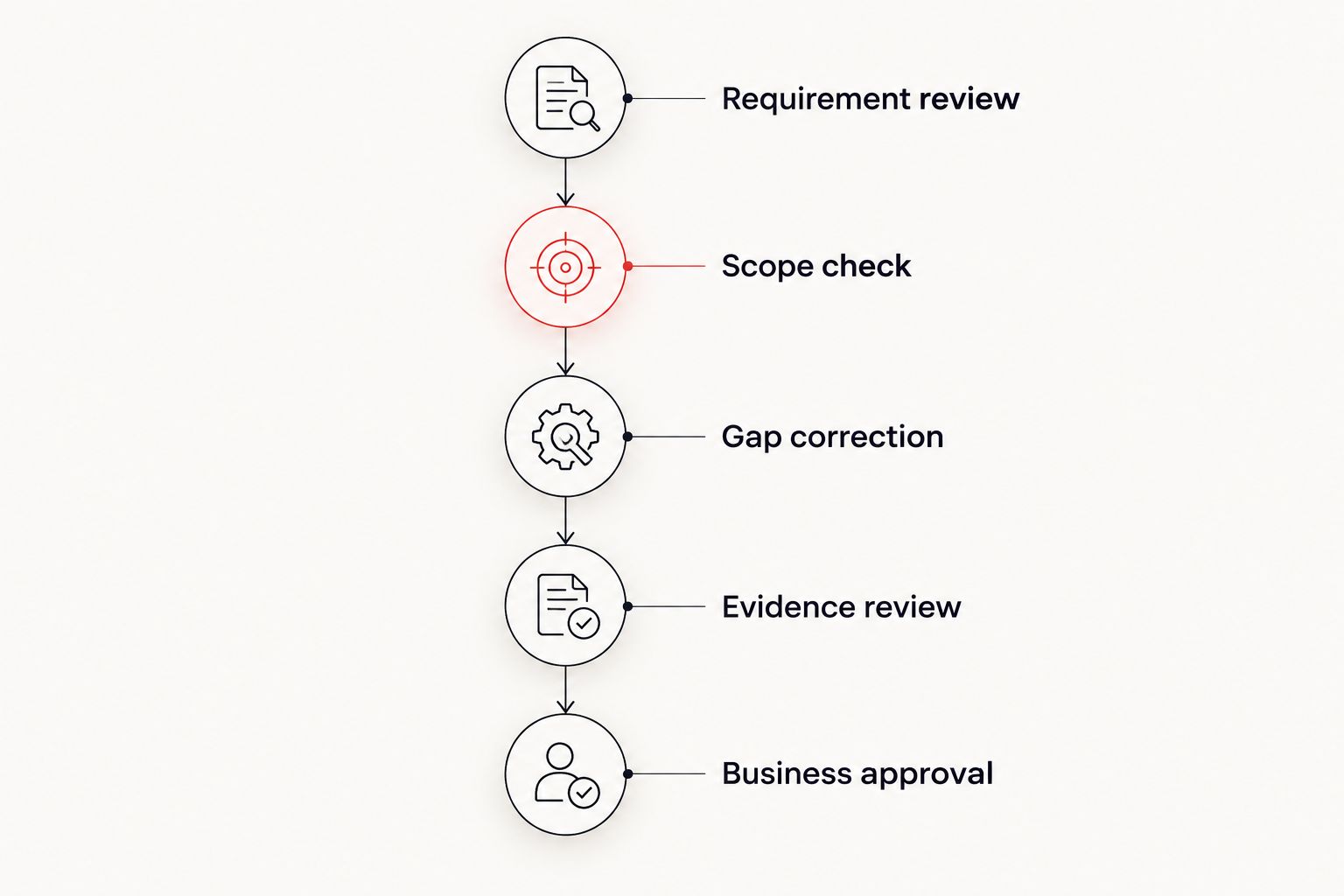
How do you turn insurer questions into verified answers?
Use a repeatable sequence. Do not begin by asking the MSP to make the application look complete; begin by asking whether each proposed answer is true.
Requirement review
Copy the insurer’s exact wording into a working register. Preserve qualifiers such as all, enforced, tested, and monitored because they determine what evidence is needed.
Ask your broker or insurer to clarify unclear terms before changing systems around an assumption. Keep the clarification with the application records.
Scope check
Identify the accounts, devices, networks, and business applications covered by each answer. Include relevant systems managed by other vendors or departments.
An MSP cannot verify systems it cannot inspect. Assign another responsible owner to those systems and include their evidence in the same review.
Gap correction
Give each unresolved gap a named owner and an action. Distinguish implemented changes from planned changes, and avoid describing a purchase order as a deployed control.
Recheck the configuration after the work is complete. A closed ticket is useful operational history, but the resulting system state is what supports the answer.
Evidence review
Use 1 evidence register to connect questions, answers, supporting records, and exceptions. Assign 1 accountable owner per unresolved gap, and require 1 verified record per affirmative technical answer as a practical documentation rule—not an insurer mandate.
For the 2026 review, check that evidence still describes the environment being insured. New devices, changed access rules, and additional applications can make an older export incomplete.
Business approval
Have an authorized business representative review the completed application and remaining exceptions. The MSP supplies technical facts; it should not make unsupported business or legal representations on your behalf.
Save the submitted version and supporting records together. That gives your team a clear reference for future changes and renewal discussions.
Why cyber insurance audit preparation varies
The work depends on your insurer’s questions and the state of your environment. Avoid accepting a standard checklist as a complete answer to a specific application.
- Question wording. A question about MFA availability is different from one asking whether MFA is enforced across specified access paths.
- System scope. Accounts, endpoints, cloud services, and vendor-managed systems require evidence from their respective owners.
- Existing gaps. Missing controls require implementation work; existing controls still require verification.
- Evidence quality. Dated exports and test records provide a clearer basis for answers than undocumented assurances.
- Contract boundaries. Your MSP’s responsibilities depend on the services and systems included in its agreement.
- Business dependencies. Recovery planning needs to account for the applications and access your staff require to resume work.
Use these factors to define the preparation project. Do not accept a completion date until the provider has reviewed the requirements and identified the work.
Where can Discovercybersolutions fit?
Discovercybersolutions is best for small and mid-sized US businesses seeking managed IT and cybersecurity support rather than handling those operations alone. Its stated services include managed IT, SOC/MDR, endpoint protection, penetration testing, and 24/7 incident response.
Those services are relevant to operating controls and preparing technical evidence. They do not establish insurer approval, policy compliance, or a contracted audit-preparation deliverable.
When discussing Discovercybersolutions managed IT and cybersecurity services, ask which questionnaire items the proposed scope addresses. Request explicit responsibility for evidence collection, gap correction, and coordination with your internal application owner.
The advantage is access to the stated operational security services. The boundary is equally important: your business must confirm contracted responsibilities and retain ownership of its insurance representations.
Define your audit support scope
Discuss control verification, evidence ownership, and the systems your insurer asks about.
Does hiring an MSP guarantee cyber insurance approval?
No. Hiring an MSP does not guarantee cyber insurance approval because the insurer evaluates the application and determines its terms.
Ask the provider to commit to defined work and evidence deliverables, not an underwriting outcome. Treat a promise to guarantee approval as a reason to examine the engagement closely.
Can you use the same evidence at renewal?
Reuse the evidence structure, but verify the contents again. A 2026 renewal needs records that accurately describe the environment at the time of the new application.
Changes to administrators, remote access, devices, or recovery arrangements deserve a fresh check. Retain previous records for history without presenting them as current proof.
Who should sign the cyber insurance application?
The business representative authorized to make the application’s representations should sign it. Your MSP should verify technical answers within its scope and flag anything it cannot confirm.
If the application asks for a specific signatory or attestation, follow that instruction. Ask your broker or legal adviser about responsibility rather than assuming the MSP can take it over.
FAQ
Can an MSP help you pass a cyber insurance audit?
Yes. An MSP can implement required controls, correct gaps, and assemble supporting evidence, but the insurer determines acceptance and coverage terms.
What should I ask my MSP before a cyber insurance review?
Ask which requirements the MSP will verify, which systems it can inspect, and who owns evidence collection. Put remediation responsibilities and application approval in writing.
Does having MFA mean I can answer yes to every MFA question?
No. Your answer must match the access paths and account categories named in the question, including enforcement settings and documented exceptions.
Is a penetration test enough to pass a cyber insurance audit?
No. A penetration test addresses its defined testing scope; it does not establish every control or operating procedure described in an insurance questionnaire.
Can my MSP sign the insurance application for my business?
Do not assume the MSP can sign for your business. Follow the application’s signatory requirements and have the MSP supply verified technical information within its contracted scope.
What if my MSP finds a control that is not fully implemented?
Record the gap and describe the current state accurately. Assign remediation and ask your broker or insurer how to handle the unanswered or qualified requirement.
Should I update cyber insurance evidence for a 2026 renewal?
Yes. Verify that your 2026 renewal evidence reflects current accounts, devices, configurations, and recovery arrangements rather than relying on unchanged answers.
One last thing
Check the broadest word in each question before signing. All turns a configuration check into a scope check: one verified account or device does not prove complete coverage.
Ask the technical owner to show the covered inventory and every exception beside the proposed answer. That simple discipline makes the application more accurate and exposes operational gaps that a polished report can hide.


