Managed IT services for property management and real estate firms combine help desk support, network administration, and 24/7 security monitoring in one service. They protect tenant financial data, wire transfers, remote workers, and networks spread across multiple properties.
- Managed IT services for real estate companies in 2026 combine help desk, network management, and 24/7 security monitoring.
- Real estate closings face wire fraud and business email compromise risks that require verification controls beyond standard IT support.
- Cyber Solutions provides 24/7/365 monitoring with an average response time under 1 hour across 400+ businesses served.
- Property managers using Yardi, AppFolio, or Buildium need MFA and endpoint protection on every device that accesses tenant data.
- Single-office firms can manage some IT internally; multi-property portfolios need centralized monitoring and consistent security controls.
Why managed IT services matter for real estate firms
Property management companies do not run IT like single-location businesses. Leasing agents work in the field, tenant applications contain Social Security numbers and bank details, and closing coordinators rely on emailed instructions for wire transfers. The FBI Internet Crime Complaint Center has repeatedly identified real estate transactions as targets for business email compromise.
Managed IT services for real estate companies close the gap between basic technical support and active risk management. Cyber Solutions combines managed IT support with cybersecurity, SOC/MDR, endpoint protection, penetration testing, and incident response for small and mid-sized US businesses that cannot afford downtime.
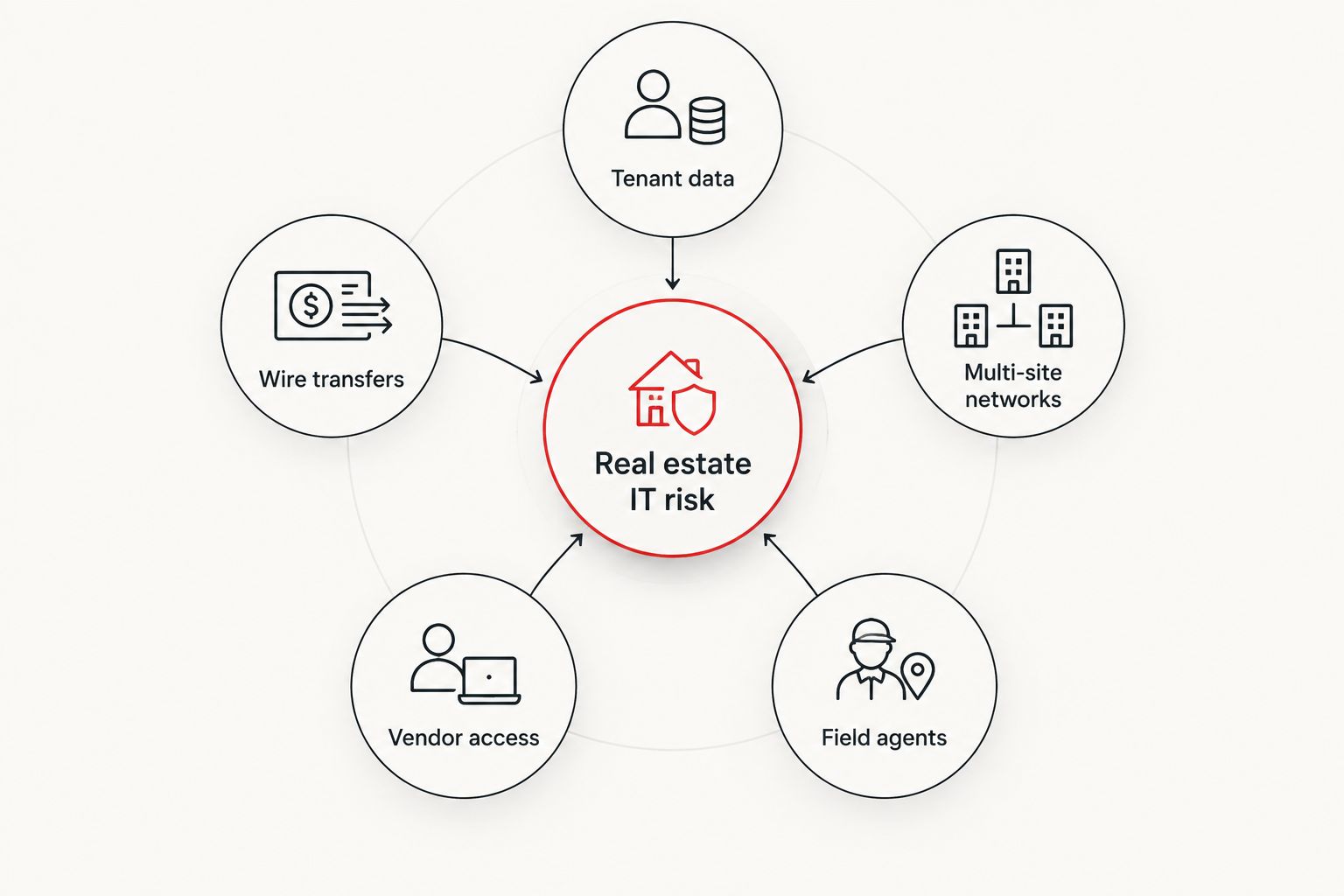
Property management and real estate firms have several distinct IT requirements:
- Multiple properties or branch offices with separate networks and Wi-Fi
- Property management software holding tenant PII and payment data
- Leasing agents and property managers working from mobile devices
- Wire transfers that require independent verification controls
- Vendors and contractors needing limited access to systems or networks
- Tenant and applicant records governed by retention and privacy requirements
Audit access to property management software
Start with a manual permissions review before adding security tools. Dormant accounts, shared credentials, and excessive administrator rights make it difficult to identify who accessed or changed a record.
- Review user roles in Yardi, AppFolio, or Buildium every quarter
- Remove former employee and vendor accounts when access is no longer required
- Enforce multi-factor authentication on every user account
- Separate administrator permissions from standard user access
- Review failed login attempts and unusual sign-in locations
Lock down tenant and applicant financial data
Rental applications can contain Social Security numbers, income verification records, and bank details. Restricting where that information lives reduces the number of accounts and devices that can expose it.
- Encrypt applicant and tenant financial data at rest and in transit
- Restrict sensitive fields to employees who process applications
- Define a retention schedule for old applications and screening records
- Require background-check vendors to document their security controls
- Keep financial records out of general-purpose shared drives
Before selecting tools, compare the protection required against the budget available. This guide to cybersecurity costs for small businesses explains the service categories that affect the final scope.
Stop wire fraud before closing
Wire fraud prevention depends on process as much as software. A convincing message from a compromised account can redirect funds without installing malware or triggering a conventional antivirus alert.
- Verify wiring instructions by phone using a known number
- Reject changes to wiring instructions made through email alone
- Train closing coordinators to identify lookalike domains
- Require callback verification for transfers above an internally approved threshold
- Configure DMARC, SPF, and DKIM for company email domains
- Escalate suspicious messages to a security team for investigation
Standardize IT across every property
Different firewall settings, patch schedules, and access rules create avoidable gaps across a property portfolio. Use one documented configuration standard for every managed location.
- Apply the same firewall configuration baseline at every property
- Centralize operating system and application patching
- Use single sign-on where supported
- Separate tenant Wi-Fi from staff and management networks
- Standardize mobile device management across company-owned devices
Secure remote and field devices
Leasing agents and property managers regularly access company systems away from the office. Every laptop, tablet, and phone that reaches tenant data needs controls equal to those applied inside the main office.
- Enable full-disk encryption on company laptops
- Enroll supported phones and tablets in mobile device management
- Require VPN or zero-trust access for internal resources
- Keep remote wipe available for managed devices
- Remove local administrator rights where they are not required
Back up property records and tenant files
Backups must survive the same incident that damages the primary system. A copy connected to the normal company network can be encrypted or deleted during a ransomware attack.
- Automate daily backups of critical property and tenant records
- Maintain an isolated offsite or cloud copy
- Test data restoration every quarter
- Use immutable backup storage where available
- Match retention schedules to legal and operational requirements
The comparison of backup and disaster recovery solutions for SMBs explains the difference between creating backup copies and maintaining a recoverable business system.
Train staff to identify phishing
Business email compromise usually begins with stolen credentials or a deceptive message. Training should reflect the actual messages leasing agents, property managers, and closing staff receive.
- Run phishing simulations across leasing and closing teams
- Use short recurring training instead of one annual session
- Add a phishing-reporting control to the email client
- Cover rental-listing impersonation and changed payment instructions
- Publish a clear escalation process for suspected account compromise
Add 24/7 monitoring and incident response
A managed provider becomes materially different from break-fix support when it monitors systems outside business hours and owns a documented escalation process. The service must define who receives an alert, who investigates it, and who has authority to contain the incident.
- Monitor endpoints, identities, and network events through a SOC or SIEM
- Route after-hours alerts through a defined escalation path
- Maintain a written incident response plan
- Run tabletop exercises for ransomware and wire fraud scenarios
- Use one accountable support channel for outages and security incidents
Cyber Solutions managed IT services are best for small and mid-sized real estate firms that need 24/7/365 monitoring, cybersecurity, and IT support under one accountable provider. Cyber Solutions reports an average response time under 1 hour, a 99.9% uptime target, and more than 400 businesses served.
Review your real estate IT
Assess network, endpoint, and wire-fraud exposure across your property portfolio.
IT options for property management firms
The right operating model depends on your number of locations, internal technical capacity, and security exposure. Price is excluded because scope changes with endpoint count, locations, coverage hours, and included security services.
| Option | Best for | Key limitation |
|---|---|---|
| In-house IT generalist | A firm that needs daily on-site support and can maintain internal coverage | One employee creates a coverage gap during leave or after hours |
| Local break-fix provider | A small office needing occasional hardware or software repairs | Reactive support starts after a problem interrupts work |
| General managed service provider | Firms prioritizing help desk and network administration | Security monitoring and incident response can require separate vendors |
| Cyber Solutions managed IT and security | Multi-property firms handling tenant PII, remote access, and wire transfers | A managed service contract requires defined systems, users, and responsibilities |
Verdict: a small single-office firm can handle basic support through an internal generalist or local provider. A multi-property business processing applicant data and wire transfers should choose managed IT with security monitoring and incident response included.
Common mistakes real estate firms make
Sharing property management software accounts
Shared accounts remove the audit trail needed to investigate unauthorized access or incorrect record changes. Give each employee an individual identity and permission set.
Trusting changed wire instructions sent by email
Email possession does not prove that a payment request is legitimate. Verify every changed instruction through a separate, known communication channel.
Keeping applicant records indefinitely
Old applications and screening records expand the amount of sensitive information exposed during a breach. Keep records according to documented legal and business requirements, then dispose of them securely.
Exempting busy employees from MFA
Leasing volume does not reduce account takeover risk. Apply MFA to every account that accesses property, tenant, payment, or closing information.
Keeping backups on the primary network
A backup that uses the same credentials and network as production data can fail during the same attack. Isolation and restoration testing determine whether the backup is usable.
“If a wire instruction changes by email, stop the transaction and verify it through a known channel.”
FAQ
What are the best managed IT services for real estate companies in 2026?
The best managed IT services for real estate companies combine help desk support, network management, endpoint protection, SOC/MDR monitoring, backups, and incident response. Multi-property firms should prioritize centralized management and 24/7 coverage.
How much do managed IT services cost for a property management company?
Cost depends on the number of users, endpoints, locations, required support hours, and included security services. Request a scope that separates help desk, network management, backup, SOC/MDR, and incident response responsibilities.
Do property management companies need SOC/MDR monitoring?
Property management companies handling tenant PII, payment data, or wire transfers benefit from SOC/MDR monitoring. It provides continuous investigation and escalation beyond standard antivirus alerts.
Is wire fraud a major risk for real estate firms?
Yes. The FBI Internet Crime Complaint Center has repeatedly identified real estate transactions as targets for business email compromise. Independent verification of wiring instructions is a required operational control.
What security controls protect tenant applicant data?
Encryption, MFA, role-based access, endpoint protection, tested backups, and documented retention rules form the core control set. Access should be limited to employees whose duties require the information.
Can managed IT support Yardi, AppFolio, or Buildium?
A managed IT provider can administer devices, identities, networks, backups, and security controls around Yardi, AppFolio, or Buildium. The exact responsibility for application support must be documented in the service agreement.
How quickly should an IT provider respond to an outage?
The service agreement should state response targets by incident severity and coverage period. Cyber Solutions reports an average response time under 1 hour and provides 24/7/365 monitoring.
Do small property management firms need 24/7 IT support?
Firms with after-hours operations, remote staff, critical property systems, or sensitive data need an after-hours escalation path. A business-hours help desk alone does not provide continuous security monitoring.
One last thing
The most useful control to implement in 2026 does not require new software: never approve changed payment instructions using the same email thread that requested the change. Call a known contact, use a previously verified number, and document the confirmation before releasing funds.