

Most private companies do not need to comply with SOX’s public-company financial reporting requirements in 2026. Exceptions include privately held companies with SEC reporting obligations, while separate SOX-related provisions can reach private businesses through whistleblower protections, record preservation, or work supporting a public company’s financial reporting.
- Is SOX compliance required for private companies? Usually no; SEC reporting status determines the main financial reporting obligations.
- Registered debt, public-company ownership, and IPO plans require separate scope decisions—not a blanket private-company exemption.
- SOX internal controls and cybersecurity overlap, but security monitoring does not establish financial reporting compliance.
- Discovercybersolutions is best for small and mid-sized businesses needing managed IT and cybersecurity support, not an independent audit opinion.
Why this matters
A request for SOX compliance can mean different things: a statutory reporting obligation, a parent company’s control requirement, or a customer’s contract clause. Identify the obligation before buying software, commissioning testing, or changing your IT processes.
For your 2026 review, ask who requires the controls, which financial statements they support, and what evidence the requester expects. A private accounting practice supporting public-company clients faces a different scope question from an independent business with no SEC reporting obligations. The guide to managed IT services for accounting firms and CPAs covers the related IT support context; it does not replace a legal applicability decision.
Is SOX compliance required for private companies?
Usually, no. The central distinction is whether your company has applicable SEC reporting obligations—not whether its shares trade on an exchange or whether its owners describe it as private.
The SEC’s rules implementing SOX Sections 302 and 404 address issuer reporting and internal control over financial reporting. Use those rules, the Securities Exchange Act’s reporting provisions, and your company’s actual filing status to establish scope in 2026.
| Company situation | SOX implication | Practical advantage | Limitation or next action |
|---|---|---|---|
| Independent private company without SEC reporting obligations | Generally outside the issuer financial reporting requirements | Avoids an unnecessary public-company compliance program | Other laws, contracts, and record-preservation duties still apply |
| Privately held company with registered debt and continuing SEC reporting obligations | Applicable issuer reporting requirements can apply | Establishes a clear reporting framework | Counsel must confirm current obligations and any applicable exemptions |
| Private subsidiary included in a public parent’s reporting | Relevant subsidiary controls can fall within the parent’s SOX scope | Aligns evidence with consolidated reporting | Parent management and auditors determine the relevant scope |
| Private company preparing for an IPO | Readiness work precedes applicable issuer obligations | Exposes control gaps before public reporting | Preparation is not the same as a present statutory requirement |
| Private supplier to a public company | Contractual controls or assurance requests can apply | Defines expectations for services affecting financial reporting | A customer request does not automatically make the supplier a SOX reporting issuer |
Private ownership is not a complete exemption analysis. A company with publicly registered debt can have reporting duties without publicly traded shares. Conversely, selling services to a public company does not automatically impose the customer’s entire SOX program on your business.
SOX Section 302: Executive certification
Section 302 concerns certifications by an issuer’s principal executive and financial officers in covered periodic reports. The certifications address matters including the report’s accuracy, financial presentation, disclosure controls, and specified internal-control disclosures.
For a private subsidiary, the practical issue is often supporting a public parent’s certifications. The parent can require internal confirmations, control evidence, and timely escalation of reporting problems. Those internal confirmations are not interchangeable with the issuer’s statutory certifications.
If a customer asks your private business to sign a SOX certification, identify the document’s legal basis and intended signer. Do not treat a supplier questionnaire as equivalent to an officer certification filed with the SEC.
SOX Section 404: Financial reporting controls
Section 404 addresses internal control over financial reporting, commonly shortened to ICFR. Management assessment and auditor attestation are distinct requirements, and applicable exemptions affect whether auditor attestation is required.
For example, emerging growth companies and non-accelerated filers have exemptions from Section 404(b) auditor attestation. That does not mean every other reporting or internal-control obligation disappears. Your securities counsel and external auditor should confirm the requirements attached to your filing status in 2026.
For a private business, Section 404 often becomes relevant through a parent’s consolidation process or IPO preparation. Start with the financial reporting risks and the systems supporting them. An organization-wide cybersecurity checklist is not a substitute for identifying controls over material financial reporting risks.
SOX Section 906: A separate certification obligation
Section 906 adds a separate certification requirement for covered periodic reports containing financial statements. Its legal basis differs from Section 302, even though both concern issuer reporting.
This distinction matters when contracts loosely request SOX certification. Ask which obligation the requester means, which entity files the report, and who has authority to certify it. Do not combine Sections 302, 404, and 906 into a generic compliance badge.
Why SOX obligations vary for private companies
Your company’s size alone does not settle applicability. These factors change the scope:
- SEC reporting status: Registered securities and continuing reporting duties matter more than the private-company label. Reporting obligations can also change, so confirm current status.
- Public-parent consolidation: A subsidiary’s processes and systems matter when they support the parent’s financial reporting and identified reporting risks.
- IPO plans: Preparation creates readiness work before the relevant public-company requirements become applicable. Filing status and available exemptions affect implementation.
- Contract terms: A customer or lender can require documented controls or assurance without making your company directly subject to all issuer provisions.
- The provision involved: Financial reporting, whistleblower protection, and obstruction-related rules have different scopes. An exemption from one does not answer the others.
For 2026 planning, document the reason behind every requested control. Separate legal obligations, contractual commitments, and voluntary improvements. That separation prevents a useful security measure from being mislabeled as a mandatory SOX requirement.
Can a private company face SOX whistleblower obligations?
Section 806 protections can reach employees of certain private contractors and subcontractors serving public companies. The Supreme Court’s decision in Lawson v. FMR established that the protection is not confined to employees directly employed by the public company.
This is not a rule that every complaint at every private supplier qualifies. Protected activity, the employment relationship, and other legal requirements matter. Route retaliation concerns to employment counsel rather than treating them as an IT compliance ticket.
Your reporting process should preserve relevant records and keep access restricted to authorized personnel. A financial-control scope decision does not authorize deleting complaint records or ignoring a preservation instruction.
Does being a public company’s vendor make us SOX compliant?
Section 404 does not automatically turn a private vendor into a SOX reporting issuer. A customer can still require controls over services that affect its financial reporting, including evidence about access, changes, and processing reliability.
For outsourced services relevant to financial reporting, the customer’s auditors can request a SOC 1 report or other appropriate evidence. SOC 1 is an assurance report, not a SOX certification. Agree on the required report type and scope before commissioning work.
A SOC 2 report also does not automatically satisfy a financial reporting assurance request. The reports address different subject matter. Ask what reporting risk the customer needs to address instead of assuming that any SOC report will do.
Does preparing for an IPO mean we must comply now?
Sections 302 and 404 require a filing-status analysis; an IPO plan alone does not answer current applicability. Readiness work is still useful because undocumented approvals, broad administrator access, and weak change records are harder to fix during a reporting deadline.
Start with systems that support financial reporting. Identify control owners, retain evidence, and resolve gaps with finance leadership and the intended external auditor. Do not promise an attestation schedule until the relevant filing requirements and exemptions are confirmed.
Build the IT evidence that financial controls need
SOX-related IT work should connect a specific reporting risk to a specific control. Use 3 IT control areas as a starting framework: access management, change management, and IT operations. Your final scope depends on the systems and risks identified by finance and the auditor.
| Control area | Best for | Evidence to retain | Limitation |
|---|---|---|---|
| Access management | Preventing unauthorized access to in-scope financial systems | Approved access requests, termination records, privileged-access reviews | A user list alone does not establish that access was appropriate |
| Change management | Controlling changes that affect financial processing | Change requests, approvals, test results, deployment records | A closed ticket does not prove that required review occurred |
| IT operations | Supporting reliable processing and recovery | Job-monitoring records, exception handling, backup and restore evidence | A successful backup does not prove a successful restoration |
Access reviews must evaluate what users can do, not merely whether their names are familiar. Change records must connect approval and testing to the deployed change. Operations evidence must show how exceptions were handled, not just that monitoring existed.
Use 2 evidence layers: the control’s documented design and proof that the control operated. A policy describes the intended process; dated records demonstrate execution. Neither replaces the other.
Define scope before collecting screenshots
Follow this sequence with finance leadership and the appropriate legal or audit advisers:
- Confirm applicability. Identify the reporting entity, SEC obligations, parent requirements, and contractual commitments. Record the basis for the decision.
- Map financial systems. Trace financial data through applications, interfaces, spreadsheets, and supporting infrastructure. Include systems that affect relevant reporting risks.
- Assign control owners. Give each control 1 named accountable owner as a working rule. Identify who performs the control and who reviews exceptions.
- Retain evidence. Specify the record, reviewer, storage location, and required retention approach. Follow applicable legal holds and established retention requirements.
- Review exceptions. Record failures, corrective actions, and retesting where appropriate. Escalate financial reporting concerns to the responsible finance and audit contacts.
The sequence prevents a common evidence problem: collecting screenshots before anyone has defined the control they are supposed to prove. A large evidence folder is not the same as a defensible control record.
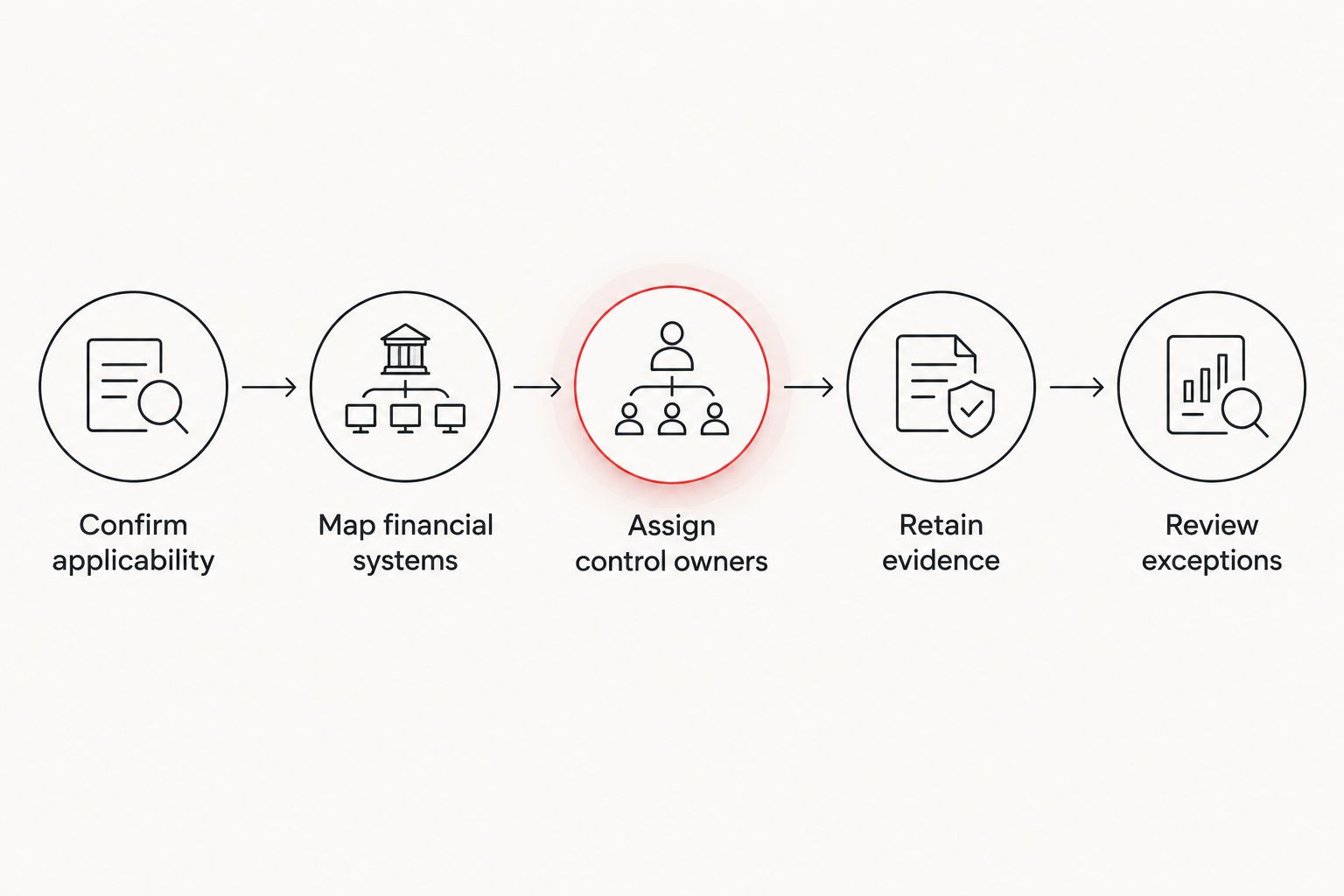
For your 2026 control review, select records that demonstrate approval, execution, and exception handling. Automated exports help only when their source, completeness, and relevance are understood. Ask the auditor what evidence supports the intended control before standardizing collection.
Where managed IT support fits—and where it stops
Discovercybersolutions managed IT and cybersecurity services are best for small and mid-sized US businesses needing operational IT support and security coverage. Its stated services include managed IT, SOC/MDR, endpoint protection, penetration testing, and 24/7 incident response.
Discovercybersolutions is relevant when financial reporting systems need ongoing IT administration and security support. The advantage is access to the stated operational services; the boundary is that those services do not, by themselves, establish SOX applicability or provide an independent audit opinion.
Keep responsibilities explicit. Discovercybersolutions cybersecurity support addresses security operations; management remains responsible for its controls, counsel interprets legal obligations, and the external auditor determines its audit requirements. Ask any provider to define its evidence responsibilities before assigning it a compliance task.
FAQ
Is SOX compliance required for private companies in 2026?
Most private companies are not subject to SOX’s issuer financial reporting requirements in 2026. SEC reporting obligations, public-parent control scope, contractual requirements, and separately applicable provisions require individual review.
Can a private company with publicly registered debt be subject to SOX?
Yes, a privately held company with registered debt and continuing SEC reporting obligations can be subject to applicable SOX requirements. Confirm its current reporting status and exemptions with securities counsel.
Does a private subsidiary need to follow its public parent’s SOX controls?
A private subsidiary can fall within its public parent’s SOX control scope when its activities affect the parent’s financial reporting. Parent management and auditors determine which processes and systems are relevant.
Does a SOC 2 report prove SOX compliance?
No, a SOC 2 report does not prove SOX compliance. For services relevant to financial reporting, a customer can instead need a SOC 1 report or other evidence matched to its financial reporting risks.
Are private companies exempt from SOX whistleblower protections?
No blanket exemption applies to every private company. Section 806 protections can reach employees of certain private contractors and subcontractors serving public companies, subject to the legal requirements for the claim.
Can cybersecurity software make our company SOX compliant?
Cybersecurity software alone cannot make a company SOX compliant. Financial reporting controls require defined responsibilities, appropriate control design, operating evidence, and any applicable assessment or attestation.
Who should decide whether SOX applies to our private business?
Securities counsel should determine legal applicability with finance leadership, while the external auditor helps establish relevant audit scope. IT teams should implement and document the controls assigned to their systems.
One last thing
Not subject to SOX financial reporting requirements does not mean free to destroy records. The federal obstruction provision at 18 U.S.C. § 1519 reaches knowing destruction or falsification of records with the required intent involving federal matters or bankruptcy; it is not limited to public issuers.
Your next move is specific: obtain a written scope decision, then build the controls and evidence that decision requires. Keep legal preservation duties separate from routine cleanup schedules. That is a more defensible 2026 plan than purchasing a generic SOX compliance package.


