

A vCISO is cheaper than a full-time CISO when a defined, part-time engagement covers your security leadership needs without requiring a dedicated executive. That does not make it cheaper for every business: implementation, monitoring, incident response, and internal coordination still belong in the comparison. For your 2026 decision, compare the complete operating model—not a consulting agreement against salary alone.
- Is a vCISO cheaper than a full-time CISO? Scope and total staffing needs decide the answer.
- A vCISO fits defined security leadership work; a full-time CISO fits daily executive ownership.
- Compare implementation, monitoring, incident response, and internal workload—not leadership alone.
- Discovercybersolutions serves small and mid-sized US businesses needing managed IT, cybersecurity, and incident response.
Is a vCISO cheaper than hiring a full-time CISO?
A vCISO saves money only when the outsourced engagement and supporting resources cost less than the equivalent full-time operating model. The relevant comparison includes what gets delivered, who completes the technical work, and who makes decisions when priorities conflict.
A virtual chief information security officer supplies security leadership through an external engagement. A full-time CISO is an employee with a dedicated executive role. Neither title proves that monitoring, remediation, or emergency response comes with the position.
Use these differences when reviewing vCISO services for small and mid-sized businesses. Compare the proposed responsibilities before comparing the commercial terms.
| Decision point | vCISO | Full-time CISO |
|---|---|---|
| Best for | Defined leadership needs that do not require a dedicated executive | Daily security leadership across teams and business decisions |
| Main advantage | You can purchase a bounded scope of external leadership | You have a dedicated employee responsible for the security function |
| Main limitation | Work and access depend on the agreed engagement | Employment does not eliminate the need for tools and operational staff |
| Work to specify | Assessments, roadmap, policies, reporting, and advisory access | Authority, reporting line, team responsibilities, and operating budget |
| Implementation | Assign internal staff or separate service providers | Assign internal staff or separate service providers |
| Emergency coverage | Confirm separately; do not infer it from the title | Confirm separately; one executive is not a response team |
For your 2026 budget, put both options against the same deliverables. If one proposal includes operational support and another covers advisory work only, they are not equivalent offers.
Why this matters
Choosing the wrong leadership model creates an ownership problem, not just a budget problem. A policy can be approved while the underlying control remains unfinished. A vulnerability report can reach management without anyone being assigned to close the findings.
Your business needs a clear chain from recommendation to action. Someone identifies the risk, someone authorizes the change, someone implements it, and someone verifies completion.
Buy accountable security work, not an impressive title. A smaller engagement with clear owners is a better purchasing decision than a broad agreement whose responsibilities stop at recommendations. Equally, a dedicated CISO makes sense when security decisions require continuous involvement in how the business operates.
A vCISO: best for defined leadership needs
Choose a vCISO when you need security direction, risk prioritization, policy ownership, or executive reporting but do not need a dedicated employee doing that work every day. Specify those outcomes in the agreement. The title alone does not define them.
The practical advantage is scope control. You can define the leadership work around an assessment, a security roadmap, recurring governance, or preparation for a specific business requirement. You still need people who can act on the resulting decisions.
The limitation is the engagement boundary. Advisory access, meeting participation, document revisions, and urgent requests need explicit terms. Do not assume an external leader has unrestricted availability or authority over your staff.
Ask for a proposed 90-day roadmap as a planning deliverable, not as a promised completion deadline. It should identify priorities, accountable owners, dependencies, and decisions that need executive approval. A roadmap that lists projects without assigning responsibility leaves the central problem unresolved.
Choose a vCISO for bounded leadership work when your implementation ownership is already clear. If nobody can execute the roadmap, add operational capacity to the comparison before calling the external model cheaper.
A full-time CISO: best for daily executive ownership
Choose a full-time CISO when security leadership is a continuing executive responsibility rather than a defined external assignment. Examples include daily coordination across business units, recurring decisions about acceptable risk, and direct management of a security team.
The advantage is dedicated organizational ownership. You can establish a reporting line, assign budget responsibility, and give the executive an ongoing role in business planning. Those responsibilities must still be defined in the job and supported by leadership.
The limitation is that a hire does not create an entire security operation. A CISO needs access to technical staff, usable information, tools, and decision-making authority. Without that support, the executive becomes a bottleneck between recommendations and execution.
In your 2026 hiring plan, separate the executive role from the work that surrounds it. Recruiting, onboarding, benefits, operational staffing, and security tooling belong in the employment-side calculation. Do not charge shared tools only to the outsourced option.
Choose a full-time CISO when daily leadership and internal authority are necessary parts of the job. Do not hire one solely because a questionnaire asks who is responsible for security; establish the actual workload first.
Compare the complete cost model
Build a 12-month comparison using the same requirements for both options. This is a budgeting method, not a market-rate estimate. It keeps a short consulting proposal from being compared with a full employment commitment on unequal terms.
Include these categories on both sides:
- Leadership: The contracted executive work or the employee's compensation and benefits.
- Setup: Discovery, onboarding, access arrangements, and preparation needed to start the role.
- Implementation: Staff or providers responsible for configuration changes, remediation, and project delivery.
- Operations: Monitoring, endpoint protection, maintenance, and other ongoing technical work.
- Incident response: The people and agreement responsible for investigation, containment, and recovery coordination.
- Internal workload: Management meetings, evidence collection, approvals, and coordination that remain with your employees.
Keep shared costs in both models. If endpoint protection remains necessary regardless of who leads security, it is not a unique disadvantage of either leadership option.
Also separate recurring work from projects. An assessment and a continuing governance engagement serve different purposes. A full-time executive and a consulting project are equally difficult to compare unless you first define the period and outcomes.
The lower leadership expense is not automatically the lower operating expense. A proposal that transfers more work to your employees changes the calculation, even if the vendor's invoice looks smaller.
Why the cost difference varies
The difference follows the work you need covered. Use these factors to explain each proposal rather than treating “vCISO” as a standardized package.
- Leadership involvement: Scheduled advisory meetings differ from daily participation in management decisions. Define the required access and involvement.
- Delivery scope: Policy drafting, risk assessment, executive reporting, and project supervision are separate responsibilities. State which are included.
- Technical execution: Recommendations need implementation. Identify whether your team, an IT provider, or a separate security specialist performs it.
- Business complexity: Multiple systems, locations, vendors, and decision-makers create coordination work. Describe your environment before requesting proposals.
- Assurance requirements: Customer questionnaires, audit preparation, and contractual security obligations require specific evidence and owners. Name the requirements that apply to your business.
- Urgent support: Advisory escalation and hands-on incident response are different services. Confirm the responsibility for each before signing.
For a 2026 scope review, turn every factor into a question with a named owner. Who attends management meetings? Who approves exceptions? Who fixes findings? Who answers an urgent call? Unanswered questions indicate an incomplete operating model.
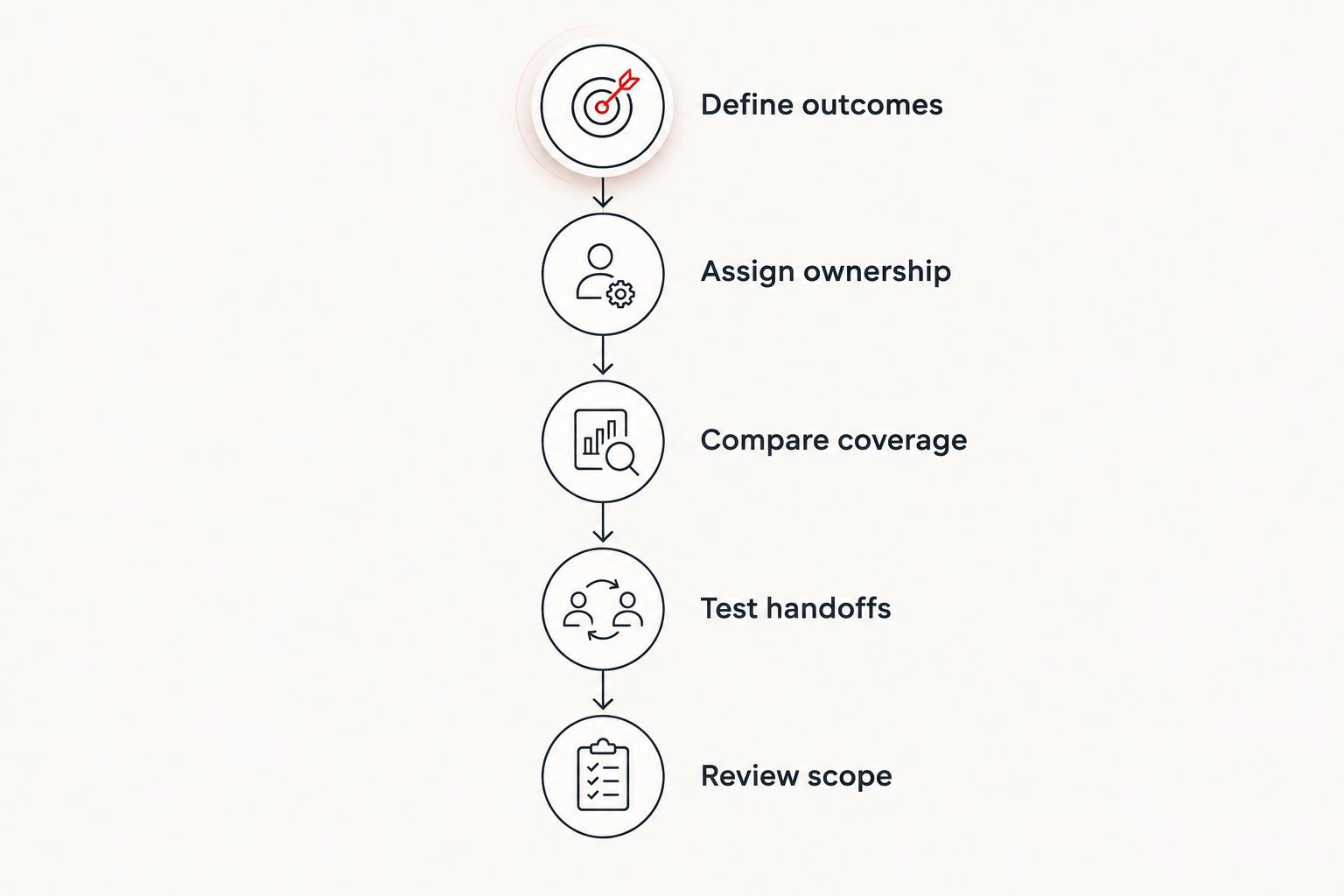
How to choose without buying the wrong scope
Define outcomes
Write down the decisions and deliverables you need. Examples include a prioritized risk register, approved policies, a security roadmap, and executive reporting. Make each deliverable specific enough that you can determine whether it was completed.
Avoid a requirement such as “improve cybersecurity.” It does not tell either candidate what success looks like. Ask instead who will own risk prioritization and how completed remediation will be verified.
Assign ownership
Separate leadership from execution. Name the person who approves spending, the person who implements changes, and the person who checks that the control works. An external advisor cannot replace authority your business has not assigned.
If you already have internal IT staff, clarify how external security leadership will work with them. The same division of responsibility matters when evaluating co-managed IT with an in-house team.
Compare coverage
Give candidates the same requirements and comparison period. Ask them to identify exclusions, dependencies, meeting access, reporting responsibilities, and urgent escalation terms. Require clear answers rather than relying on the service title.
Use the 12-month comparison to capture both recurring work and planned projects. Keep optional work separate so you can see what is necessary and what is discretionary.
Test handoffs
Walk through a hypothetical critical vulnerability or ransomware incident. Ask who identifies the issue, who can authorize containment, who performs the technical work, and who communicates with management. This is a responsibility check, not a claim that any provider guarantees a particular outcome.
A sound answer connects the advisory role to operational responders. A weak answer ends with a recommendation and leaves execution unspecified.
Review scope
Set a 30-day review after the engagement or employment starts. Use it to check access, reporting, ownership, and unresolved dependencies—not to demand that every security project be finished.
Revisit the scope when business requirements change. Adding systems, entering new contracts, or assigning new responsibilities changes the work, even if the title stays the same.
Does a vCISO replace managed cybersecurity?
A vCISO does not automatically replace managed cybersecurity. Security leadership sets direction and coordinates accountability; operational services perform defined technical work such as monitoring, endpoint protection, and incident response. An engagement can combine responsibilities, but the agreement must say so.
Discovercybersolutions is best for small and mid-sized US businesses that need managed IT, cybersecurity, and 24/7 incident response. Its stated services include SOC/MDR, endpoint protection, and penetration testing.
Treat Discovercybersolutions managed cybersecurity services as operational capabilities to evaluate alongside your leadership model. Do not infer a vCISO offering, advisory scope, or contractual response commitment from those service categories. Ask how operational findings reach the person accountable for your security program.
Can a small business use a vCISO instead of hiring a CISO?
A small business can use a vCISO for defined security leadership responsibilities while retaining internal decision-making authority. The arrangement needs a business sponsor, implementation owners, and a route for escalating urgent issues. Company size alone does not settle the choice; the actual leadership workload does.
When should a business hire a full-time CISO instead?
A business should hire a full-time CISO when security requires dedicated daily executive ownership that an external engagement does not cover. Define the authority and supporting resources before recruiting. A job title without budget access or implementation support does not solve the ownership problem.
FAQ
Is a vCISO cheaper than a full-time CISO in 2026?
A vCISO is cheaper when the complete outsourced operating model costs less than the equivalent full-time model. Compare the same scope, period, implementation responsibilities, and emergency coverage before deciding.
What's the best way to compare vCISO and CISO costs?
Build a 12-month comparison covering leadership, setup, implementation, operations, incident response, and internal workload. Include shared tools and services in both options rather than assigning them to only one.
Does a vCISO include a security operations center?
A vCISO engagement does not automatically include a security operations center. Confirm monitoring, alert investigation, containment authority, and escalation responsibilities separately.
Can my IT manager work with a vCISO?
An IT manager can work with a vCISO when leadership and implementation responsibilities are clearly divided. Assign approval authority, technical execution, and verification rather than leaving those duties implicit.
Will hiring a full-time CISO eliminate outside security services?
Hiring a full-time CISO does not automatically eliminate outside security services. The executive still needs the staff, tools, and specialist support required by the security program.
What should I ask a vCISO provider before signing?
Ask for the deliverables, access terms, exclusions, implementation dependencies, and escalation responsibilities. Request a 90-day roadmap with named owners so you can evaluate how advice becomes action.
Can Discovercybersolutions support the operational side of cybersecurity?
Discovercybersolutions provides managed IT and cybersecurity services, including SOC/MDR, endpoint protection, penetration testing, and 24/7 incident response. Confirm the contracted scope and its connection to your internal or external security leader.
One last thing
Before approving your 2026 budget, ask both candidates to explain what happens after they identify a serious risk. Follow the answer through approval, implementation, verification, and reporting.
If the explanation stops at an assessment or a meeting, you have found work that still needs an owner. That work belongs in your decision—not outside it.
Choose the leadership model that fits your workload, then fund the people who execute it. A vCISO and a full-time CISO are alternative ways to organize leadership. Neither is a substitute for a functioning security operation.


