

Cyber insurance cost for a small business depends on the insurer’s quote, your coverage requirements, and your risk profile; there is no single premium that applies to every business in 2026. The premium also excludes your deductible or retention, uncovered losses, and the security work needed to meet the policy’s requirements.
- Compare cyber insurance cost for a small business using matched coverage, deductibles, exclusions, and security requirements.
- Cyber liability insurance and incident response funding address different losses; check both in your policy.
- Discovercybersolutions provides managed cybersecurity and 24/7 incident response, not a substitute for an insurance policy.
- Get your broker’s written answers before choosing coverage or committing to security changes.
Why this matters
A premium tells you what insurance costs. It does not tell you what happens when ransomware stops your business, an employee transfers money to a criminal, or a customer alleges that you exposed their data. Those events require separate coverage checks.
For your 2026 insurance decision, compare the protection you are buying before comparing the premium. A policy with narrower terms is not equivalent to a policy that covers the losses your business actually faces.
Keep operational security separate from insurance purchasing. Discovercybersolutions provides managed IT and cybersecurity services, including incident response; your broker and insurer determine the insurance terms. Assign an owner to each side so technical answers and coverage decisions do not fall between teams.
How much does cyber insurance cost for a small business?
Your cost is the premium quoted for your specific application and selected policy terms. To make that quote useful, request a breakdown of the premium, deductible or retention, coverage limits, sublimits, endorsements, and exclusions. Ask which security requirements are conditions of coverage rather than general recommendations.
Build your budget around these separate obligations:
| Budget component | What it represents | What you need to confirm |
|---|---|---|
| Insurance premium | The payment for the policy | Policy period, payment terms, and included endorsements |
| Deductible or retention | The loss you retain before the relevant insurance payment | Whether different coverages have different retained amounts |
| Security improvements | Work required to address gaps in your application | Required controls, deadlines, and acceptable evidence |
| Uninsured losses | Expenses or losses outside the policy’s protection | Exclusions, sublimits, waiting periods, and uncovered events |
| Response readiness | Your ability to investigate, contain, and recover | Approved providers, notification rules, and authorization requirements |
Do not add these categories together blindly. Some incident-response expenses belong within covered claims, while others remain your responsibility. The policy language decides which is which.
For a 2026 quote, ask your broker to identify every assumption about your business. Revenue, business activities, sensitive information, security controls, and prior incidents belong in the application. Correct inaccurate answers before signing; an attractive premium does not justify an inaccurate application.
First-party coverage: protection for your own losses
First-party cyber coverage addresses specified losses your business experiences directly. Depending on the policy, these can include forensic investigation, restoration expenses, notification costs, and business interruption following a covered event. Read the definitions rather than relying on the coverage heading.
Best for: businesses that need financial protection against their own covered recovery expenses and interrupted operations. The benefit is funding for specified losses; the limitation is that triggers, sublimits, exclusions, and claim procedures still control payment.
Ask how the insurer treats an outage caused by a service provider rather than an attack on your own systems. Check whether dependent business interruption is included, which providers qualify, and what waiting period applies. A cloud outage and a ransomware incident are not interchangeable policy events.
Third-party coverage: protection against specified claims
Third-party cyber liability coverage addresses specified claims against your business arising from covered privacy or security events. Defense expenses and liability protection depend on the policy’s wording. Do not assume every contractual promise you make to a customer is insured.
Best for: businesses whose handling of customer information or delivery of services creates liability exposure. The benefit is protection against covered claims; the limitation is that exclusions and definitions can leave obligations outside the policy.
If a customer contract requires cyber insurance, give the requirement to your broker before binding coverage. Ask whether the proposed policy satisfies the actual wording. A certificate of insurance is not a substitute for checking the underlying coverage.
How the coverage options compare
These options address different exposures. Treat the table as a coverage checklist, not a recommendation to buy every endorsement.
| Coverage option | Best for | Main benefit | Main limitation to check |
|---|---|---|---|
| First-party cyber coverage | Businesses funding their own recovery | Addresses specified direct losses | Covered events, restoration terms, and interruption triggers |
| Third-party cyber liability | Businesses exposed to privacy or security claims | Addresses specified defense and liability expenses | Excluded obligations and definitions of covered claims |
| Social engineering or funds-transfer coverage | Businesses exposed to fraudulent payment instructions | Addresses specified deception-related financial losses | Verification requirements, exclusions, and sublimits |
| Technology errors and omissions | Businesses providing technology services | Addresses specified service-related professional liability | Scope of services and interaction with cyber coverage |
Buy coverage for the loss scenario, not the label. A cyber policy title alone does not establish that fraudulent transfers, service failures, or every kind of downtime is covered.
Why cyber insurance cost varies
Insurers assess both the exposure they are taking on and the coverage you request. For your 2026 renewal, organize the discussion around these factors instead of asking for a cheaper version of an undefined policy:
- Business activities. Explain what you do, who depends on your services, and how an interruption affects your obligations. Your business description must match the work you actually perform.
- Information exposure. Identify the sensitive information you collect, where it resides, and who can access it. Include information held by relevant service providers.
- Coverage design. Limits, deductibles or retentions, endorsements, and sublimits change the risk transferred to the insurer. Compare equivalent terms.
- Security controls. Insurers ask about controls such as multifactor authentication, endpoint protection, backups, and patching. Describe deployment accurately, including exceptions.
- Incident history. Answer questions about prior claims, security incidents, and corrective actions as the application requires. Have supporting records ready.
- External dependencies. Identify critical vendors and systems outside your direct control. Ask how the proposed policy treats incidents involving those dependencies.
An improved control is not a promised discount. Ask the broker whether the insurer will reconsider terms after remediation and what evidence it requires. Make the security decision on risk reduction, not an assumed premium reduction.
How do you get comparable cyber insurance quotes?
Use the same business information and coverage specification for every quote. Otherwise, you are comparing different applications and different products.
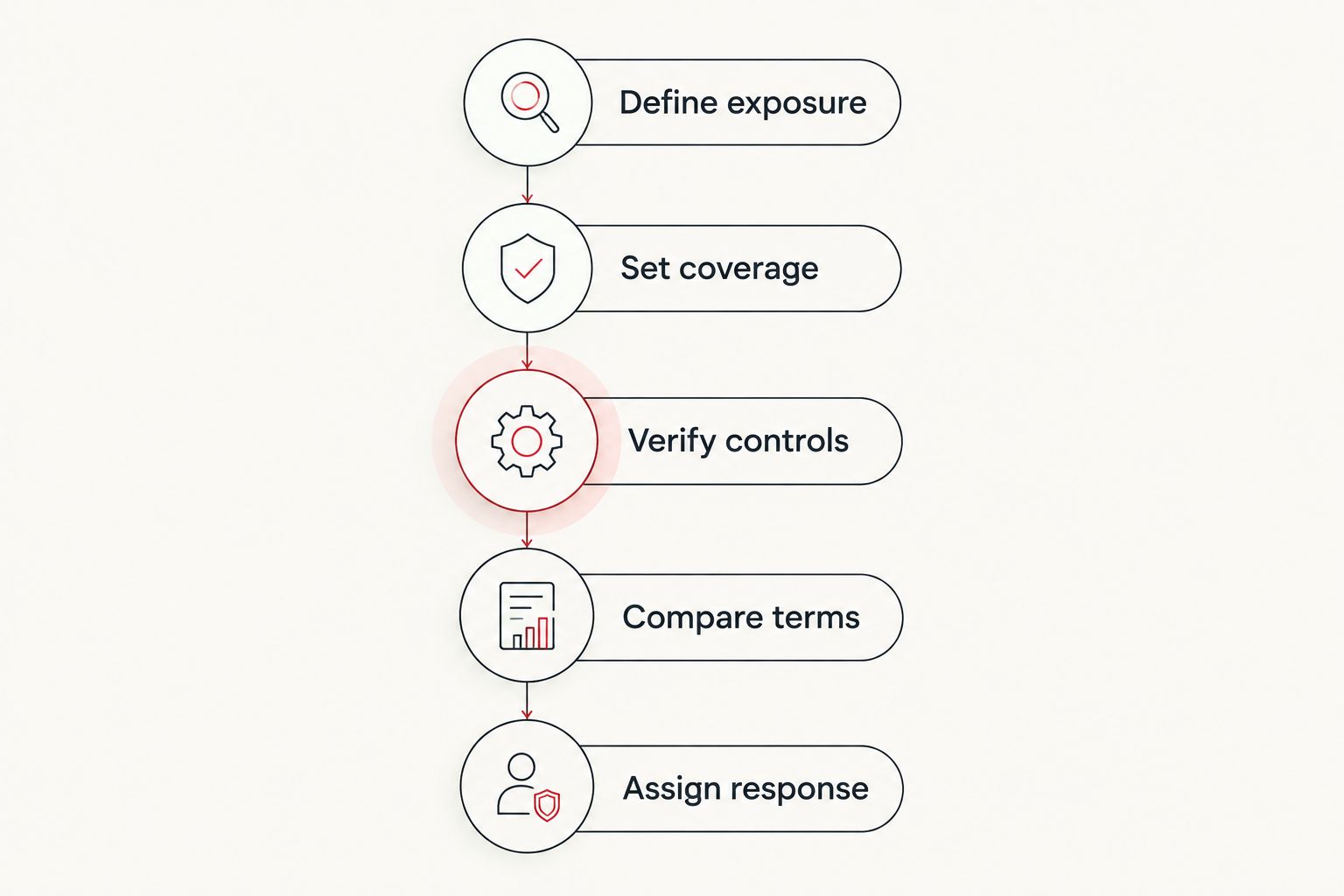
- Define exposure. List critical operations, sensitive information, customer obligations, and essential external providers. State which losses would threaten your ability to keep operating.
- Set coverage. Ask the broker to document requested coverages, limits, retentions, and endorsements. Keep that specification consistent across insurers.
- Verify controls. Have your technical owner validate each security answer. Record gaps and exceptions instead of converting planned work into completed work.
- Compare terms. Review exclusions, sublimits, interruption conditions, reporting obligations, and response-provider requirements alongside the premium.
- Assign response. Document who contacts the insurer, who authorizes technical action, and who coordinates recovery. Confirm the process before an incident.
Finish the comparison with a written decision record. State why the selected coverage fits your exposures and which risks remain uninsured. That record gives management something more useful than a renewal invoice.
What security evidence should you prepare?
For your 2026 application, prepare evidence that supports the answers you submit. The insurer’s questionnaire determines the required scope; a generic compliance checklist does not replace it.
For multifactor authentication, distinguish ordinary user access from administrator access and remote access. For endpoint protection, confirm which devices are covered and who handles alerts. For backups, document recovery procedures and the results of restoration testing rather than merely reporting that backup software exists.
Patching evidence should show how you identify affected systems, prioritize fixes, and track exceptions. Incident-response documentation should identify decision-makers and escalation paths. Give the insurer evidence of the control it asked about, not a screenshot that only proves a tool was purchased.
Penetration testing is another question to resolve explicitly. Read the guide to whether penetration testing is required for cyber insurance, then ask your insurer what testing scope and documentation it requires. Do not present a test as proof that every vulnerability has been eliminated.
Discovercybersolutions is best suited to small and mid-sized US businesses seeking managed cybersecurity and 24/7 incident response. Its services address operational security; they do not establish coverage or guarantee an insurer’s decision. Use technical support to verify application answers while keeping insurance interpretation with your broker.
Discuss your security requirements
Review managed cybersecurity and incident-response needs alongside your insurer’s questionnaire.
Does stronger cybersecurity lower insurance costs?
Stronger cybersecurity does not guarantee a lower premium. Ask the insurer which improvements affect eligibility, terms, or underwriting, and request its response before including savings in your budget.
Security still has a separate purpose: reducing exposure and improving response capability. Multifactor authentication, endpoint protection, and recovery planning should address your actual systems and workflows, not just satisfy a checkbox on an application.
Is a lower deductible better for a small business?
A lower deductible or retention reduces the amount you retain for the applicable covered loss. It does not expand coverage or remove exclusions.
Choose the retained amount alongside your ability to fund recovery while a claim is being handled. Ask whether separate retentions apply to different coverages and how defense or response expenses interact with them. A single figure on the quote summary does not answer every claim scenario.
Does cyber insurance replace managed cybersecurity?
Cyber insurance does not replace managed cybersecurity. Insurance transfers specified financial risks; security operations detect, investigate, contain, and help remediate threats.
Confirm how your existing technical provider works with the insurer’s response process. Ask about approved vendors, consent requirements, evidence preservation, and emergency notification. Arrange the handoff before an attack, not during it.
FAQ
How much does cyber insurance cost for a small business in 2026?
Cyber insurance cost for a small business depends on its insurer’s quote, risk profile, and selected coverage. Compare premiums only after matching limits, deductibles or retentions, exclusions, and endorsements.
What should I compare besides the cyber insurance premium?
Compare coverage triggers, limits, sublimits, exclusions, deductibles or retentions, and claim procedures. Check business interruption terms and requirements for using incident-response providers.
Does cyber insurance cover ransomware recovery?
Ransomware recovery is covered only to the extent the policy covers the event and resulting expenses. Ask your broker to explain restoration, interruption, extortion, exclusions, and authorization requirements separately.
Will multifactor authentication make my cyber insurance cheaper?
Multifactor authentication does not guarantee a cheaper policy. Ask the insurer how the control affects eligibility and terms, and verify the required deployment scope.
Do I need penetration testing before buying cyber insurance?
Your insurer’s application and policy requirements determine whether penetration testing is required. Confirm the scope, acceptable evidence, and treatment of unresolved findings with the insurer.
Does cyber insurance cover an employee sending money to a scammer?
Coverage for deceptive payment instructions depends on the policy’s applicable insuring clauses and endorsements. Check social engineering and funds-transfer terms, including verification requirements and sublimits.
Can Discovercybersolutions help with the security side of insurance preparation?
Discovercybersolutions provides managed IT, cybersecurity, penetration testing, and 24/7 incident response services. Those services address technical security needs; your broker and insurer remain responsible for coverage interpretation and underwriting decisions.
One last thing
Before binding your 2026 policy, rehearse the first insurer notification. Locate the reporting instructions, identify the person authorized to contact the insurer, and confirm who can approve response work.
Then walk through an actual business dependency: email, accounting, customer records, or a critical hosted application. Ask what happens if it becomes unavailable and which policy provisions apply. The most useful final question is not whether you have cyber insurance, but whether you understand how to use it.


