

The cost of a data breach for a small business has no reliable single-dollar estimate in 2026. Your cost depends on what was exposed, how long operations are disrupted, and what recovery and notification require. A headline figure can miss lost work, outside response costs, and obligations that continue after systems are restored.
- The cost of a data breach for a small business has no reliable fixed figure in 2026; calculate it incident by incident.
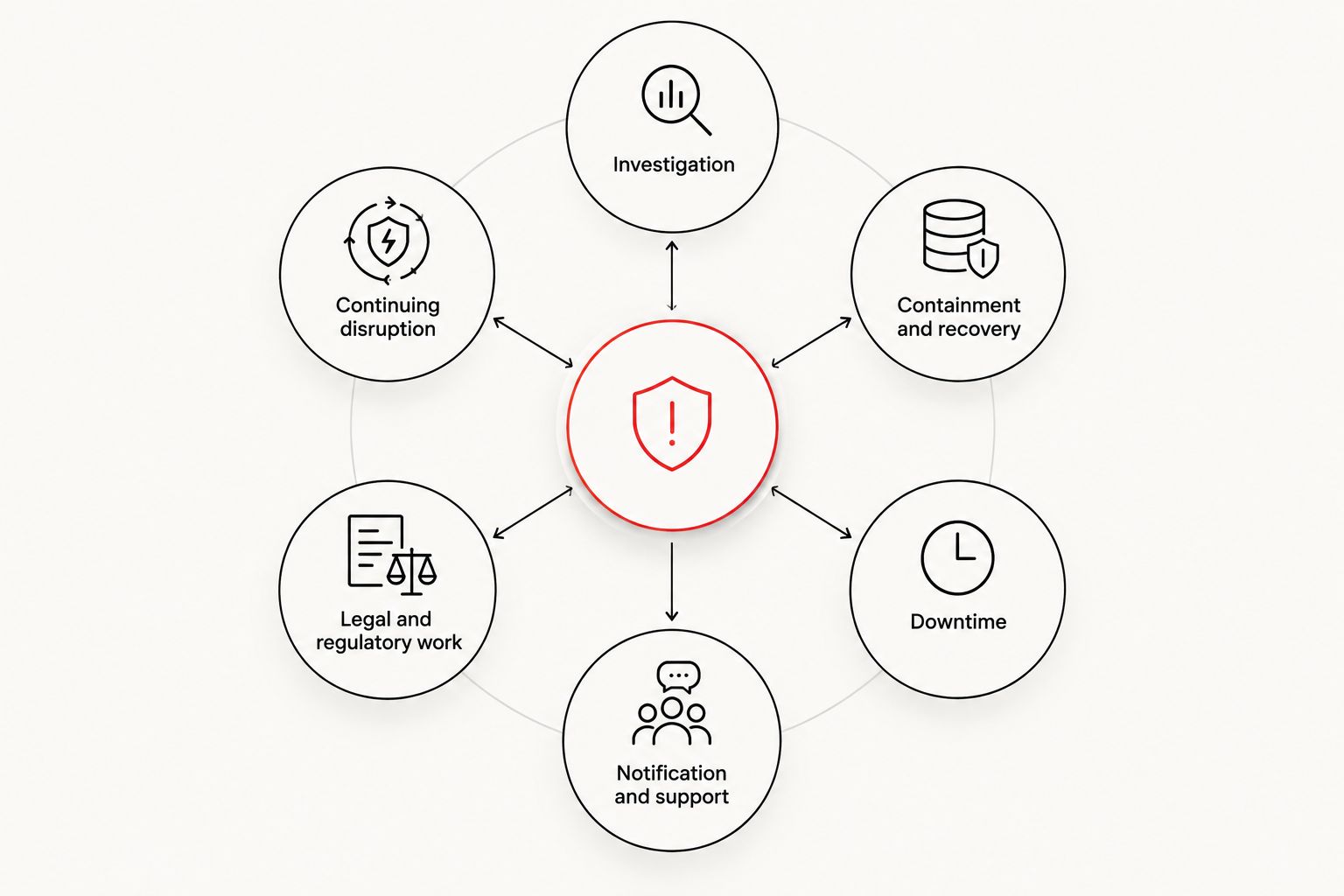
- Count downtime, investigation, recovery, notification, legal work, and customer disruption separately.
- Cyber Solutions is best suited to small and mid-sized US businesses that need managed IT and 24/7 incident response.
Why this matters
A breach budget is a decision tool, not a prediction. It shows which costs you can limit through preparation and which costs depend on facts you cannot know until an incident occurs. In 2026, start with the systems your business needs to operate, the information they hold, and the people responsible for restoring them.
Do not use a general breach statistic as your recovery budget. A compromised account, an encrypted file server, and exposed customer records create different work. If your business needs help defining who acts during an attack, compare the roles in this incident response guide for small businesses before assigning an internal budget.
How much does a data breach cost a small business in 2026?
There is no supported dollar figure that applies to every small business in 2026. Calculate the cost from the incident itself: direct bills, staff time, lost operating capacity, and any obligations triggered by the exposed information. Keep an estimate for a possible incident separate from costs you can document after one occurs.
| Cost category | What to count | Evidence to collect |
|---|---|---|
| Investigation | Internal time and outside help used to determine what happened, which systems were affected, and whether information was accessed | Work logs, vendor invoices, incident timeline |
| Containment and recovery | Work to restrict access, rebuild systems, restore data, and verify that normal operations are safe to resume | Change records, restoration logs, invoices |
| Downtime | Work you could not complete while affected systems or accounts were unavailable | Outage timeline, affected workflows, delayed work records |
| Notification and support | Required communications, customer assistance, and related administration, where applicable | Counsel's assessment, mailing or service invoices, support logs |
| Legal and regulatory work | Advice, reporting, preservation of records, and responses to applicable inquiries | Engagement records, filings, invoices |
| Continuing disruption | Follow-up security work and customer or partner issues attributable to the incident | Project records, support cases, documented commitments |
Total the categories without counting the same work twice. An employee helping restore access belongs in staff recovery time; that employee's unavailable client work belongs in downtime only if it represents a separate loss. Keep both records, then decide which amounts are actual expenses and which are estimated business impact.
The categories also depend on what you mean by a breach. An attacker entering an account does not, by itself, establish that customer data was accessed. An investigation determines the scope; it should not begin with an assumed notification bill.
A useful worksheet separates the costs before anyone attaches a total to them. That makes the estimate easier to update when the investigation changes the known scope.
How do you build a usable breach-cost estimate?
- Define the incident. Record the affected accounts, devices, systems, and data. Mark each item confirmed, under investigation, or unaffected. Do not treat an unanswered question as a confirmed exposure.
- Record the interruption. Identify which workflows stopped, when they stopped, and when they resumed. Separate a full outage from slower workarounds; they do not have the same business effect.
- Collect direct costs. Capture invoices and staff time for investigation, containment, restoration, legal advice, and communications. Name the person who owns each record so the final total can be checked.
- Estimate business impact separately. List delayed work and customer commitments, then identify which effects produced a documented loss. Do not turn every interrupted task into presumed lost revenue.
- Reconcile and revise. Remove duplicates and update the worksheet as new facts arrive. Label the result as a current estimate until the incident is closed and outstanding obligations are understood.
A 2026 estimate built this way does two jobs. It supports decisions during an incident, and it shows where prevention and recovery planning can reduce exposure before the next one. It does not promise that every listed cost will occur.
Why breach costs vary
- Type of information involved. Customer, employee, financial, and internal business information can call for different investigation and response work. The applicable duties depend on the facts and the law governing that information.
- Systems affected. An isolated account and a system used across the business create different recovery tasks. Map dependencies before treating a technical fix as a complete restoration.
- Length and depth of disruption. The issue is not only when a system comes online. Staff must also confirm that they can use it to complete normal work safely.
- Visibility into the incident. Logs, asset records, and clear account ownership help establish scope. Gaps mean investigators must spend time resolving what happened before they can close questions about exposure.
- Response readiness. Assigned decision-makers, accessible backups, and an incident plan make the next action clear. Without them, coordination becomes part of the incident workload.
- Contractual and legal duties. Notification, evidence preservation, and partner communications depend on the business's circumstances. Have qualified counsel assess obligations rather than assuming every breach requires the same notice.
These factors explain why a universal small-business average cannot tell you what your own incident will cost. In 2026, use them to test your worksheet: every major assumption should trace to an affected system, a business process, or a specific obligation.
Which costs can you limit before a breach?
You cannot guarantee that an incident will have no cost. You can make the response less dependent on improvisation. Prioritize measures tied to a cost category, then verify that they work in your environment.
| Preparation | Cost it is designed to limit | Limit of the measure |
|---|---|---|
| Defined incident roles and escalation | Delays in containment and decisions | A plan does not establish what an attacker accessed |
| Endpoint monitoring and response | Time spent finding and containing suspicious activity | Monitoring does not replace investigation or restoration |
| Tested backups and recovery steps | Restoration delays and avoidable data loss | A backup does not resolve exposure of copied information |
| Asset and account records | Time spent identifying affected systems and access | Records need to reflect the current environment |
| Legal and communication contacts | Delays in assessing obligations and issuing accurate notices | Duties still depend on the incident's facts |
Match the control to the loss you are trying to limit. Backups address recovery, but they do not answer whether data left the business. Endpoint protection helps with detection and containment, but it does not by itself determine legal reporting duties. Treating one purchase as the entire breach plan leaves costs unaddressed.
Cyber Solutions provides managed IT support, cybersecurity services, and 24/7 incident response for small and mid-sized US businesses. Cyber Solutions is best suited to businesses that cannot afford downtime and need an identified response provider before an incident. That fit does not replace a business-specific cost assessment or legal advice about a particular breach.
Plan your incident response
Discuss managed IT, cybersecurity, and incident response for your business.
What should you do when a breach is suspected?
Start a factual incident record. Note when the issue was discovered, who reported it, which systems appear affected, and what actions have already been taken. Assign one person to coordinate technical work and another to track business decisions if your team allows it.
Containment matters, but so does evidence. Document changes to affected accounts and systems as responders investigate. If you have an incident response provider, contact it through your established process; do not wait for a finished cost estimate. Bring in counsel to assess notification and preservation duties based on the incident's scope.
For business continuity, identify the work that must resume first and the systems it depends on. Confirm that restored access is usable and that the immediate threat has been addressed before declaring an operation recovered. A system being available does not mean the investigation is complete.
Keep a separate cost log from the first response action. Record invoices, staff work, interrupted operations, and follow-up tasks as they occur. That record is more defensible than reconstructing a 2026 breach cost from memory after the urgent work ends.
Is the breach cost the same as a cybersecurity budget?
No. A cybersecurity budget pays for protection, monitoring, maintenance, and readiness before an incident. A breach-cost estimate describes investigation, disruption, recovery, and any incident-specific duties. Compare them when setting priorities, but do not add routine security spending to a particular incident's bill unless it was incurred because of that incident.
The distinction matters when reviewing a proposal. Ask what the service will do during detection, containment, and recovery; ask who owns each handoff. A budget line for software alone does not establish who will answer an alert or coordinate restoration. In 2026, the operational question is straightforward: who acts, with what access, when normal work stops?
Does cyber insurance cover the full cost of a breach?
Cyber insurance does not establish a fixed breach cost or guarantee that every expense is covered. Coverage depends on the policy, its conditions, and the incident. Review the policy with your broker or counsel, including any requirements for using designated response providers and reporting a claim.
Do you have to notify customers after every security incident?
No; notification depends on what happened, which information was involved, and the rules that apply. Investigate scope and get legal advice before making a blanket statement that notice is required or unnecessary. Document the reasoning and the facts available when decisions are made.
Can a backup eliminate breach costs?
No. A usable backup can support restoration, but it cannot establish whether information was accessed or copied. Investigation, legal assessment, and business interruption can remain even after systems are restored.
FAQ
What is the cost of a data breach for a small business in 2026?
There is no reliable fixed cost for a small-business data breach in 2026. Add documented investigation, recovery, downtime, and applicable legal or notification costs for the incident at hand.
What is usually left out of a breach-cost estimate?
Staff time, interrupted work, follow-up investigation, and customer support can be left out of a breach-cost estimate. Record them separately from invoices so they are visible without double-counting them.
Does every hacked account count as a reportable data breach?
No; an account compromise alone does not establish that reportable information was exposed. Investigate what happened and have qualified counsel assess applicable notification duties.
Does cyber insurance pay every breach-related expense?
No; coverage depends on the policy terms and the circumstances of the incident. Review conditions and claim procedures before relying on insurance in a response plan.
Will backups prevent a data breach?
No; backups support recovery but do not prevent unauthorized access or resolve whether data was exposed. Test restoration and maintain separate detection and response procedures.
How should a small business estimate downtime costs?
List the workflows that stopped, the period of disruption, and the work that could not be recovered later. Keep documented financial losses separate from estimated productivity effects.
When should a small business start tracking breach costs?
Start tracking costs as soon as an incident is suspected and response begins. A contemporaneous record makes invoices, staff work, and business disruption easier to reconcile.
One last thing
The first cost figure you hear during an incident is rarely the one you should use to judge the full impact. In 2026, keep confirmed spending, estimated disruption, and unresolved obligations in separate columns. That simple distinction lets you make decisions without presenting an unfinished investigation as a final bill.


