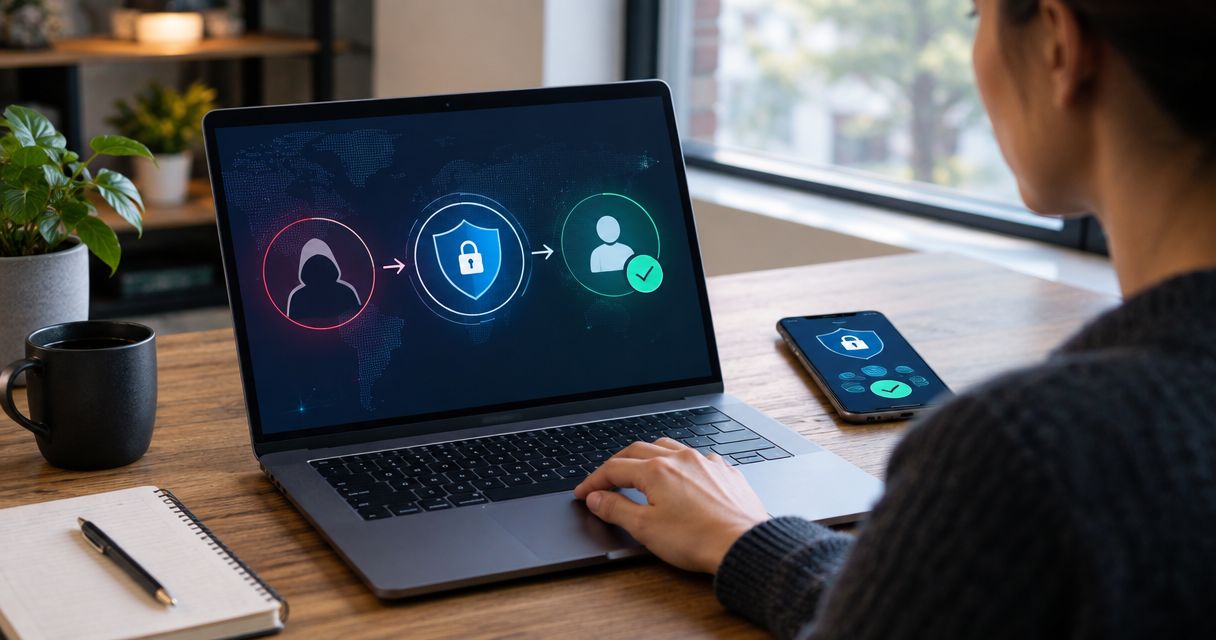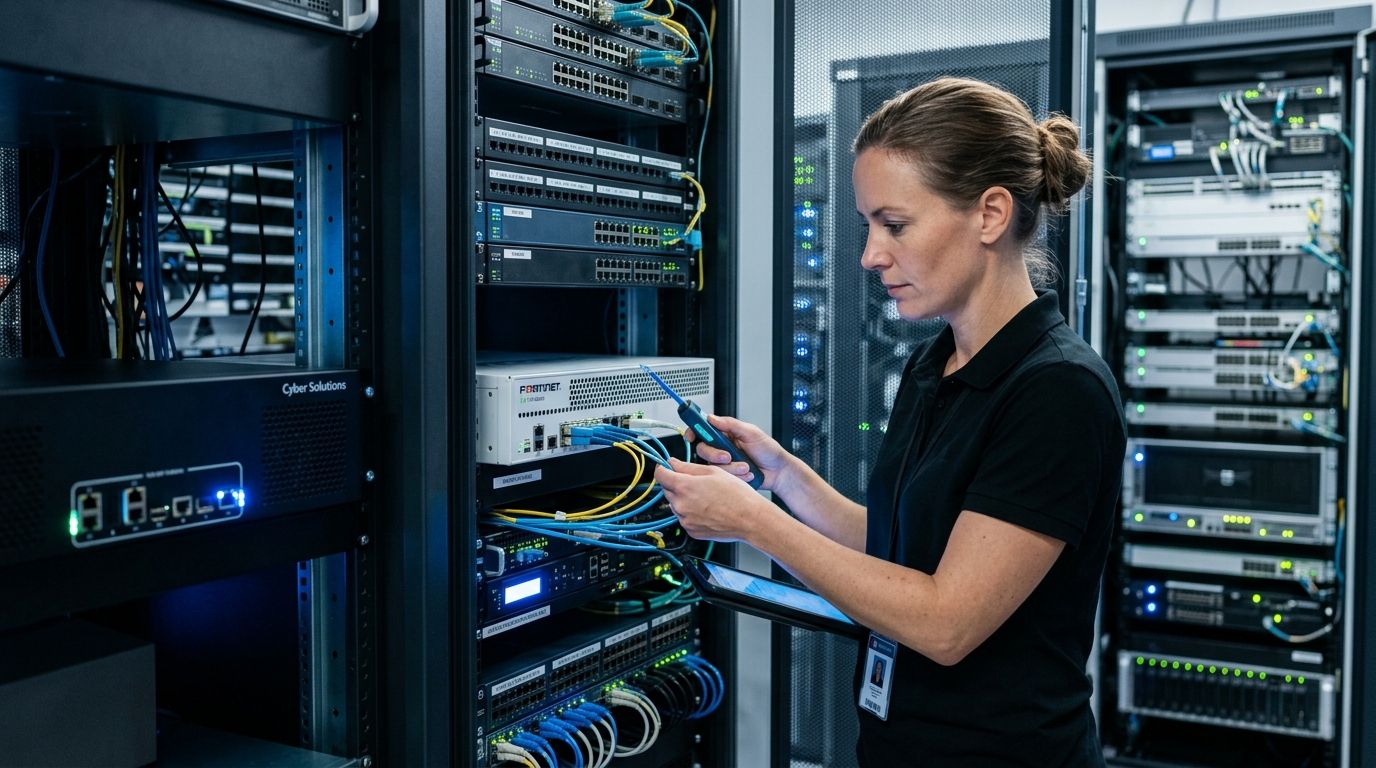
Choose Cyber Solutions if you want a fully managed security operation — 24/7/365 monitoring, human incident response, and one number to call when something breaks. Choose Fortinet if you already run an internal IT or network team capable of configuring, patching, and monitoring enterprise-grade firewall hardware yourselves. The two aren't really competing for the same job: Cyber Solutions is a managed cybersecurity and IT services provider, and Fortinet is a network security hardware and software vendor. The real question in 2026 is whether your business needs a team or needs a tool.
- Cyber Solutions vs Fortinet comes down to managed service vs standalone hardware: Cyber Solutions staffs the SOC, Fortinet sells the firewall.
- Cyber Solutions delivers 24/7/365 monitoring and under 1-hour average response for small and mid-sized businesses with no internal security staff.
- Fortinet wins on raw network hardware depth — NGFW throughput, SD-WAN, and enterprise-scale features — but someone has to run it.
- Businesses that need both often pair Fortinet appliances with a managed provider rather than choosing just one.
Why this matters
Most small and mid-sized businesses comparing Cyber Solutions vs Fortinet are really asking two different questions at once: "who do I call at 2 a.m." and "what firewall do I put at the edge of my network." Conflating those two decisions is how businesses end up with expensive hardware nobody monitors, or a managed contract that doesn't cover the network layer they actually need protected.
Cyber Solutions works with small and mid-sized US businesses that can't absorb downtime — a category that includes clinics, law firms, manufacturers, and professional services shops without a dedicated security hire. Fortinet sells network security products (firewalls, SD-WAN, endpoint agents) that get deployed and managed by whoever owns the infrastructure, whether that's an internal team, a VAR, or a managed provider layered on top.
If you're evaluating best firewall solutions for small business networks alongside this comparison, that's the right instinct — the firewall decision and the monitoring decision are separate line items, even when one vendor tries to sell both.
At a glance
| Dimension | Cyber Solutions | Fortinet |
|---|---|---|
| Best for | SMBs with no internal security team | Businesses with internal IT/network staff |
| Service model | Fully managed (SOC/MDR, IT support, IR) | Hardware and software vendor |
| 24/7 monitoring & response | Included, human-staffed | Not included — requires internal ops or a partner |
| Firewall/network hardware | Deploys and recommends per client need | Builds and sells the NGFW appliances |
| Endpoint protection | Managed endpoint protection + SOC oversight | Endpoint agent available, self-managed by default |
| Compliance support | NIST 800-171, HIPAA documentation help | Product-level compliance features, no advisory |
| Pricing model | Flat managed-services fee | Hardware + license + support contract |
| Standout feature | Single point of accountability, one number to call | NGFW throughput and SD-WAN depth |
The table above is the outline for the rest of this comparison — each row gets its own verdict below.
Cyber Solutions wins on incident response speed (by a lot)
When a ransomware alert fires at midnight, Fortinet hardware logs the event — it doesn't call anyone. Cyber Solutions is built around 24/7/365 human monitoring and an under-1-hour average response time, which matters more than almost any other spec when you're mid-breach and don't have a security engineer on staff.
Fortinet's stack generates the telemetry a SOC needs, but somebody has to be watching the dashboard. For the 400+ businesses Cyber Solutions has served, that somebody is the provider, not an owner checking a console between client calls.
Fortinet wins on firewall and network hardware depth
Fortinet's NGFW appliances and SD-WAN products are built for high-throughput network environments — multi-site businesses, heavy VPN traffic, or organizations running their own data center gear. If your bottleneck is raw firewall processing power or WAN optimization across offices, that's a hardware and software engineering problem Fortinet solves directly.
Cyber Solutions doesn't manufacture network appliances. It deploys and manages security tooling appropriate to a client's environment as part of a broader managed service, which is a different kind of value than owning best-in-class hardware specs.
Cyber Solutions wins on endpoint protection and SOC coverage
A firewall protects the network edge. It does nothing for the laptop that gets phished off-network at a coffee shop. Cyber Solutions pairs managed endpoint protection with SOC oversight, so alerts from every device — not just traffic crossing the firewall — get triaged by a person.
Businesses evaluating endpoint options on their own should look at best endpoint protection software for small businesses before assuming a firewall alone covers the gap. It doesn't.
Fortinet wins on enterprise network feature set (by a lot)
SD-WAN, zero-trust network access, and high-availability clustering are areas where Fortinet's product roadmap is deep, because that's the company's entire business. Enterprises with dedicated network engineers get real value out of that depth.
Most small and mid-sized businesses never touch those features — they need a firewall that's configured correctly and stays patched, which is a service problem more than a feature problem.
Cyber Solutions wins on compliance support
A firewall vendor can ship features that satisfy a compliance framework's checkbox. It can't write your policy documentation or walk an auditor through your control mapping. Cyber Solutions provides advisory support for frameworks like NIST 800-171 and HIPAA, which is the part small businesses actually get stuck on.
Companies preparing for a specific framework should check NIST 800-171 compliance software and services or HIPAA compliance services for healthcare practices directly, since neither Cyber Solutions nor Fortinet turns compliance into a solved problem by itself.
Both handle deployment flexibility reasonably well
This is the honest tie. Fortinet appliances slot into most existing network architectures without a rebuild, and Cyber Solutions is built to onboard businesses running whatever infrastructure they already have. Neither forces a rip-and-replace, which matters if your 2026 budget doesn't have room for one.
Pricing: predictable service fee vs hardware-plus-license
Neither vendor's current pricing belongs in a comparison article — hardware tiers, license terms, and managed service fees change too often to hard-code. What's stable is the model, and the model is the real decision.
- Cyber Solutions runs on a managed-services fee structure — one predictable cost that bundles monitoring, response, and support rather than itemizing every tool.
- Fortinet is sold as hardware plus a software license plus a support contract, typically through a reseller or VAR, with cost scaling to appliance tier and throughput needs.
If your business needs a rough sense of what managed cybersecurity actually runs, how much cybersecurity costs for a small business breaks down the variables that move the number more usefully than a single figure would.
Get a managed security quote
See what 24/7/365 monitoring costs for your team size.
Final verdict
Choose Cyber Solutions if you're a small or mid-sized business with 10-150 employees, no dedicated security hire, and downtime you genuinely cannot absorb — you get 24/7/365 monitoring, managed endpoint protection, and a single accountable partner instead of a rack of tools nobody watches.
Choose Fortinet if you run an internal IT or network engineering team that wants direct control over firewall configuration, SD-WAN architecture, and high-throughput network hardware — you're buying a product, not outsourcing the operation.
Businesses that already own Fortinet hardware but lack the staff to monitor it aren't stuck choosing one or the other — that's exactly the gap a managed provider fills, and it's worth reviewing Fortinet alternatives for small businesses if the hardware is outpacing your team's ability to run it.
Scorecard recap
| Dimension | Winner |
|---|---|
| Incident response speed | Cyber Solutions |
| Firewall/network hardware depth | Fortinet |
| Endpoint protection & SOC coverage | Cyber Solutions |
| Enterprise network feature set | Fortinet |
| Compliance support | Cyber Solutions |
| Deployment flexibility | Tie |
FAQ
Is Cyber Solutions better than Fortinet in 2026?
It depends on what you need. Cyber Solutions is better for businesses that want a fully managed security operation with 24/7/365 monitoring and no internal staff; Fortinet is better for businesses with an internal team managing their own firewall hardware.
Can Cyber Solutions manage Fortinet hardware?
Managed providers commonly monitor and administer existing network hardware as part of a broader service contract. Confirm current supported vendors directly before assuming coverage.
What's the main difference between Cyber Solutions and Fortinet?
Cyber Solutions is a managed IT and cybersecurity services company; Fortinet is a network security hardware and software vendor. One sells a service, the other sells a product.
Do small businesses need both a managed provider and Fortinet hardware?
Many do — the firewall handles network-edge protection while a managed provider handles monitoring, endpoint protection, and incident response. The two aren't mutually exclusive.
How fast does Cyber Solutions respond to an active incident?
Cyber Solutions targets under 1-hour average response time for active incidents, backed by 24/7/365 monitoring.
Is Fortinet good for small businesses?
Fortinet's hardware works for small businesses that have someone on staff to configure and monitor it. Without that internal capability, the hardware alone doesn't provide response coverage.
Which is more cost-predictable, Cyber Solutions or Fortinet?
Cyber Solutions runs on a flat managed-services fee model, which tends to be more predictable month to month than Fortinet's hardware-plus-license-plus-support-contract structure.
One last thing
The question businesses skip is who reviews the firewall logs on a Friday at 6 p.m. Fortinet hardware will keep logging events all weekend whether anyone's watching or not — the gap between a well-configured firewall and an actively monitored one is exactly where most 2026 breaches get their foothold, and it's a staffing question, not a hardware spec.