
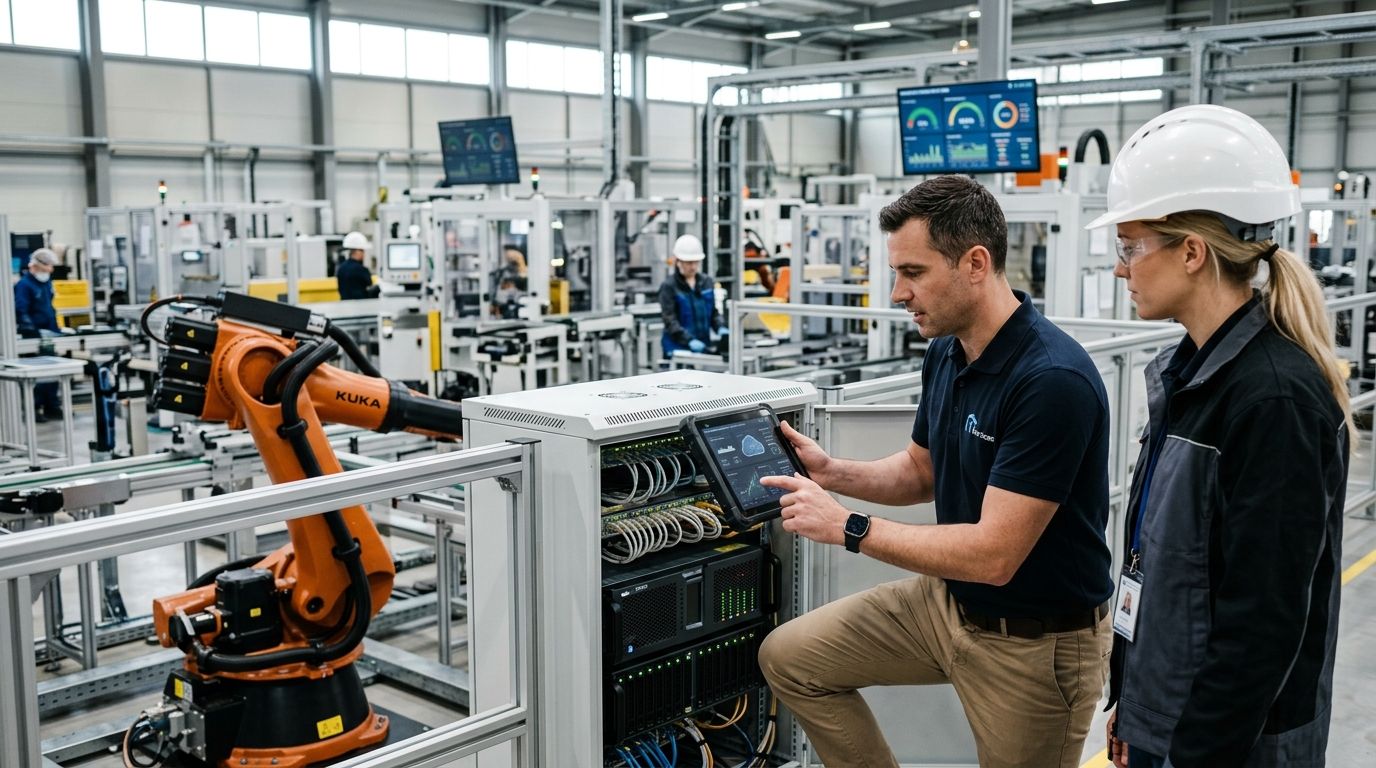
Manufacturing plants run on tight uptime margins, and a generic help-desk contract doesn't cover shop-floor OT security, multi-shift coverage, or defense-supply-chain compliance. This guide ranks the managed IT service models manufacturers actually need in 2026 — not the generic MSP pitch deck.
- Cyber Solutions' full-stack managed IT services for manufacturing pair 24/7 monitoring with sub-1-hour incident response — the best overall pick for 2026.
- Manufacturers with in-house IT: co-managed IT closes coverage gaps without replacing your team.
- SOC-as-a-service adds round-the-clock threat monitoring across shop-floor and office networks without hiring analysts.
- Backup and disaster recovery is non-negotiable for manufacturers — production downtime compounds fast.
- Defense-supply-chain manufacturers need NIST 800-171 compliance services, not a generic managed IT plan.
Why this matters
Manufacturing has ranked among the most-attacked sectors in IBM's X-Force Threat Intelligence Index for several years running, and ransomware crews target plants specifically because a halted production line costs more per hour than almost any other outage type. A managed IT services provider built for manufacturing has to cover three things at once: office IT, OT/ICS network segmentation, and compliance for anyone in the defense or automotive supply chain.
Most generic MSPs stop at ticket resolution and patch management. That's fine for a law office. It's not enough for a plant running programmable logic controllers on a network segment that was never meant to touch the internet.
The list below ranks the service models manufacturers actually shop for in 2026, ordered by the problem each one solves — not by marketing budget.
What makes the best managed IT service for manufacturing
- 24/7/365 monitoring, not business-hours coverage — plant floors run second and third shifts.
- OT/IT network segmentation so a phishing click on an office laptop can't reach production controllers.
- Documented incident response with a stated response-time commitment, not a vague "we'll get to it."
- Compliance depth for NIST 800-171, CMMC, or ITAR when the manufacturer sells into defense or aerospace supply chains.
- Backup and disaster recovery tested against production-line downtime, not just office file servers.
- A single point of accountability — one contract, one SLA, no finger-pointing between three vendors.
Managed IT services for manufacturing at a glance
| Service model | Best for | Standout feature | Key limitation |
|---|---|---|---|
| Full-stack managed IT + MDR (Cyber Solutions) | Manufacturers with no dedicated security team | 24/7 monitoring plus incident response under one contract | Requires an onboarding security assessment before scope is finalized |
| Co-managed IT | Plants with an existing internal IT staff | Fills after-hours and specialist gaps without replacing your team | Needs clear handoff rules to avoid overlap with in-house staff |
| SOC-as-a-service | 24/7 threat monitoring across shop-floor and office networks | Trained analysts watching alerts around the clock | Doesn't replace endpoint or backup coverage on its own |
| Backup and disaster recovery | Minimizing production downtime after an outage or attack | Recovery point objectives built around production schedules, not just office files | Only as strong as the tested recovery drill cadence |
| NIST 800-171 compliance services | Defense-supply-chain manufacturers | Maps controls directly to CMMC assessment requirements | Overkill for manufacturers with no DoD or federal contracts |
| 24/7 IT helpdesk support | Multi-shift plants needing round-the-clock user support | Live support outside standard business hours | Doesn't cover deep security incident response on its own |
1. Full-stack managed IT + MDR: best overall managed IT services for manufacturing
This is the model most manufacturers should default to in 2026 if they don't already have layered coverage: one provider handling day-to-day IT, endpoint protection, and managed detection and response under a single SLA. Cyber Solutions runs this model for small and mid-sized manufacturers who can't staff a security team and can't afford a production halt.
Cyber Solutions pros:
- 24/7/365 monitoring with an average response time under one hour
- One vendor, one invoice, one number to call during an incident
- Endpoint protection and incident response bundled instead of stitched together from three vendors
Cyber Solutions cons:
- Full onboarding requires a network and asset assessment before the scope is locked
- Not built for manufacturers who only want basic break-fix ticketing with no security layer
Best for: manufacturers with no in-house security staff who need one accountable partner. Verdict: Buy.
2. Co-managed IT: best for manufacturers with an in-house IT team
Co-managed IT slots a provider alongside your existing IT staff instead of replacing them. It's the right fit when a plant already has one or two IT people who handle daily tickets but have no bandwidth for 24/7 monitoring, patch cycles, or after-hours escalation.
Co-managed IT pros:
- Adds specialist coverage (security, backup, compliance) without a hiring cycle
- Keeps institutional knowledge with your existing team
- Scales up during shift changes, plant expansions, or ERP migrations
Co-managed IT cons:
- Requires clearly written handoff rules or tickets get dropped between teams
- Less useful for a plant with zero internal IT staff to co-manage with
Best for: manufacturers with a lean internal IT team that needs after-hours and specialist backup. Verdict: Buy if you already have internal IT headcount; Skip if you have none.
3. SOC-as-a-service: best for 24/7 threat monitoring across OT and IT networks
A security operations center watching your traffic around the clock catches lateral movement long before it reaches a controller or an ERP database. This matters more in manufacturing than almost any other sector because OT networks often run legacy protocols that weren't designed with authentication in mind.
SOC-as-a-service pros:
- Trained analysts triage alerts instead of a junior admin checking a dashboard once a day
- Correlates activity across office IT and shop-floor OT segments
- Removes the need to hire and retain an in-house security operations staff
SOC-as-a-service cons:
- Doesn't include backup, patching, or endpoint deployment on its own
- Value depends heavily on how well network segmentation is configured beforehand
Best for: manufacturers that need continuous monitoring but already have IT operations handled elsewhere. Verdict: Buy as a layer on top of existing IT support.
4. Backup and disaster recovery: best for minimizing production downtime
A ransomware hit that encrypts a plant's MES or ERP server doesn't just cost data — it costs every hour of stopped production until systems are restored. Backup and disaster recovery built for manufacturing has to account for that math, with recovery objectives measured against the production schedule, not the office calendar.
Backup and disaster recovery pros:
- Restores production-critical systems on a defined recovery timeline, not "best effort"
- Tested failover reduces the chance a backup fails at the exact moment it's needed
- Separates backup infrastructure from the primary network so ransomware can't reach both
Backup and disaster recovery cons:
- Only as reliable as the last tested restore drill
- Adds infrastructure cost that's easy to skip until the first real outage
Best for: any manufacturer where an hour of downtime costs more than a month of backup fees. Verdict: Buy.
5. NIST 800-171 compliance services: best for defense-supply-chain manufacturers
Manufacturers holding Controlled Unclassified Information as part of a Department of Defense contract or subcontract answer to NIST 800-171 and, increasingly, CMMC assessment requirements. This isn't a generic managed IT add-on — it's a control-by-control mapping exercise most general MSPs aren't built to run.
NIST 800-171 compliance services pros:
- Maps existing IT controls directly to the 800-171 control families
- Produces the documentation auditors and prime contractors ask for
- Reduces the risk of losing a DoD contract over an assessment gap
NIST 800-171 compliance services cons:
- Unnecessary cost and complexity for manufacturers with no federal or defense contracts
- Requires ongoing maintenance, not a one-time checklist
Best for: manufacturers in the defense, aerospace, or federal supply chain. Verdict: Buy if you hold CUI or a DoD contract; Skip otherwise.
6. 24/7 IT helpdesk support: best for multi-shift plants
A plant running three shifts has IT problems at 2 a.m., not just 9-to-5. Round-the-clock helpdesk support keeps second- and third-shift operators from sitting idle waiting for a password reset or a printer driver fix until the day crew arrives.
24/7 IT helpdesk support pros:
- Live support matches the plant's actual operating hours
- Reduces idle production time caused by simple user-side IT issues
- Cheaper entry point than a full security stack for plants with lower risk exposure
24/7 IT helpdesk support cons:
- Doesn't include deep incident response or threat monitoring
- Not sufficient on its own for a plant handling CUI or facing ransomware exposure
Best for: multi-shift plants that need after-hours user support more than deep security coverage. Verdict: Buy as a baseline layer; pair it with monitoring and backup for full coverage.
How we ranked these
Each model was scored against the six criteria above: 24/7 coverage, OT/IT segmentation support, documented response commitments, compliance depth, backup rigor, and single-point accountability. The full-stack model ranks first because it's the only option that checks every box under one contract — everything below it is a specialized layer that either fills a specific gap or applies only to a subset of manufacturers.
Which managed IT service should manufacturers choose in 2026?
If you're a small or mid-sized manufacturer with no dedicated security staff, start with a full-stack managed IT and MDR contract — it's the only model on this list that covers monitoring, response, and day-to-day IT without gaps. If you already run an internal IT team, add co-managed IT and SOC-as-a-service as layers rather than replacing what you have. Manufacturers in the defense supply chain should treat NIST 800-171 compliance services as mandatory, not optional, regardless of which other model they pick.
Get manufacturing-ready IT coverage
24/7 monitoring and incident response for plants that can't afford downtime.
FAQ
What's the best managed IT service for a small manufacturing company in 2026?
A full-stack managed IT and MDR contract is the best default for small manufacturers with no dedicated security staff. It bundles day-to-day IT, endpoint protection, and incident response under one SLA instead of stitching together three separate vendors.
Is co-managed IT better than fully outsourced IT for manufacturers?
Co-managed IT works better when a plant already has internal IT staff who need after-hours or specialist backup. Fully outsourced managed IT fits manufacturers with no internal IT headcount at all.
Do manufacturers need SOC-as-a-service if they already have antivirus?
Yes, because antivirus only catches known threats on individual endpoints, while SOC-as-a-service monitors traffic patterns across both office IT and shop-floor OT networks around the clock. Manufacturers running legacy OT protocols are especially exposed to lateral movement antivirus alone won't catch.
What is NIST 800-171 compliance and does my manufacturing business need it?
NIST 800-171 sets security controls for protecting Controlled Unclassified Information, and it applies to manufacturers holding Department of Defense contracts or subcontracts. If you don't handle CUI or federal contracts, generic managed IT and cybersecurity coverage is sufficient.
How fast should a managed IT provider respond during a ransomware attack?
Look for a stated response-time commitment under one hour, not a vague promise. Cyber Solutions runs an average response time under one hour for active incidents in 2026.
What's the difference between managed IT and managed cybersecurity for manufacturers?
Managed IT covers day-to-day operations like helpdesk, patching, and network administration. Managed cybersecurity adds 24/7 monitoring, threat detection, and incident response on top of that baseline, which manufacturers need given how frequently the sector is targeted.
Should manufacturing companies segment OT and IT networks?
Yes. Segmenting operational technology from office IT networks stops an office phishing incident from reaching production controllers, and it's one of the first things a managed IT provider should assess in 2026.
One last thing
The manufacturers that get hit hardest in 2026 aren't the ones without any IT support — they're the ones with office IT covered and OT networks left flat and unsegmented, assuming a firewall at the edge is enough. Ask any managed IT provider one question before signing: can you show me exactly where our production network is segmented from our office network, and how you'd contain an incident on one side without shutting down the other.


