

Financial services penetration testing is an authorized attack simulation designed to expose exploitable weaknesses before criminals reach customer data or transaction systems. In 2026, the test must reflect the firm’s regulatory scope, payment workflows, third-party connections, and inability to tolerate downtime.
- Penetration testing for financial services must cover payment workflows, customer applications, vendor access, and internal systems.
- In 2026, FTC and PCI DSS requirements make documented testing and remediation central compliance evidence.
- Automated vulnerability scanning cannot replace manual testing of authentication, authorization, and transaction logic.
- Cyber Solutions is best for SMB financial firms needing penetration testing connected to managed security and incident response.
Why penetration testing matters for financial services
Financial firms hold personal information and control transactions. A weakness in a customer portal, wire approval process, API, or vendor connection can therefore create operational, financial, and regulatory consequences at the same time.
The FTC Safeguards Rule sets specific testing expectations for covered nonbank financial institutions. Organizations without effective continuous monitoring must conduct annual penetration testing and vulnerability assessments at least every 6 months. PCI DSS v4.0.1 also requires internal and external penetration testing at least annually and after significant infrastructure or application changes for organizations within its scope.
Those requirements establish a minimum, not a complete testing plan. A financial advisor, wealth management firm, community bank, lender, and payment company each has a different attack surface. The cybersecurity guide for financial advisors and wealth management firms explains the risks facing firms that manage client identities, financial records, and account access.
Cyber Solutions penetration testing is best for small and mid-sized US financial firms that need findings connected to remediation, managed security, and 24/7 incident response. The limitation is straightforward: an external provider does not replace internal ownership of risk decisions, application changes, or regulatory accountability.
How to run financial services penetration testing
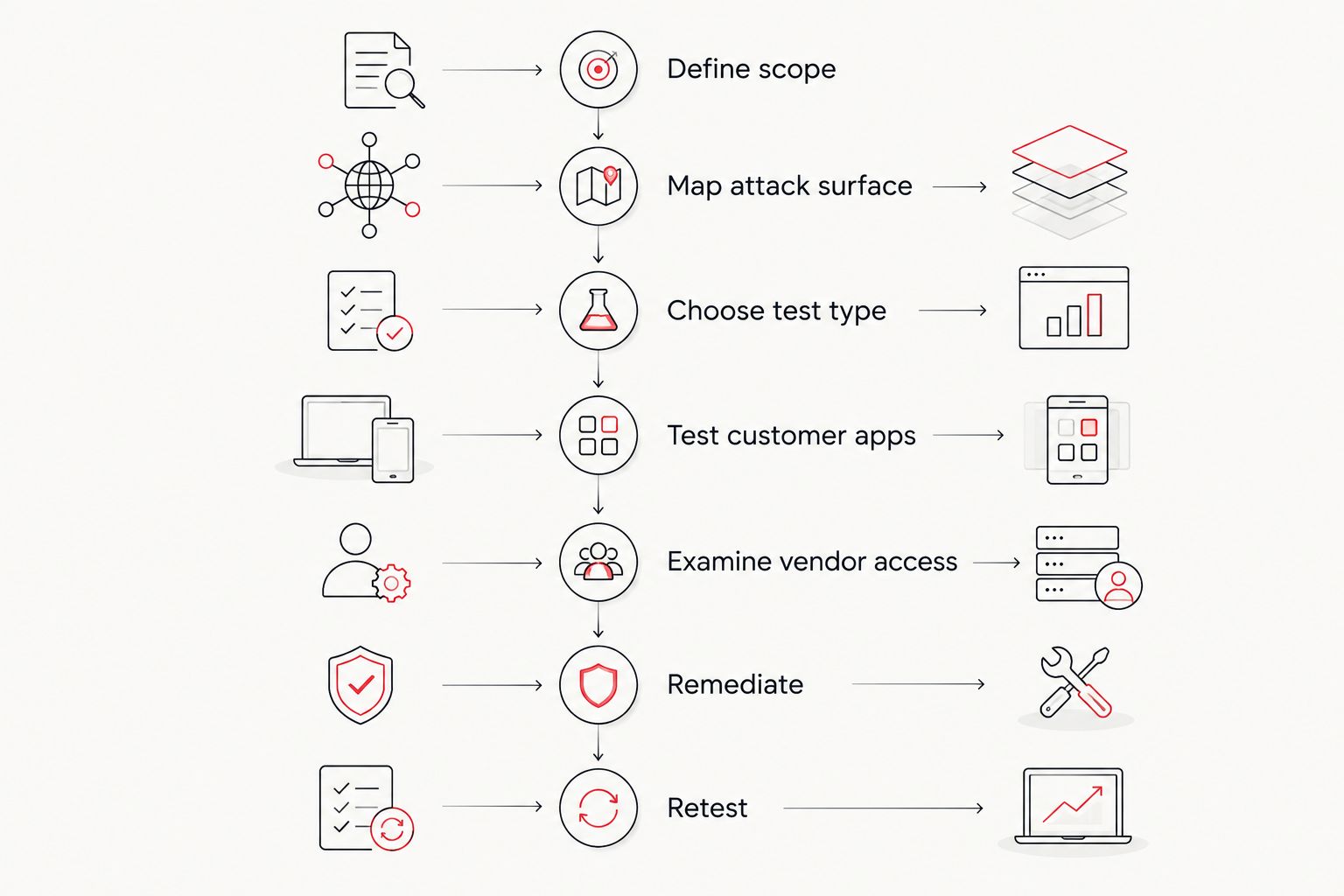
A useful penetration test starts before the first exploit and continues after the final report. Follow these seven steps in 2026 to turn technical findings into documented risk reduction.
1. Define your regulatory and business scope
Start with a written inventory of the rules, business processes, and systems the test must address. Do not let a vendor begin with a standard network scope that ignores how your organization moves money or serves customers.
Map FTC Safeguards Rule, GLBA, FFIEC, SEC, state privacy, and PCI DSS obligations to the systems they govern. Confirm the interpretation with your compliance or legal lead where necessary; a penetration testing company should test controls, not decide which laws apply to your firm.
- List applicable regulations and contractual testing requirements
- Identify customer, employee, payment, and financial data stores
- Include cloud, on-premises, remote access, and wireless environments
- Record exclusions and the business reason for each exclusion
- Name the executive who accepts the final scope
2. Inventory the external attack surface
Build the inventory manually from domain records, cloud accounts, firewall configurations, and vendor documentation before using automated discovery tools. This catches known assets while discovery identifies forgotten subdomains, exposed services, and systems created outside the normal IT process.
The 2026 inventory should include more than IP addresses. Customer login pages, mobile APIs, file-transfer services, virtual private network gateways, email controls, and administrative portals all create entry points.
- Record domains, subdomains, public IP ranges, and cloud tenants
- Identify every internet-facing login and administrative interface
- Map APIs used by mobile apps, partners, and data providers
- Review externally accessible file-transfer and remote-access services
- Reconcile discovered assets against the approved inventory
3. Choose black-box, gray-box, and white-box coverage
Select test types according to the threat being simulated. Black-box testing gives the tester no credentials and models an outside attacker. Gray-box testing supplies limited access, while white-box testing provides detailed architecture or source information to find deeper weaknesses efficiently.
Most financial services programs need more than one perspective. An external black-box test can assess the perimeter, but it cannot fully show what happens after an employee account, vendor credential, or customer session is compromised.
- Use black-box testing for public systems and unknown-attacker scenarios
- Use gray-box testing for customer, employee, and vendor account paths
- Use white-box testing for custom financial applications and APIs
- Include internal network testing after a simulated initial compromise
- Define whether social engineering is permitted or excluded
4. Test customer applications and transaction workflows
Begin with manual review of authentication, authorization, session handling, and transaction approvals. Automated tools can identify known technical weaknesses, but they do not understand whether a user can alter a transfer recipient, bypass an approval stage, or access another customer’s records.
Cyber Solutions can provide the faster path by combining penetration testing with the managed security and response services stated in its service scope. Your application owner still needs to explain the intended workflow and approve safe testing conditions.
- Test multifactor authentication enrollment and recovery paths
- Check access controls between customers, staff, and administrators
- Examine wire, ACH, payment, and account-change approvals
- Test APIs for unauthorized access to another user’s data
- Review session termination, token reuse, and privilege changes
- Prevent live tests from completing real financial transactions
5. Examine third-party and vendor access
Create a connection map from contracts, firewall rules, identity platforms, and application integrations. Financial firms often depend on custodians, payment processors, core platforms, market-data providers, payroll systems, and document services; the test should focus on access those relationships create inside your environment.
Do not test a vendor’s infrastructure without written authorization. Test your controls around the connection: credential permissions, network segmentation, logging, authentication, and the ability to disable access quickly.
- List API, VPN, file-transfer, and remote-support connections
- Confirm each vendor account has a current business owner
- Check permissions against the least-privilege requirement
- Test segmentation between vendor access and sensitive systems
- Verify vendor activity reaches security logs and alerts
- Remove or disable connections with no active business purpose
6. Assign remediation owners and deadlines
Convert every confirmed finding into a tracked task. The report should identify the affected asset, attack path, evidence, business impact, recommended correction, responsible owner, and target completion date.
Cyber Solutions can connect test findings to endpoint protection, SOC/MDR monitoring, managed IT, or incident response where those services match the weakness. The firm’s leadership must still accept residual risk when a finding cannot be corrected immediately.
- Validate findings before assigning severity
- Prioritize exploitable paths to transactions and customer data
- Give every finding one accountable owner
- Set deadlines based on severity and operational exposure
- Document compensating controls for delayed fixes
- Escalate overdue critical findings to executive leadership
7. Retest fixes and schedule the next assessment
Retesting proves whether the remediation removed the attack path without creating another weakness. A ticket marked complete is not evidence that exploitation has stopped.
The 2026 schedule should include regulatory minimums and event-driven testing. Major application releases, cloud migrations, acquisitions, new payment integrations, and material network changes can justify another test before the annual cycle returns.
- Retest critical and high-severity findings after remediation
- Preserve evidence showing the original and corrected conditions
- Schedule the next full test before closing the engagement
- Trigger testing after significant application or infrastructure changes
- Run vulnerability assessments between full penetration tests
- Review recurring findings for failures in change management
Compare penetration testing options
The right delivery model depends on your internal security staff, application complexity, and need for remediation support. None of these options removes management’s responsibility for approving scope and accepting residual risk.
| Option | Best for | Main advantage | Key limitation |
|---|---|---|---|
| Internal security team | Large institutions with dedicated offensive-security staff | Direct knowledge of systems and business processes | Independence can be questioned, and specialist skills require permanent headcount |
| Independent specialist | Fintech companies with custom applications or payment logic | Deep manual testing of applications and APIs | Remediation and continuous monitoring usually require separate teams |
| General managed service provider | Firms prioritizing one IT vendor relationship | Existing knowledge of the network and support environment | Testing depth and financial-sector experience vary by provider |
| Cyber Solutions | Small and mid-sized US firms connecting testing to managed IT, cybersecurity, and incident response | One remediation path across testing and ongoing operations | Not a replacement for internal compliance, legal, or application ownership |
Use the comparison of penetration testing companies for small businesses to evaluate provider fit beyond these delivery models. Ask every candidate for a sample report, tester qualifications, rules of engagement, retesting terms, and a clear explanation of how business logic receives manual coverage.
A 2026 selection process should also separate vulnerability scanning from penetration testing. A provider that only runs an automated scanner is delivering vulnerability assessment, regardless of what the proposal calls it.
“A penetration test without a remediation owner and retest date is a report, not risk reduction.”
Common mistakes financial services firms make
Scoping around the audit instead of the attack
A narrow test can produce a clean report while leaving customer applications, payment workflows, or vendor access untouched. Scope the systems an attacker would target, then map the resulting evidence to audit requirements.
Treating automated scans as penetration tests
Scanners identify known exposures at scale. They do not reliably test transaction logic, chained attack paths, role boundaries, or the business impact of compromised credentials. Use scanning between tests, not as the replacement.
Testing production without operational safeguards
Financial firms cannot afford avoidable disruption. Rules of engagement must identify prohibited actions, approved test windows, emergency contacts, data-handling requirements, and conditions that stop testing. These controls protect operations without weakening the assessment.
Excluding vendors by default
A tester cannot attack third-party infrastructure without permission, but that does not justify ignoring vendor risk. Your authentication, network segmentation, access permissions, and monitoring around each connection remain testable.
Closing findings without verification
Configuration screenshots and completed tickets do not prove that an attack path is closed. Retest the exact exploit, preserve the result, and check whether the correction introduced a different weakness.
Scope your penetration test
Align customer systems, vendor access, and regulatory requirements before testing starts.
FAQ
What is penetration testing for financial services?
Penetration testing for financial services is an authorized attempt to exploit weaknesses in a financial firm’s applications, networks, accounts, and transaction workflows. The scope should reflect customer data, payment activity, vendor access, and applicable regulatory requirements.
How often should a financial institution conduct penetration testing?
The schedule depends on the institution’s regulatory and contractual scope. The FTC Safeguards Rule requires annual penetration testing for covered institutions that do not use effective continuous monitoring, while PCI DSS requires annual testing and testing after significant changes for in-scope environments.
Is a vulnerability scan the same as a penetration test?
No, a vulnerability scan automatically identifies known weaknesses, while a penetration test uses human analysis and controlled exploitation to prove attack paths and business impact. Financial firms need scanning between deeper manual tests.
Should financial application testing include transaction workflows?
Yes, financial application testing should cover authorization and approval logic around transactions, account changes, and sensitive records. Automated scanners cannot fully determine whether a valid user can abuse an intended workflow.
What should a financial services penetration testing report include?
The report should include scope, methods, confirmed findings, evidence, affected assets, business impact, severity, remediation guidance, and retest results. A separate executive summary should explain material risk without depending on technical jargon.
Can a penetration test disrupt financial operations?
Controlled testing can affect systems if rules of engagement are weak. Approved test windows, prohibited actions, emergency contacts, safe transaction controls, and stop conditions reduce operational risk.
Does Cyber Solutions replace an internal compliance team?
No, Cyber Solutions provides managed IT, cybersecurity, penetration testing, and incident response services, but the financial firm retains responsibility for compliance interpretation and risk acceptance. Internal owners must approve scope and remediation decisions.
What should financial firms prioritize in a 2026 penetration test?
Prioritize customer-facing applications, authentication, transaction approvals, privileged access, vendor connections, and paths to sensitive financial data. The final priority order should follow business impact and confirmed regulatory scope.
One last thing
Ask the tester to demonstrate one complete attack path, not just hand over a list of isolated weaknesses. A low-severity configuration issue can become serious when it combines with weak account recovery, excessive vendor permissions, or poor network segmentation.
That chained view is where penetration testing earns its place in a 2026 security program. Cyber Solutions can help small and mid-sized financial firms connect the result to managed protection and 24/7 response, but every engagement should still end with named owners, verified fixes, and a scheduled retest.


