
Cybersecurity and managed IT companies routinely overpay for Google Ads because they budget off the wrong number. The all-industry blended average cost-per-click sits at $2 to $4 in 2026 — but cybersecurity, MSSP, and managed IT keywords rarely trade anywhere close to that baseline. Depending on how a campaign gets classified, expect $5 to $9 per click, and higher for incident-response or breach-adjacent terms.
- Blended Google Ads CPC across all industries runs $2-$4 in 2026; cybersecurity services CPC benchmarks sit 2-3x above that.
- No public benchmark study tracks cybersecurity services as its own paid search category — campaigns fall under Technology, Business Services, or Legal buckets.
- Legal services lead published category benchmarks at $6-$9 per click; incident response and breach-response searches compete in that same range.
- Businesses budgeting PPC for managed IT or MSSP campaigns in 2026 should plan for $5-$9 per click, not the $2-$4 blended figure most free calculators quote.
- Organic authority content — cost guides, comparison pages, provider roundups — costs a fraction of sustained spend at this CPC tier.
Why This Matters
Most businesses shopping for cybersecurity cost estimates assume a Google Ads budget behaves the same across every keyword set. It doesn't. A managed IT provider bidding on "SOC as a service" competes in a completely different auction than a retailer bidding on "running shoes," and the gap between those auctions is the entire point of a benchmark table.
Get the CPC assumption wrong and one of two things happens: you underfund a campaign expecting $3 clicks and burn through budget in days, or you overpay for traffic that organic content could have captured for a fraction of the cost. Both mistakes are common among small and mid-sized businesses running their first paid security campaign in 2026.
Google Ads CPC Benchmarks By Category, 2026
The table below uses the industry categories that Google Ads benchmark aggregators actually publish. Cybersecurity and managed IT campaigns don't get their own line item in these reports — they get folded into Technology, Business & Professional Services, or Legal, depending on how the campaign targets.
| Ad Category (Google Ads, 2026) | Reported Avg. CPC Range | Where Cybersecurity Keywords Typically Land |
|---|---|---|
| All Industries (blended) | $2 – $4 | Baseline reference point only |
| Technology / B2B Software | $3.50 – $5 | Branded "cybersecurity company" searches |
| Healthcare & Compliance | $3 – $6 | HIPAA compliance, healthcare IT terms |
| Finance & Insurance | $4 – $6 | Cyber insurance, vCISO, audit-adjacent terms |
| Business & Professional Services | $5 – $7 | Managed IT services, MSSP, SOC-as-a-service |
| Legal Services | $6 – $9 | Incident response, breach-response terms |
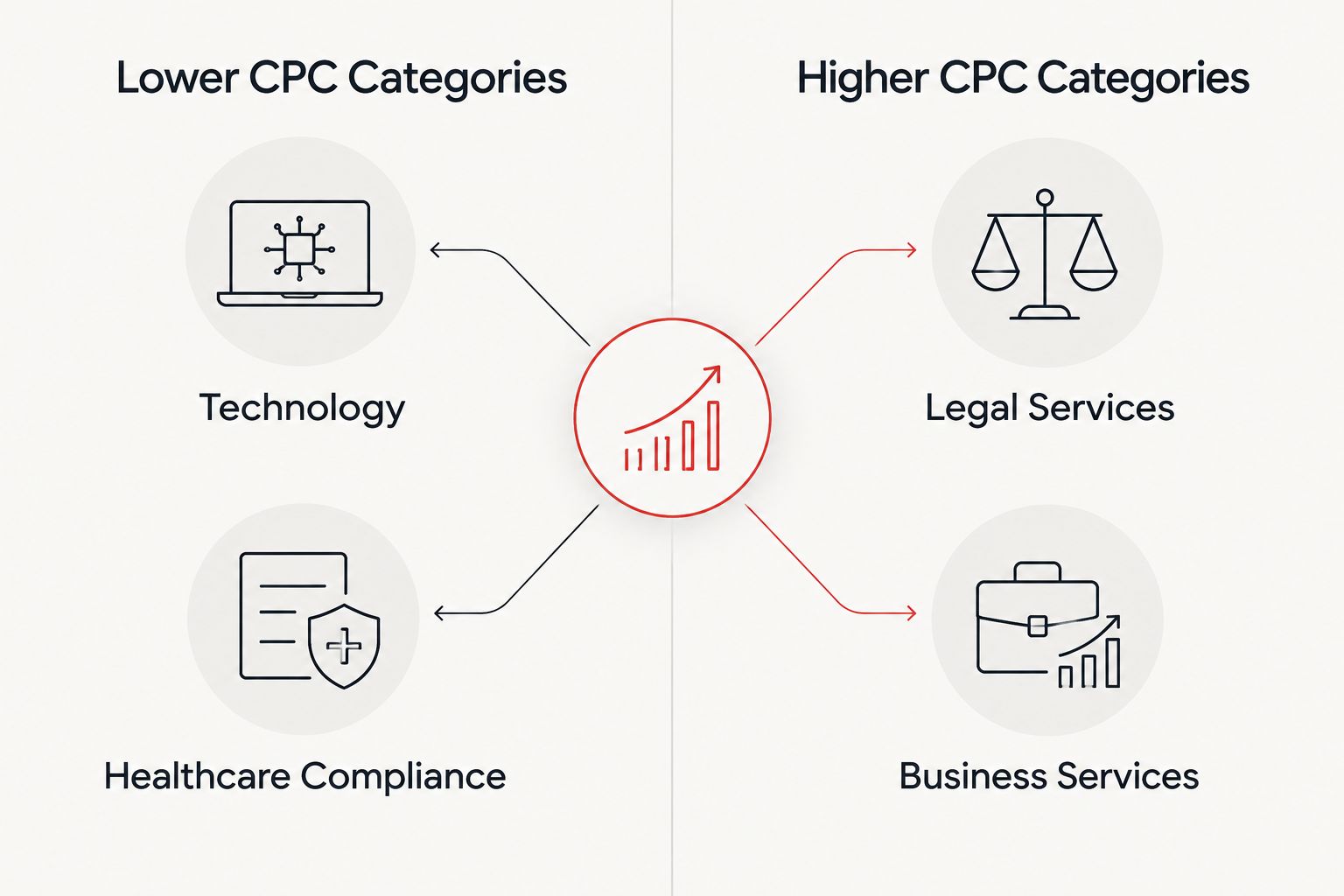
Legal services lead the field at $6-$9 per click, roughly 2.5x the $2-$4 blended baseline — and incident-response and breach-adjacent search terms compete directly in that bracket because they carry the same urgency and high-stakes commercial intent as attorney searches. Technology and Healthcare & Compliance trail closest to the blended average, at $3-$6, because those buckets absorb a mix of low-intent informational traffic alongside commercial searches.
Business & Professional Services sits in the middle at $5-$7, and that's the bucket where most managed IT and SOC-as-a-service provider campaigns actually run. If your ad platform reports show CPCs under $4 for terms like "managed security services" or "24/7 SOC monitoring," that's a sign of low competition on a long-tail variant, not a discount on the category.
Methodology And The Gap In Public Data
These ranges reflect the broad industry categories that Google Ads benchmark aggregators publish annually, updated for 2026. No public benchmark study tracks "cybersecurity services" as a standalone paid search category — a business bidding on "incident response company near me" is invisible in aggregate reporting because that campaign gets bucketed under Business Services, Technology, or Legal depending on how the advertiser structured targeting.
That's the single biggest limitation of any CPC table applied to this category: the number you see is a proxy, not a direct measurement. Actual auction pricing also moves with geography, device type, and seasonal spikes — breach-response search volume climbs sharply after a major disclosed incident, and CPCs climb with it.
How To Use These Benchmarks
- Budget against the category ceiling, not the blended floor. If your campaign targets managed IT, MSSP, or SOC terms, model spend at $5-$9 per click, not the $2-$4 all-industry average most free PPC calculators default to.
- Expect incident-response and breach-adjacent terms to price like legal keywords. These searches carry emergency intent, and Google's auction rewards that with Legal-tier CPCs even when the advertiser isn't a law firm.
- Treat organic content as the hedge against CPC volatility. A cybersecurity cost guide or a comparison page that ranks organically keeps capturing the same searches after a breach spike sends paid CPCs up — without a per-click bill.
- Track your own auction data monthly. Published benchmarks are directional; your account's actual CPC by keyword group is the only number that should drive next month's budget.
Businesses evaluating an incident response provider after a breach are searching under time pressure, and that urgency is exactly what pushes those keywords toward the top of the CPC range in 2026.
Get a cybersecurity cost breakdown
See what managed IT and SOC coverage actually costs before you build a PPC budget around it.
FAQ
What is the average CPC for cybersecurity services in Google Ads in 2026?
Cybersecurity and managed IT campaigns typically run $5 to $9 per click in 2026, well above the $2-$4 all-industry blended average, because these campaigns get classified under Business Services or Legal buckets rather than a standalone category.
Why don't Google Ads benchmark reports list cybersecurity as its own category?
No major public benchmark aggregator breaks out cybersecurity services as a standalone paid search category. Campaigns get folded into Technology, Business & Professional Services, or Legal depending on how the advertiser targets the keywords.
Is Legal really the highest CPC category, above cybersecurity?
Legal services lead published 2026 benchmarks at $6-$9 per click. Incident response and breach-response cybersecurity terms compete directly in that same range because they carry comparable urgency and commercial intent.
How much should a small MSP or MSSP budget for Google Ads in 2026?
Plan around $5-$7 per click for managed IT and MSSP terms, the Business & Professional Services range, and budget toward the $6-$9 range for any incident-response or breach-adjacent keyword set.
Do incident response search terms cost more than managed IT services terms?
Yes. Incident response and breach-response searches typically price near the Legal services range of $6-$9 per click, while general managed IT services terms sit lower, around $5-$7.
Is organic SEO cheaper than PPC for cybersecurity companies long term?
Organic content has no per-click cost once it ranks, which makes it a hedge against CPC spikes that follow major breach news. Paid search still wins for immediate, time-sensitive visibility.
What raises CPC for cybersecurity keywords specifically?
High customer lifetime value, competitive bidding from vendors and MSPs targeting the same buyer, and emergency-intent searches after breach news all push cybersecurity CPCs above general Technology-category averages.
How often do these CPC benchmarks change?
Category-level CPC benchmarks are typically refreshed annually by industry aggregators, but auction pricing within a single account can shift monthly with search volume, seasonality, and breach-driven demand spikes.
One Last Thing
The most expensive click in this whole category isn't a managed IT term — it's an incident-response search typed by someone already mid-breach. Those searches price like Legal-category keywords in 2026 not because the buyer is comparison shopping, but because they have no patience for it. If a competitor's paid ad isn't the first thing they see, an organic guide ranking for penetration testing companies or incident response providers is the next best thing they'll click.